









The Hidden Difference Between a Real AC Tune-Up and a 15-Minute Visual Check
Your air conditioner is running constantly, but the house still feels warm, leaving you wondering what exactly you paid for during your last service visit. Here at Piggies Air Conditioning, when homeowners ask what our techs actually look for during a San Dimas AC tune-up, it usually stems from the frustration of a previous technician simply swapping a filter, shining a flashlight into the unit, and driving away 15 minutes later. That superficial "blow-and-go" approach might tick a box on a schedule, but it does absolutely nothing to prepare your cooling equipment for the grueling heat of peak summer.
To get the most out of your cooling system, you need comprehensive air conditioning services that go beyond surface-level checks and guesses.
The Visual Inspection Trap
In our years of serving Baldwin Park, San Dimas, and the surrounding communities, we've found that many homeowners operate under the assumption that an air conditioning inspection and a mechanical tune-up are the same thing. They are not. A visual inspection relies entirely on what a technician can see with the naked eye. If the fan is spinning and the unit sounds relatively normal, a visual inspector will give you a thumbs-up and hand you a bill. The problem is that modern air conditioning systems are highly complex, pressurized electrical machines. The components that dictate whether your system will survive a 100-degree afternoon or suffer a catastrophic breakdown operate completely out of sight.
Surviving peak July heat requires rigorous, behind-the-scenes technical validation. A true mechanical tune-up involves hooking up diagnostic equipment, measuring electrical draw, evaluating pressure differentials, and benchmarking the current performance of your system against the manufacturer's original specifications. When you understand the difference between a superficial glance and a deep mechanical audit, you take control of your home's comfort and protect your wallet from premature equipment failure.
Exposing the 'Blow-and-Go' Maintenance Myth in Local Markets
A pattern we see often in our local market is a quick 15-minute visual check, but here is why our team at Piggies Air Conditioning takes the time to perform a comprehensive, data-driven mechanical tune-up. A "blow-and-go" service typically involves a technician showing up, hosing off the outside unit without actually cleaning the coils, glancing at the thermostat, and rushing out the door to their next appointment. This practice is incredibly common, and it leaves homes completely vulnerable to mid-summer breakdowns because the root causes of system failure are never identified or addressed.
Securing a reliable AC maintenance plan means demanding a service that actually tests the internal workings of your professional equipment.
Why the 15-Minute Check Fails
In our experience, when an HVAC technician uses uncalibrated analog gauges—or worse, no gauges at all—they are guessing about the health of your system. They cannot tell you if your compressor is working too hard, if your electrical components are on the verge of burning out, or if your refrigerant levels are slightly off. True maintenance is a proactive defense mechanism designed to catch small degradation before it becomes a massive repair bill. It is never meant to be a reactive upsell tactic used only when something is already broken.
• Diagnostic Tools — The 15-Minute 'Blow-and-Go' Check: Flashlight and naked eye — A Real Mechanical Tune-Up: Digital manifolds and multimeters
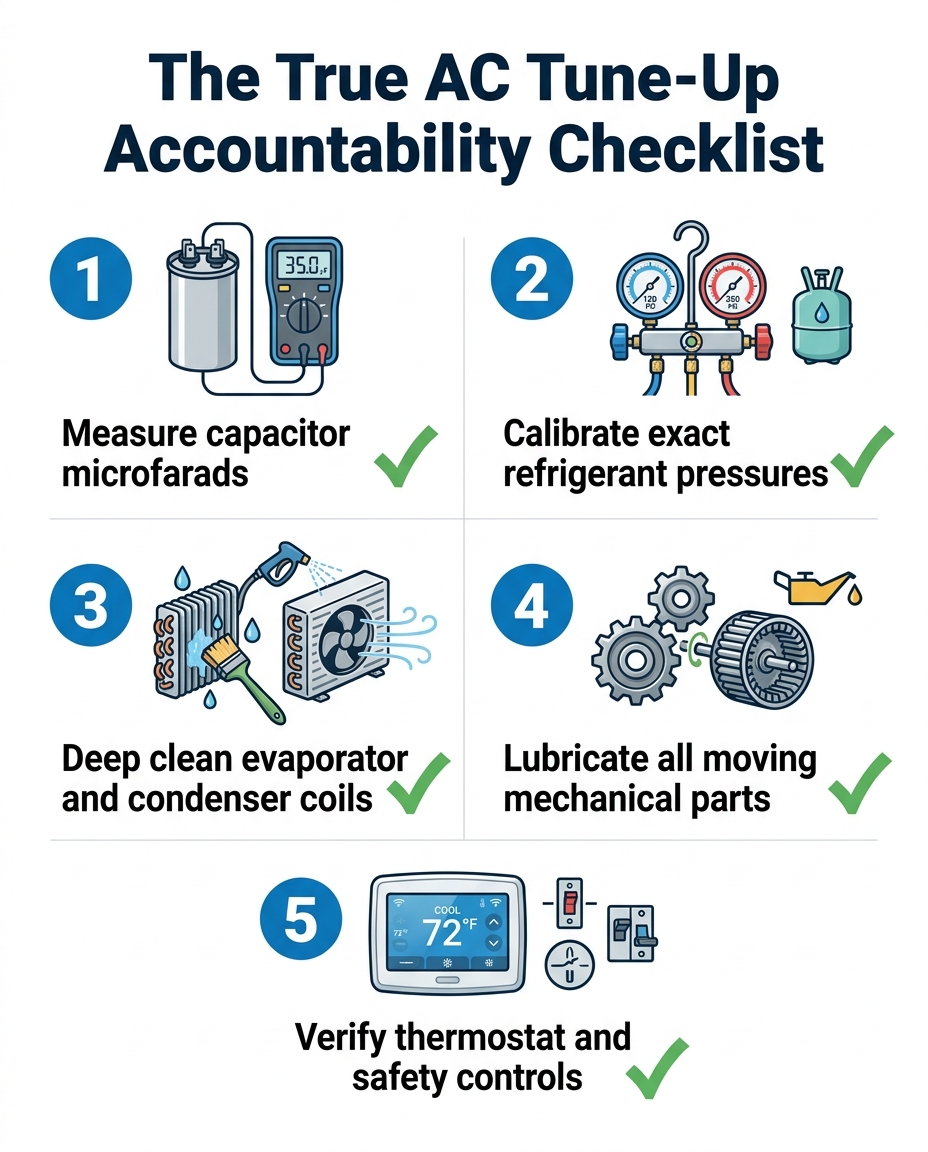
• Electrical Testing — The 15-Minute 'Blow-and-Go' Check: Listens for strange noises — A Real Mechanical Tune-Up: Measures exact capacitor microfarads
• Coil Care — The 15-Minute 'Blow-and-Go' Check: Sprays water on the outside cabinet — A Real Mechanical Tune-Up: Deep chemical cleaning of internal fins
• Refrigerant Check — The 15-Minute 'Blow-and-Go' Check: Feels the copper line for coldness — A Real Mechanical Tune-Up: Calculates exact superheat and subcooling
• Goal — The 15-Minute 'Blow-and-Go' Check: Get to the next house quickly — A Real Mechanical Tune-Up: Ensure reliable operation through peak heat
By relying on measurable data during the pre-summer cooling season, a professional technician can show you exactly how your system is performing. Instead of saying, "It looks fine," they can say, "Your system is drawing the exact right amount of amperage, and we have the numbers to prove it."
Electrical Diagnostics: Why We Measure Capacitor Microfarads
In our years of rescuing stranded homeowners during peak July heatwaves, we've found that one of the most critical steps in a legitimate tune-up involves the electrical system, specifically the capacitors. If you have ever heard a buzzing sound coming from your outdoor unit while the fan refuses to spin, you have likely experienced a capacitor failure. A capacitor acts like a heavy-duty battery jump-starter for your system's compressor and fan motors. Every time your thermostat calls for cooling, the capacitor delivers a massive jolt of stored electricity to get those heavy mechanical parts moving.
The Battery Jump-Starter of Your AC
Over time, the intense heat generated by continuous operation degrades the internal components of these capacitors. A technician performing a superficial check might just look at the capacitor to see if it is swollen, bulging, or leaking oil. However, a capacitor can look perfectly normal on the outside while being completely hollowed out on the inside. This is why our technicians use specialized multimeters to measure the exact microfarads (the unit of electrical capacitance) the component is holding.
Here is what we look for during an electrical diagnostic:
• Exact microfarad readings: We compare the current reading to the manufacturer's rating printed on the side of the capacitor. If a 45-microfarad capacitor is only reading 38, it is failing and will soon leave you without air conditioning.
• Contactor pitting: We inspect the electrical contactors for burn marks or pitting, which can cause the system to short out or weld shut, forcing the AC to run continuously.
• Wire degradation: We check for brittle, heat-damaged wires that could pose a safety hazard or cause intermittent power loss.
• Amp draw on motors: We measure how much electricity the compressor and fan motors are pulling. High amp draw indicates the motor is struggling against friction or impending failure.
By measuring capacitor microfarads and exact refrigerant pressures, we catch weakened components early. Replacing a degraded capacitor during a routine tune-up prevents a catastrophic, sudden failure during high-load periods when you need your cooling system the most.
Deep Coil Cleaning: Combating Southern California Heat and Dust
Your air conditioning system does not actually create cold air; it removes heat from the air inside your home and dumps it outside. This entire process relies on two sets of coils: the indoor evaporator coil (which absorbs the heat) and the outdoor condenser coil (which releases the heat). For this heat transfer to happen efficiently, the metal fins on these coils must be completely clean and free of debris.
The 30% Efficiency Drop
In our region, the intense dry heat and airborne dust from Santa Ana winds create heavy particulate buildup on outdoor condensing units. Inside the home, pet dander, dust, and cooking oils can mat down the evaporator coil. This dirt acts as an insulating blanket. According to Department of Energy (DOE) data, a dirty condenser coil can reduce your system's energy efficiency by up to 30%. When the coils are insulated by dirt, the compressor has to run longer and work significantly harder to achieve the same amount of cooling, drastically reducing its lifespan.
Just this past July, a local homeowner reached out to our Piggies Air Conditioning dispatch needing prompt AC service to address a heavily soiled evaporator coil that was severely restricting airflow. Our technician responded rapidly, provided a clear quote upfront, and completed the deep cleaning efficiently, restoring the system's airflow and cooling capacity before the afternoon heat peaked.
To ensure this level of performance for every San Dimas home, our professional technicians follow a strict coil cleaning protocol:
1. Initial Inspection: We evaluate the level of buildup on both the indoor and outdoor coils to determine the appropriate cleaning solution.
2. Debris Removal: We carefully remove heavy, loose debris like leaves, twigs, and thick dust blankets from the outdoor cabinet.
3. Chemical Application: We apply a specialized, foaming coil cleaner designed to push embedded dirt out from deep within the delicate aluminum fins without damaging the metal.
4. Gentle Rinsing: We rinse the coils using a controlled water flow, ensuring all chemical residue and dirt are flushed away completely.
5. Fin Straightening: We use a fin comb to carefully straighten any bent aluminum fins, maximizing the surface area available for heat transfer.
This specific step is non-negotiable in our climate. A deep clean directly impacts the longevity of the compressor and ensures your system can breathe easily all summer long.
Calibrating Exact Refrigerant Pressures for Peak Efficiency
A widespread misconception our team encounters among homeowners is that air conditioners slowly "consume" or "burn up" refrigerant over time, requiring a top-off every few years. This is completely false. Your air conditioning system is a closed loop. If your refrigerant levels are low, it means you have a leak somewhere in the system that needs to be located and repaired.
The Myth of 'Topping Off' Refrigerant
Guessing at refrigerant levels is one of the most dangerous things a technician can do to your equipment. An overcharged system (too much refrigerant) can cause liquid to flow backward into the compressor, destroying it instantly. An undercharged system (too little refrigerant) causes the indoor coil to drop below freezing, turning it into a block of ice and completely stopping airflow.
If you suspect your system is struggling due to a leak or pressure issue, securing professional AC repair in San Dimas is the only way to safely restore balance to the system.
Our Piggies Air Conditioning technicians use highly sensitive digital manifolds to measure exact refrigerant pressures. We don't just look at the raw pressure; we calculate the "superheat" and "subcooling" metrics. These calculations tell us exactly what state the refrigerant is in (liquid or gas) at specific points in the cycle. By measuring capacitor microfarads and exact refrigerant pressures, we guarantee that the system is calibrated to handle continuous operation during peak heat. Accurate pressure readings ensure that your system is removing the maximum amount of heat and humidity from your home for every dollar you spend on electricity.
Optimizing Airflow and Mechanical Components
While electrical health and refrigerant pressures are critical, the physical, moving parts of your air conditioning system require just as much attention. The blower motor inside your home and the fan motor outside are responsible for moving massive volumes of air. If these mechanical components are struggling, your comfort will suffer, and your utility bills will skyrocket.
Friction is the Enemy of Efficiency
During a comprehensive tune-up in the pre-summer cooling season, our technicians meticulously evaluate the mechanical airflow systems. We inspect the blower motor housing for heavy dust accumulation, which can unbalance the fan wheel and cause severe vibrations. We check the condition of all fan blades to ensure they are not cracked or warped. If your system utilizes belts, we check them for fraying and proper tension.
Understanding how much electricity an AC unit uses often comes down to evaluating mechanical friction. When moving parts lack proper lubrication, metal grinds against metal. This friction forces the motors to draw significantly more electrical current just to maintain normal speeds.
Our mechanical optimization process includes:
• Lubricating bearings and moving parts: We apply the correct grade of oil to any unsealed motor bearings to eliminate friction and reduce electrical draw.
• Evaluating indoor filtration: We check the static pressure drop across your air filter. A filter that is too restrictive can choke the blower motor, while a filter that is too porous allows dirt to coat the evaporator coil.
• Thermostat calibration: We verify that the thermostat is reading the room temperature accurately and communicating flawlessly with the outdoor equipment.
• Checking safety controls: We test all limit switches and overflow safety pans to ensure the system will shut itself down safely in the event of a drain clog or electrical surge.
By eliminating mechanical friction and optimizing airflow, we drastically reduce the daily energy consumption of your cooling system.
Your Accountability Benchmark: How to Know It Was Done Right
The entire purpose of a behind-the-scenes look at our process is to give you a benchmark for accountability. You should never have to take a technician's word for it when they say your system is "good to go." A real technician will take the time to explain their findings, show you the actual numbers on their meters, and provide clear, data-backed recommendations.
Demanding Data Over Guesses
Recently, a San Dimas customer called our team at Piggies Air Conditioning to have their AC unit checked out, requesting next-day service. Our technician arrived early the following morning, diagnosed a simple electrical fix, and took the time to clearly explain both the immediate repair and our long-term recommendations for the system's health. That level of communication is the standard you should demand.
When you schedule an AC tune-up in San Dimas, you should expect a comprehensive service report. Here is your summary checklist to know the job was done right:
• Documented electrical readings: The report should list the specific microfarad readings of your capacitors, not just a checkmark.
• Refrigerant metrics: The technician should be able to explain your superheat or subcooling numbers and confirm they match factory specs.
• Visual proof of clean coils: A professional will gladly show you before-and-after photos of your evaporator and condenser coils.
• Amp draw records: The report should show the starting and running amp draw of your compressor and fan motors.
• Clear explanations: The technician should walk you through the health of your system in plain English, without using high-pressure sales tactics.
Transparency is the ultimate proof of a job well done. By demanding data-driven maintenance rather than settling for visual inspections, you protect your investment and ensure your home stays consistently comfortable all summer long.
Other blogs


Customer Testimonials



CUSTOMER SERVICE!
I highly recommend this company for anyone needing AC repair or maintenance. I'll definitely be calling them again for any future needs!

I had the pleasure of experiencing outstanding service and professionalism from Ruben, and I am beyond impressed. From the moment I first contacted them, by phone and follow up communication via email for my quotes. The attention to detail and commitment to excellence were evident.
Ruben, was incredibly responsive, addressing all my inquiries promptly and with clear, thorough explanations. Their dedication to understanding and meeting my needs was remarkable.
Ruben, went above and beyond to ensure that everything was handled seamlessly, demonstrating not just professionalism, but also a sincere dedication to customer satisfaction.
I can't recommend Piggies air Conditioning/Ruben highly enough. If you're looking for someone who combines expertise with exceptional service, look no further. They are a true example of what outstanding professionalism should be.
The technician arrived on time, which I really appreciated given how crucial air conditioning is in this heat. Ruben was professional and friendly, explaining what he was doing throughout the process. The issue I had was diagnosed fairly quickly, and they provided me with a few options on how to fix it. The pricing was transparent, and I didn't feel like there were any hidden costs, which is always a plus when it comes to service calls like these. Highly recommend this company!
1st & foremost, huge shout out to Ruben thank u so so much for reaching out & making things happen SO FAST! I was so surprised since i had reached out to a couple different places who lagged on even answering calls, messages, etc.
Ruben was also very informative & taught me ALOT that i didnt know about.
Also cant leave the amazing Luis & Miles out of
this review.
They came, they saw, they conquered!
And they worked pretty swiftly too, felt very comfy around em, loved their personalities, great attitude, work ethic, professionalism, had some really good convos & they still got the job done lightning fast
SUPER HUGE SHOUT OUT & THANKS for everything guys! Definitely recommending u guys to everyone i know.
recommendations and feedback. The actual installation was painless and unremarkable, his AC experts got it done, got it cleaned and most importantly got it right. Rueben even went a step further to assure we had
protection from the coming rain, that is service unheard of these days. His price was competitive and a REAL value for the service we recieved. Using anyone else for your AC needs, would be a huge mistake. We thank them again and will recommend to everyone.
Echoing a lot of the other reviews here, Piggies Air Conditioning responds so quickly to requests (even though I actually accidentally sent in multiple requests on my side without responding, oops!)
They were able to come do a FREE energy audit and initial inspection on the same day and Ruben was amazing at explaining his thoughts on our house's situation and what he thought was worth the money and wasn't worth the money.
I truly felt like he was trying to help me find the best solution to our issues instead of just trying to upsell us on everything and anything.
I'm definitely recommending this business to anyone I know if they want a trustworthy and realistic service, value, and quality.