





Protecting Your Home from Fall Weather Extremes
The transition from summer to fall brings relief from the heat, but if you haven't started your seasonal home maintenance checklist, it also kicks up a massive problem for your home's mechanical systems: severe dust accumulation. Your AC might finally be getting a break, but the indoor environment is about to face a new threat. The dry, high-velocity winds characteristic of the region rapidly change indoor environmental needs, forcing fine particulate matter through every tiny gap in your home's envelope just as you prepare to switch your thermostat over to heating mode.
Standard seasonal checklists often focus on freezing pipes and snow, completely ignoring the reality of Southern California's unique environmental challenges. Here at Piggies Air Conditioning, our team frequently sees the toll this vulnerable period takes on local homes. During this transition, the shift from heavy cooling to initial heating creates significant stress on your equipment. If you ignore the dust and debris before turning on your furnace, you risk poor indoor air quality and potential system failures.
The regional reality: The most effective approach prioritizes adapting to the October Santa Ana winds. By addressing these regional realities and clearing out the accumulated debris, you can protect your investment in your air conditioning services and ensure that any transition to high-efficiency heat pumps goes smoothly before winter arrives. Fall maintenance is not just a chore list; it is a vital climate adaptation strategy.
How Severe Autumn Winds Impact Your Indoor Environment
When the heavy winds arrive, they bring massive amounts of dust, pollen, and debris blow-off from the nearby foothills straight into local neighborhoods. This environmental stress places an enormous burden on homes and their HVAC systems. The problem begins outdoors but quickly infiltrates the home, degrading indoor air quality and putting mechanical components at risk just when they are transitioning between seasonal modes.
In our experience serving the Baldwin Park area, the root cause of this indoor air quality drop is the sheer volume of airborne particulate matter driven by the October Santa Ana winds. As this debris finds its way inside, it bypasses standard defenses and heads straight for your return vents. The solution requires a comprehensive understanding of how this dust load affects your specific equipment and taking proactive steps to mitigate the damage before the first major cold snap hits.
The Surge in Airborne Particulate Matter
Wind events carry fine dust and allergens indoors at an alarming rate. We measure these particles in microns, specifically focusing on PM10 (dust and pollen) and PM2.5 (fine particles that can penetrate deep into the lungs). During a severe wind event, the concentration of these particles inside a poorly sealed home can spike dramatically.
• Health implications: Increased particulate matter often leads to respiratory irritation, aggravated allergies, and a general decline in indoor comfort.
• Surface accumulation: You will likely notice a fine layer of grit settling on hard surfaces within hours of a windstorm, indicating that the air you are breathing is equally saturated.
• HVAC ingestion: Everything floating in your indoor air is eventually pulled into your HVAC system's return ducts, forcing your air filter to capture an entire season's worth of debris in a matter of days.
Strain on HVAC Blower Motors and Components
As the massive dust load hits your HVAC system, the first casualty is usually the air filter. Once the filter clogs, the blower motor must work significantly harder to pull the same volume of air through the restricted media. This strain forces the motor to run hotter and longer, leading to reduced system efficiency and potential premature wear.
Furthermore, if the filter fails or is improperly seated, that fine dust coats the delicate internal components. A dust-coated blower wheel loses its aerodynamic efficiency, moving less air while consuming more electricity. Addressing this specific dust load is a critical first step before activating any heating equipment, as running a furnace with a restricted blower motor can trigger safety switches and cause the system to shut down completely.
Assessing Your Cooling Equipment Post-Summer
After running constantly through the peak heat of summer, your outdoor condenser unit needs attention. Evaluating your cooling equipment post-summer is a critical part of the fall transition, especially in areas like Baldwin Park where the late-season heat waves can abruptly give way to dusty windstorms. Resolving cooling issues in the fall prevents compounding problems when the system eventually switches to heating mode, particularly if you utilize a heat pump.
Homeowners can perform several visual inspections safely without ever opening the equipment cabinet or exposing themselves to high-voltage components. Identifying signs of wear and tear early allows for proactive scheduling of professional service before the system is needed again.
Clearing Exterior Debris Safely
Keeping the perimeter of the outdoor unit clear of fall foliage and wind debris is essential for optimal airflow. When the system operates, it needs to pull air through the exterior coils to release heat. If those coils are choked by dry leaves or caked in dirt, the compressor suffers.
1. Turn off the power: Always locate the outdoor disconnect box and switch it to the "off" position before performing any exterior clearing.
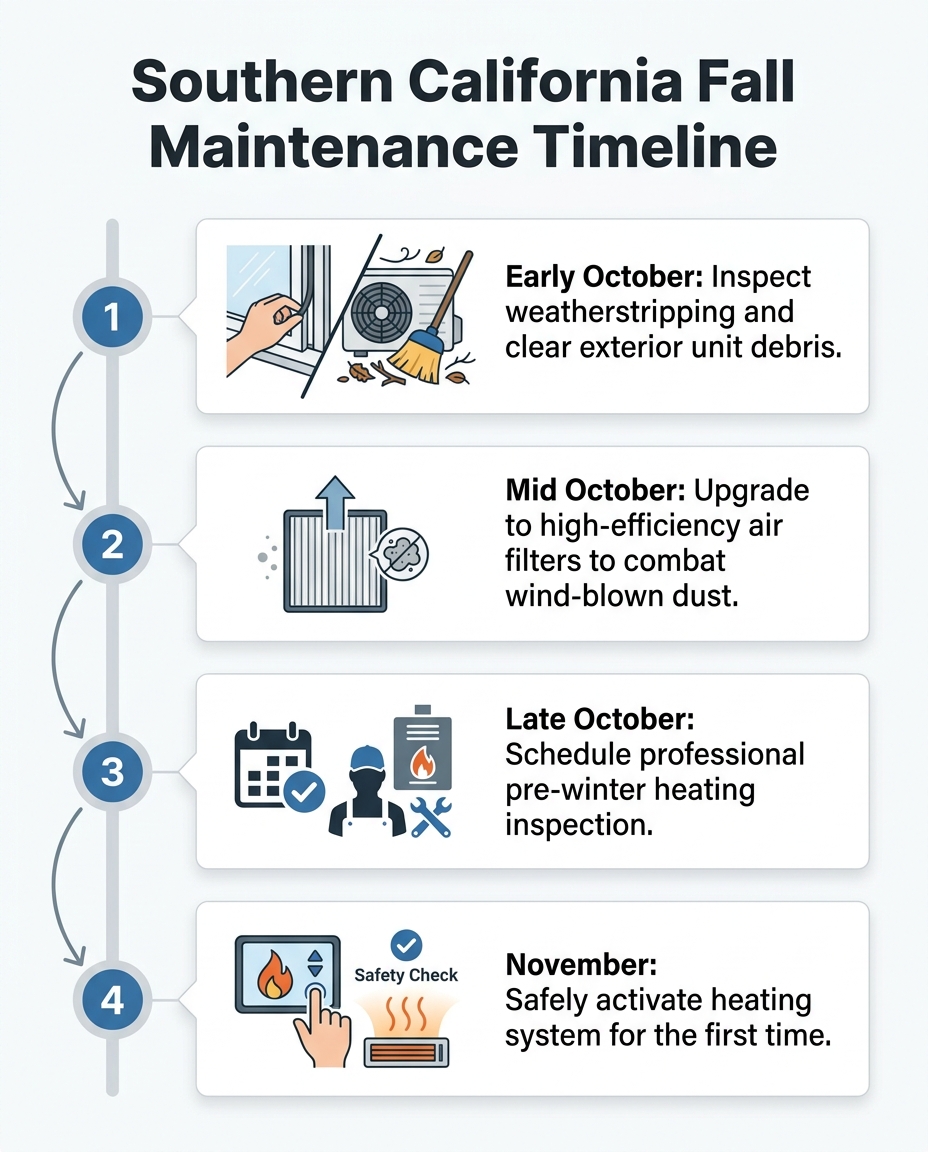
2. Remove large debris by hand: Carefully pull away any dry leaves, twigs, or wind-blown trash that has accumulated against the metal louvers or base of the unit.
3. Establish a clearance zone: Ensure there is a minimum of two feet of clear space around the entire perimeter of the condenser. Trim back any encroaching bushes or decorative plants.
4. Inspect for physical damage: Look for bent fins, frayed insulation on the refrigerant lines, or unusual oil spots near the base, which could indicate a leak requiring professional attention.
5. Rinse the outer cabinet gently: Using a standard garden hose on a low-pressure setting, you can rinse loose dust off the exterior cabinet. Never use a pressure washer, as the high force will instantly crush the delicate aluminum fins.
Essential Filtration Updates for Heavy Dust Loads
The immediate need for robust air filtration strategies becomes glaringly apparent during dusty conditions. Our technicians constantly remind homeowners that standard fiberglass filters—the cheap, transparent blue ones—are entirely insufficient during high-particulate events. They are designed merely to protect the equipment from large debris like pet hair, not to improve indoor air quality or capture the fine silt driven by the October Santa Ana winds.
The filtration upgrade: Upgrading to higher MERV-rated filters (Minimum Efficiency Reporting Value) is a fundamental climate adaptation strategy. A pleated filter rated between MERV 8 and MERV 11 strikes the right balance for most residential systems, effectively capturing fine dust and allergens without restricting airflow to a dangerous degree. Maintaining proper filtration is a neutral, universally recommended step that directly correlates to the longevity of the entire HVAC system.
• Standard Fiberglass (MERV 1-4) — Best For: Basic equipment protection only; poor dust capture — Replacement Frequency During Fall: Every 30 days (Not recommended for wind events)
• Pleated Media (MERV 8-11) — Best For: Capturing fine dust, pollen, and pet dander — Replacement Frequency During Fall: Every 30 to 60 days based on wind severity
• High-Efficiency (MERV 13+) — Best For: Superior IAQ; requires professional verification for airflow — Replacement Frequency During Fall: Varies by media cabinet depth
Monitoring Indoor Air Quality During Wind Events
During the peak wind season, you must adopt a more frequent filter checking schedule. A filter that typically lasts three months might become completely impacted in just three weeks during a severe dust event. Signs that your home's filtration system is struggling include increased dust settling on furniture, lingering odors, and the HVAC system running longer cycles to reach the set temperature.
If upgraded standard filters are not enough to combat the particulate load, it may be time to discuss professional-grade air purifiers or upgraded media cabinets with your technician. These advanced systems integrate directly into the ductwork, providing hospital-grade filtration that neutralizes allergens and captures microscopic dust before it ever reaches the living space.
Why a Pre-Winter Heating Inspection is Non-Negotiable
The transition to heating season requires more than just flipping a switch on the thermostat. Establishing the critical need for a professional inspection before the first furnace activation is about protecting your home and your family. The inherent danger of turning on a heating system that has sat dormant for months—and is now heavily coated in fall dust and debris—cannot be overstated.
Every fall, our crew at Piggies Air Conditioning responds to early-season heating failures that trace directly back to neglected maintenance. When dust accumulates on critical components, it insulates parts that need to release heat and blocks sensors that ensure safe operation. The solution is a neutral, expert assessment that prioritizes safety and system longevity over high-pressure sales. Our licensed professionals in Baldwin Park know exactly how local environmental factors impact specific furnace models and can verify that the system is safe to operate.
The Danger of Operating a Dusty Furnace
When you activate a dusty furnace for the first time, you will almost certainly notice a distinct burning smell. While a brief odor burning off a small amount of settled dust is common, a strong, lingering smell indicates a serious problem. Accumulated dust can interfere with the flame sensor, causing the furnace to short-cycle or fail to ignite entirely.
More importantly, dust and debris can mask or contribute to issues with the heat exchanger. The heat exchanger is the metal barrier that separates the combustion process from the air circulating through your home. If it is compromised, dangerous combustion gases, including carbon monoxide, can leak into the living space. Only a thorough professional inspection can verify the integrity of this critical component.
Professional Safety Checks vs. DIY Risks
There is a clear boundary between safe homeowner maintenance and technical work that strictly requires a certified technician. Changing filters, clearing exterior debris, and replacing thermostat batteries are excellent DIY tasks. However, opening the furnace cabinet to clean burners, test electrical components, or inspect the flue pipe crosses the line into dangerous territory.
• Replacing the air filter — Appropriate Action: Homeowner DIY — Risk Factor: Low
• Clearing leaves from outdoor unit — Appropriate Action: Homeowner DIY — Risk Factor: Low
• Testing ignition sequence and burners — Appropriate Action: Licensed Professional Only — Risk Factor: High (Fire/Gas hazard)
• Inspecting heat exchanger integrity — Appropriate Action: Licensed Professional Only — Risk Factor: High (Carbon Monoxide hazard)
• Testing safety limit switches — Appropriate Action: Licensed Professional Only — Risk Factor: High (Electrical/Fire hazard)
Attempting DIY repairs on gas or complex electrical heating components poses severe safety risks. Professional maintenance ensures safe operation by systematically testing every safety control, verifying proper gas pressure, and ensuring the venting system is completely clear before the heavy winter usage begins.
Evaluating System Efficiency and Upgrade Opportunities
The fall maintenance check is the perfect time to evaluate the overall health of your HVAC system. A thorough inspection can reveal if an aging system is no longer equipped to handle local climate extremes. If your technician notes severe wear on the blower motor, a cracked heat exchanger, or a compressor that is pulling too many amps, using the fall transition to plan for necessary system replacements is a smart, proactive strategy.
The efficiency advantage: Upgrading to modern, high-efficiency equipment before peak winter or the following summer offers immediate benefits in comfort and energy consumption. We regularly show homeowners how modern systems feature variable-speed motors and advanced staging that provide superior humidity control and quieter operation. You can often offset the upfront costs of these upgrades by exploring general utility incentive programs and HVAC financing options that make premium equipment highly accessible.
Navigating Utility Incentives and Support
Energy rebates and tax credits are frequently available for qualifying high-efficiency installations, particularly for advanced heat pump technology that reduces overall grid strain. While programs change frequently, a knowledgeable local contractor can serve as a helpful guide in navigating the complex process of selecting qualifying equipment.
It is highly recommended to consult with local experts to verify current programs and understand exactly how to apply for your SCE HVAC rebate or similar local incentives. Proper documentation and choosing equipment with the correct SEER2 and HSPF2 ratings are essential steps to ensure you receive the maximum available support for your energy-efficient upgrades.
General Exterior Upkeep for Autumn Readiness
Rounding out the seasonal checklist requires looking beyond the HVAC equipment to the home's overall building envelope. Crucial non-HVAC home maintenance tasks relevant to the region support overall HVAC efficiency and indoor air quality. If the home itself is leaking, even the best mechanical systems will struggle to maintain comfort during the October Santa Ana winds.
• Inspect and update weatherstripping: Check the seals around all exterior doors and windows. Replacing worn weatherstripping is critical to seal the home against high-velocity, dust-laden winds, keeping particulate matter out and conditioned air in.
• Clear gutters and downspouts: Remove dry leaves and wind-blown debris from the roof drainage system. Preventing blockages now ensures water flows freely away from the foundation before the winter rains arrive.
• Test safety alarms: Test all smoke and carbon monoxide detectors, replacing batteries as needed. This step is especially critical before the heating season begins and combustion appliances are activated.
• Seal exterior penetrations: Look for gaps where plumbing, electrical, or cable lines enter the home. Use exterior-grade caulk or expanding foam to seal these gaps, preventing drafts and pest intrusion.
• Secure outdoor items: Store or tie down patio furniture and lightweight yard items that could become dangerous projectiles during severe fall wind events.
Frequently Asked Questions About Fall Home Maintenance
What should I do to my house in the fall?
Based on what we see in Baldwin Park neighborhoods, the primary focus should be on securing the building envelope and preparing mechanical systems for temperature shifts. You need to seal the home against dust by checking weatherstripping, clear exterior debris from gutters and AC units, and schedule a professional HVAC inspection. Taking these steps early prevents minor issues from turning into major winter emergencies.
What is a fall maintenance checklist?
A fall maintenance checklist is a proactive schedule of tasks designed to protect the home from seasonal weather shifts. It guides homeowners through preparing mechanical systems for temperature changes, ensuring safety devices are functional, and reinforcing the home's exterior. Following a checklist ensures no critical system is overlooked during the busy transition season.
How often should HVAC be serviced?
Industry standards highly recommend bi-annual service for traditional split systems. You should schedule maintenance once in the spring to prepare the cooling equipment for summer heat, and once in the fall to prepare the heating equipment for winter cold. This consistent oversight catches wear and tear early and preserves the system's operational efficiency.
When should I turn on my heater in California?
You should wait until a professional has inspected the system and cleared accumulated dust before activating the heat. Typically, this is safest after the major October wind events subside and the nighttime temperatures consistently drop. Turning it on without an inspection risks circulating heavy dust and missing potential safety hazards.
How do Santa Ana winds affect indoor air quality?
High-velocity winds force fine particulate matter, pollen, and dust through tiny gaps in the home's exterior. This rapid influx rapidly degrades indoor air quality if the home's filtration system is inadequate or the filter is already clogged. Upgrading to a pleated filter and sealing drafts are the best defenses against this seasonal IAQ drop.
Why is a pre-winter heating inspection necessary if I just used my AC?
Cooling and heating rely on entirely different internal components within your HVAC system. While the blower motor is shared, the furnace burners, ignition sequence, and heat exchanger sit idle all summer and require separate safety validation before use. An AC tune-up does not cover the critical combustion safety checks needed for a gas furnace.
Ensuring Comfort and Air Quality Before Winter
Adapting to seasonal changes is ultimately about protecting both the physical integrity of the home and the health of its occupants. The transition period in Baldwin Park brings unique challenges, but a proactive approach to maintenance ensures that your home remains a comfortable, clean refuge from the harsh exterior elements.
The value of professional oversight: Relying on licensed experts to handle the technical aspects of your seasonal home maintenance checklist guarantees that safety protocols are followed and system longevity is preserved. Take action today by scheduling your seasonal heating inspection, updating your filtration strategy, and exploring efficiency upgrades to ensure your home is fully prepared before winter arrives.
Other blogs


Customer Testimonials



CUSTOMER SERVICE!
I highly recommend this company for anyone needing AC repair or maintenance. I'll definitely be calling them again for any future needs!

I had the pleasure of experiencing outstanding service and professionalism from Ruben, and I am beyond impressed. From the moment I first contacted them, by phone and follow up communication via email for my quotes. The attention to detail and commitment to excellence were evident.
Ruben, was incredibly responsive, addressing all my inquiries promptly and with clear, thorough explanations. Their dedication to understanding and meeting my needs was remarkable.
Ruben, went above and beyond to ensure that everything was handled seamlessly, demonstrating not just professionalism, but also a sincere dedication to customer satisfaction.
I can't recommend Piggies air Conditioning/Ruben highly enough. If you're looking for someone who combines expertise with exceptional service, look no further. They are a true example of what outstanding professionalism should be.
The technician arrived on time, which I really appreciated given how crucial air conditioning is in this heat. Ruben was professional and friendly, explaining what he was doing throughout the process. The issue I had was diagnosed fairly quickly, and they provided me with a few options on how to fix it. The pricing was transparent, and I didn't feel like there were any hidden costs, which is always a plus when it comes to service calls like these. Highly recommend this company!
1st & foremost, huge shout out to Ruben thank u so so much for reaching out & making things happen SO FAST! I was so surprised since i had reached out to a couple different places who lagged on even answering calls, messages, etc.
Ruben was also very informative & taught me ALOT that i didnt know about.
Also cant leave the amazing Luis & Miles out of
this review.
They came, they saw, they conquered!
And they worked pretty swiftly too, felt very comfy around em, loved their personalities, great attitude, work ethic, professionalism, had some really good convos & they still got the job done lightning fast
SUPER HUGE SHOUT OUT & THANKS for everything guys! Definitely recommending u guys to everyone i know.
recommendations and feedback. The actual installation was painless and unremarkable, his AC experts got it done, got it cleaned and most importantly got it right. Rueben even went a step further to assure we had
protection from the coming rain, that is service unheard of these days. His price was competitive and a REAL value for the service we recieved. Using anyone else for your AC needs, would be a huge mistake. We thank them again and will recommend to everyone.
Echoing a lot of the other reviews here, Piggies Air Conditioning responds so quickly to requests (even though I actually accidentally sent in multiple requests on my side without responding, oops!)
They were able to come do a FREE energy audit and initial inspection on the same day and Ruben was amazing at explaining his thoughts on our house's situation and what he thought was worth the money and wasn't worth the money.
I truly felt like he was trying to help me find the best solution to our issues instead of just trying to upsell us on everything and anything.
I'm definitely recommending this business to anyone I know if they want a trustworthy and realistic service, value, and quality.