






Navigating Your Heating Replacement Before Winter Arrives
At Piggies Air Conditioning, we often hear from customers whose aging furnace is rattling louder than usual, leaving them worried it will not survive another chilly season. Seeking out reliable options comparisons for homeowners is the smartest first step you can take before the cold weather truly sets in. Facing a failing heating system is stressful, especially when you are forced into a rushed decision during a cold snap. By evaluating your choices early, our team can give you the time to understand exactly what your home needs.
The core decision usually comes down to choosing between the familiar reliability of a traditional gas furnace and the year-round efficiency of a modern heat pump. Both systems have distinct advantages, but as we frequently advise our Baldwin Park customers, the right choice depends heavily on your comfort goals, your existing infrastructure, and your long-term energy plans. Evaluating these options before winter arrives ensures you make a confident, unhurried decision that benefits your household for years to come.
Because modern heat pumps handle both heating and cooling, this upgrade process is deeply connected to your home's overall climate control. If you are exploring comprehensive comfort strategies, learning more about our air conditioning services can help you make a well-rounded choice.
Understanding Your Core Options: Heat Pumps vs. Gas Furnaces
In our years of performing HVAC replacements, we have found that before you can make an informed decision, you need to understand how these two distinct technologies operate. While both keep your home warm, their methods of generating and delivering that heat are entirely different. Knowing these mechanical differences is the foundation of any solid HVAC comparison.
The Mechanics of Modern Gas Furnaces
Traditional gas furnaces rely on a combustion process to generate heat. When your thermostat signals a drop in temperature, the furnace ignites natural gas or propane in a burner. This creates hot combustion gases that pass through a heat exchanger. Your blower motor then forces indoor air over this hot heat exchanger, warming the air before distributing it through your ductwork.
• Familiar reliability: Homeowners are accustomed to the rapid, intense heat delivery that a gas furnace provides.
• High efficiency ratings: Modern condensing furnaces are engineered to extract as much heat as possible from the fuel they burn, minimizing waste.
• Single-purpose design: A furnace only provides heating, meaning you still need a separate air conditioning unit for the summer months.
How Air-Source Heat Pumps Work
Instead of burning fuel to create heat, air-source heat pumps use electricity and refrigerant to transfer heat from one place to another. Even in cold weather, there is ambient heat energy in the outside air. The heat pump extracts this energy, compresses the refrigerant to raise its temperature, and moves it inside your home.
During a mid-fall heating startup, our technicians frequently note how smoothly heat pumps transition between seasons. Because they move heat rather than generating it, they can deliver significantly more heat energy to your home than the electrical energy they consume. Investing in a high-efficiency heat pump installation provides a modern, electrified alternative to traditional fossil fuel systems, offering both winter warmth and summer cooling from a single unit.
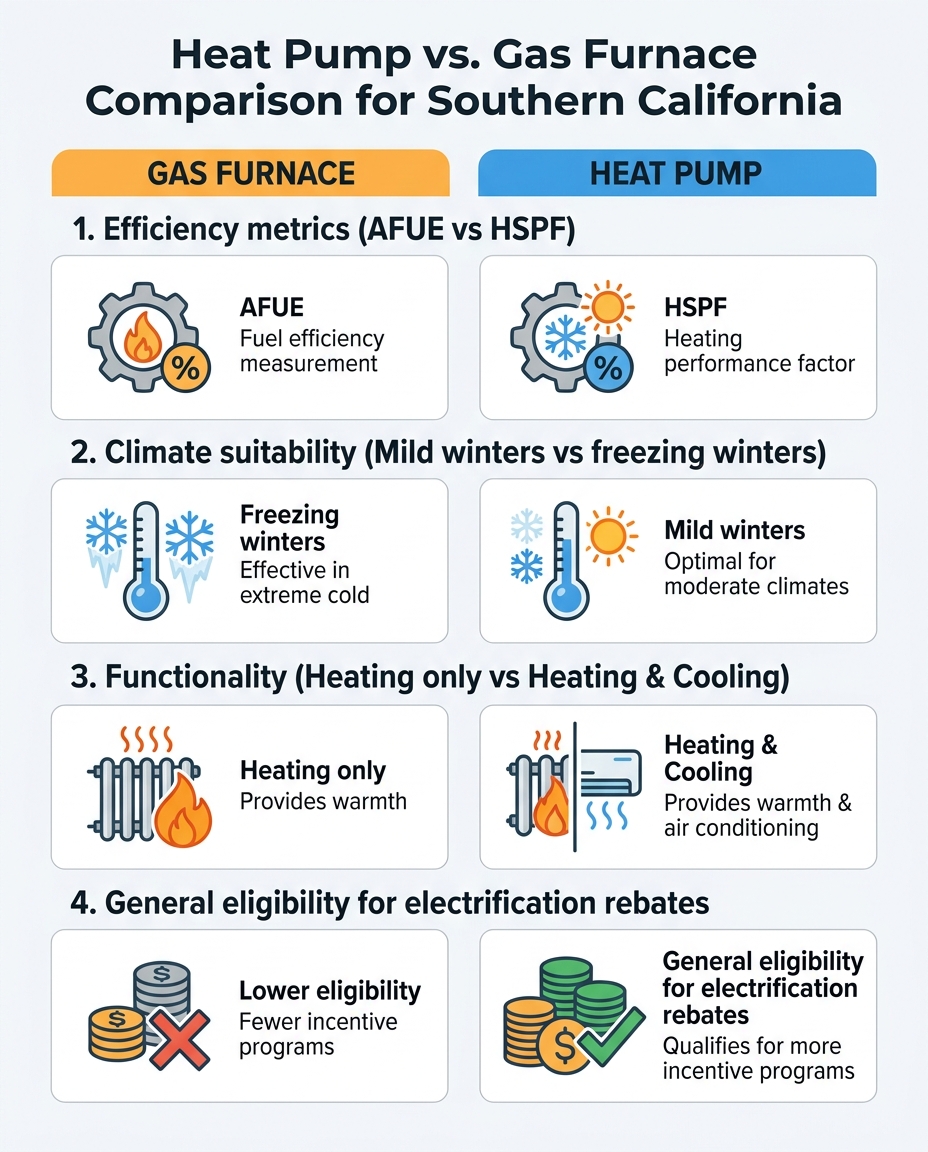

Climate Suitability: Heating Southern California Homes
Regional climate is arguably the most critical factor in determining how an HVAC system will perform. What works perfectly in a snowy northern state might be wildly inefficient or unnecessary in a moderate climate. Our installation team knows that understanding local weather patterns is essential for choosing the right equipment.
Operating in Mild Winter Conditions
Having serviced Baldwin Park for years, we know firsthand that extreme freezing temperatures are exceptionally rare here. Our mild, chilly nights keep heat pumps operating well within their peak efficiency range. In colder regions, heat pumps sometimes rely on supplemental electric resistance heat strips when temperatures plummet below freezing. Because our local winters are relatively gentle, a heat pump can comfortably warm your home without ever needing to activate those energy-heavy backup strips.
Conversely, a gas furnace provides incredibly robust heat, which is excellent for rapid warming. However, because our winters are short and mild, we often see dedicated gas furnaces sitting completely dormant for the vast majority of the year, taking up space and requiring maintenance despite limited use.
Dual-Functionality for Summer Cooling
Southern California's intense, prolonged summer heat waves require reliable, heavy-duty cooling. This is where our experts find the dual-functionality of a heat pump becomes highly advantageous for the region. By simply reversing the flow of refrigerant, a heat pump acts exactly like a high-performance air conditioner during the summer months.
Instead of maintaining two completely separate systems—a furnace for winter and an AC for summer—you consolidate your climate control into one efficient unit. If you are considering this transition, exploring current HVAC promotions and rebates can make upgrading to climate-appropriate technology much more accessible.
Energy Efficiency Metrics: Comparing AFUE and HSPF
To truly compare the long-term energy usage of both systems, you need to break down their technical efficiency ratings. Manufacturers use different metrics to measure combustion systems versus electric heat transfer systems. Understanding these acronyms helps you project your future utility consumption.
Decoding Annual Fuel Utilization Efficiency (AFUE)
Gas furnaces are rated by their AFUE percentage. This number represents how much of the fuel consumed is actually converted into usable heat for your home, versus how much is lost as exhaust. For example, a furnace with a high AFUE rating wastes very little fuel. However, because combustion can never be more than 100% efficient, a gas furnace will always consume more energy than the heat it outputs.
Understanding Heating Seasonal Performance Factor (HSPF)
Heat pumps are rated by HSPF, which measures the total heating output over a standard winter season divided by the total electricity consumed. Because heat pumps move existing heat rather than generating it from scratch, they routinely achieve efficiencies well over 100%. A higher HSPF rating directly correlates with lower monthly utility usage and a reduced environmental impact.
When our Piggies Air Conditioning crew performs mid-fall heating startups, we often see older systems showing signs of severe efficiency loss. Comparing these modern metrics is the best way to understand the potential savings of an upgrade.
• Efficiency Measurement — Gas Furnace (AFUE): Percentage of fuel converted to heat — Heat Pump (HSPF): Ratio of heat output to electricity used
• Maximum Efficiency Limit — Gas Furnace (AFUE): Always under 100% (some heat is lost to exhaust) — Heat Pump (HSPF): Can exceed 300% (transfers more energy than it uses)
• Environmental Impact — Gas Furnace (AFUE): Relies on fossil fuels; produces local emissions — Heat Pump (HSPF): Fully electric; supports home electrification goals
• Operational Waste — Gas Furnace (AFUE): Minimal in high-efficiency models, but always present — Heat Pump (HSPF): Extremely low waste due to heat transfer technology
How Utility Incentives and SCE Rebates Influence Your Choice
The landscape of home heating is shifting rapidly toward electrification. State and federal agencies, alongside local utility companies, are heavily incentivizing homeowners to transition away from fossil fuels. This shift drastically affects which equipment qualifies for financial assistance.
Qualifying for Electrification Incentives
High-efficiency heat pumps frequently qualify for utility programs and generic federal tax credits because they align with broader energy conservation goals. Traditional gas furnaces, on the other hand, are increasingly excluded from these incentive programs. When you choose a heat pump, you are stepping into a category of equipment that energy providers actively want you to adopt.
It is important to review generic federal tax credits and local utility programs carefully. While specific program terms change frequently, the overarching trend is clear: electrification is rewarded. Piggies Air Conditioning provides expert, hands-on guidance through the generic SCE rebate application process, ensuring customers match the right qualifying equipment to available incentives. We strongly advise all readers to verify current programs with their utility provider or a tax professional.
Stacking Rebates with Tax Credits
Many homeowners in Baldwin Park are surprised to learn that local utility rebates can often be combined with broader federal energy credits. This stacking effect can make high-tier, ultra-efficient equipment much more attainable. To navigate this process smoothly, reviewing resources on how to apply for your SCE HVAC rebate offers step-by-step generic guidance to point you in the right direction. Always verify current programs with a tax professional or your utility provider to understand exactly what your new system qualifies for.
Indoor Air Quality and Long-Term Maintenance
Beyond efficiency and utility bills, your heating system choice directly impacts your daily living environment. The secondary effects on home comfort, safety, and upkeep are major factors our team tells customers to weigh before scheduling an installation.
Combustion vs. Electric Heating Impacts
Indoor air quality is fundamentally different between the two systems. A gas furnace burns fuel, which inherently produces combustion byproducts like carbon monoxide and nitrogen dioxide. While modern furnaces are incredibly safe and vent these gases outdoors, there is always a baseline risk associated with having natural gas lines and combustion occurring inside your home.
Our indoor air quality specialists always point out that heat pumps eliminate this risk entirely. Because they use electric heat transfer, there is no combustion, no exhaust flues, and no carbon monoxide risk. This provides peace of mind for families heavily focused on indoor air quality and safety.
Seasonal Maintenance Requirements
Maintenance schedules also differ significantly. A standalone gas furnace typically requires a single inspection before winter. However, because a heat pump operates year-round—cooling in the summer and heating in the winter—it requires biannual check-ups to ensure the refrigerant charge is correct, the coils are clean, and the reversing valve functions properly.
Regardless of the system you choose, proactive maintenance is non-negotiable. Having a technician inspect the equipment during a mid-fall heating startup extends the lifespan of either system, prevents unexpected winter breakdowns, and keeps the manufacturer's warranty valid.
Weighing Installation Timelines and Upfront Considerations
Upgrading your HVAC system is a major logistical event. Timing your replacement correctly and understanding your home's current infrastructure will save you from unnecessary stress and delays.
The Advantage of Proactive Replacement
Our scheduling team will tell you that mid-fall is the absolute optimal window for heating system replacements. As temperatures drop later in the year, HVAC demand spikes. Emergency calls flood in, and equipment availability can become constrained.
"Replacing your heating system before it fails completely gives you the leverage to choose the right technology, rather than settling for whatever is available in an emergency."
By scheduling your installation during the mid-fall heating startup window, you secure your preferred equipment and ensure the work is completed before you actually need the heat.
Assessing Your Current Infrastructure
Your home's existing setup plays a major role in your decision. If you are transitioning from a gas furnace to a heat pump, your electrical panel may need an upgrade to handle the 240-volt circuit required by the new system. Conversely, if you are sticking with a gas furnace, your existing gas lines and flue pipes must be inspected for safety and code compliance.
While high-efficiency systems represent a significant investment in your home's future, flexible HVAC financing options can help manage the upgrade. Evaluating the long-term energy savings against these initial installation logistics is the key to making a smart, balanced choice.
Empowering Your Next HVAC Decision
Choosing between a heat pump and a gas furnace ultimately comes down to your local climate, your efficiency goals, and your home's infrastructure. In Baldwin Park, the mild winters and hot summers make dual-purpose heat pumps incredibly attractive, though gas furnaces remain a reliable, familiar option for rapid heating.
As your local comfort experts, we believe a clear, technically accurate options comparisons for homeowners helps you confidently decide which system fits your specific needs. By exploring your choices early, you avoid emergency decisions and give yourself the time to take full advantage of available utility incentives. We invite you to learn more about current HVAC promotions and rebates to maximize your investment and secure your home's comfort for the seasons ahead.
Frequently Asked Questions
Should I replace my gas furnace with a heat pump?
Replacing a gas furnace with a heat pump is an excellent choice if you want to improve energy efficiency and consolidate your heating and cooling into one system. Heat pumps run entirely on electricity, which aligns with modern energy incentive programs and eliminates combustion risks in your home. Your decision should factor in your current electrical panel capacity and your long-term goals for home electrification.
What are the pros and cons of a heat pump vs furnace?
The main advantage of a heat pump is its extreme energy efficiency and ability to provide both heating and cooling, though it may require electrical upgrades to install. A gas furnace offers incredibly fast, intensely warm air and utilizes existing gas lines, making it a straightforward replacement. However, a furnace only provides heat, meaning it sits unused all summer, and it relies on fossil fuels rather than renewable-ready electricity.
What is the most efficient heating system for a home?
Air-source heat pumps are widely considered the most energy-efficient heating systems available for moderate climates. Because they transfer existing ambient heat rather than burning fuel to create it, they can output significantly more energy than they consume. High-efficiency condensing gas furnaces are also highly optimized, but they can never surpass 100% efficiency due to the physics of combustion.
Do I need a gas furnace in Southern California?
No, a gas furnace is not strictly necessary in Southern California due to the region's mild winter climate. Temperatures rarely drop low enough to require the heavy-duty combustion heat that a furnace provides. A heat pump is usually more than capable of keeping a home comfortable during chilly nights while also serving as a powerful air conditioner during the hot summer months.
How do utility rebates affect the cost of a new HVAC system?
Utility rebates and energy tax credits can significantly offset the initial investment required for high-efficiency HVAC equipment. Programs are increasingly designed to reward homeowners who choose electrified systems, making premium heat pumps more accessible. By qualifying for these generic programs, you can often upgrade to a better, more efficient system while keeping your upfront out-of-pocket expenses manageable.
Can a heat pump cool my home during the summer?
Yes, a heat pump functions exactly like a standard central air conditioner during the summer months. It uses a reversing valve to switch the flow of refrigerant, pulling heat out of your indoor air and releasing it outside. This dual-functionality makes it an incredibly versatile, year-round climate control solution for areas that experience intense summer heat waves.
Other blogs


Customer Testimonials



CUSTOMER SERVICE!
I highly recommend this company for anyone needing AC repair or maintenance. I'll definitely be calling them again for any future needs!

I had the pleasure of experiencing outstanding service and professionalism from Ruben, and I am beyond impressed. From the moment I first contacted them, by phone and follow up communication via email for my quotes. The attention to detail and commitment to excellence were evident.
Ruben, was incredibly responsive, addressing all my inquiries promptly and with clear, thorough explanations. Their dedication to understanding and meeting my needs was remarkable.
Ruben, went above and beyond to ensure that everything was handled seamlessly, demonstrating not just professionalism, but also a sincere dedication to customer satisfaction.
I can't recommend Piggies air Conditioning/Ruben highly enough. If you're looking for someone who combines expertise with exceptional service, look no further. They are a true example of what outstanding professionalism should be.
The technician arrived on time, which I really appreciated given how crucial air conditioning is in this heat. Ruben was professional and friendly, explaining what he was doing throughout the process. The issue I had was diagnosed fairly quickly, and they provided me with a few options on how to fix it. The pricing was transparent, and I didn't feel like there were any hidden costs, which is always a plus when it comes to service calls like these. Highly recommend this company!
1st & foremost, huge shout out to Ruben thank u so so much for reaching out & making things happen SO FAST! I was so surprised since i had reached out to a couple different places who lagged on even answering calls, messages, etc.
Ruben was also very informative & taught me ALOT that i didnt know about.
Also cant leave the amazing Luis & Miles out of
this review.
They came, they saw, they conquered!
And they worked pretty swiftly too, felt very comfy around em, loved their personalities, great attitude, work ethic, professionalism, had some really good convos & they still got the job done lightning fast
SUPER HUGE SHOUT OUT & THANKS for everything guys! Definitely recommending u guys to everyone i know.
recommendations and feedback. The actual installation was painless and unremarkable, his AC experts got it done, got it cleaned and most importantly got it right. Rueben even went a step further to assure we had
protection from the coming rain, that is service unheard of these days. His price was competitive and a REAL value for the service we recieved. Using anyone else for your AC needs, would be a huge mistake. We thank them again and will recommend to everyone.
Echoing a lot of the other reviews here, Piggies Air Conditioning responds so quickly to requests (even though I actually accidentally sent in multiple requests on my side without responding, oops!)
They were able to come do a FREE energy audit and initial inspection on the same day and Ruben was amazing at explaining his thoughts on our house's situation and what he thought was worth the money and wasn't worth the money.
I truly felt like he was trying to help me find the best solution to our issues instead of just trying to upsell us on everything and anything.
I'm definitely recommending this business to anyone I know if they want a trustworthy and realistic service, value, and quality.