










Is Your AC Struggling to Keep Up with August Heat?
Is your cooling system constantly running but failing to keep the house comfortable? When you are researching Heat Pumps vs. Traditional AC: Which Makes Sense for Brea Homeowners?, our team at Piggies Air Conditioning finds that the conversation usually starts because an aging unit is showing serious signs of fatigue. The late-summer August cooling demand places maximum strain on older equipment, turning minor inefficiencies into glaring comfort issues. If your energy bills are spiking and your vents are blowing tepid air right as the kids head back to school, you are likely facing a major decision: do you replace your failing unit with another standard air conditioner, or is it time to transition to a modern heat pump?
Making this choice requires understanding how each system aligns with your long-term goals for home comfort and energy efficiency. Both options offer powerful cooling relief, but they take entirely different approaches to managing your indoor climate year-round. If you are ready to evaluate your options, exploring modern Heat Pumps or discussing heat pump installation services with our experienced professionals can help clarify the best path forward for your property.
How Each System Manages Late-Summer Cooling
Before comparing the differences, it helps to understand what these systems have in common. Many homeowners assume that a heat pump uses entirely different technology to cool a house. In reality, during the cooling season, a heat pump and a traditional air conditioner operate in the exact same way.
The Problem: Indoor Heat Accumulation
As the sun beats down on your roof and walls, heat energy penetrates your living space. Your cooling system's job is not actually to create cold air, but to remove that accumulated heat energy from inside your home and release it outside.
The Cause: The Refrigeration Cycle
Both traditional ACs and heat pumps rely on a closed-loop refrigeration cycle. Warm indoor air blows across an evaporator coil filled with cold liquid refrigerant. The refrigerant absorbs the heat, turns into a gas, and travels to the outdoor compressor. The compressor pressurizes the gas, raising its temperature, and moves it to the condenser coil where a fan blows the heat out into the outdoor air. The refrigerant then returns indoors to repeat the cycle.
The Solution: Identical Cooling Performance
Because they use the exact same mechanical process to cool your home, a high-efficiency heat pump and a high-efficiency air conditioner will provide virtually identical comfort during a late-summer heatwave. The true difference between the two technologies lies in how they handle the winter months. If you are considering replacing both your furnace and AC with a heat pump, you are essentially investing in a reversible air conditioner that can run its refrigeration cycle backward to heat your home.
The Southern California Climate Advantage
Geography plays a massive role in HVAC performance. If you read generic advice online, you will often see warnings about heat pumps struggling in freezing winter temperatures. While that is a valid concern for homes in the Midwest or Northeast, we can assure you it is entirely irrelevant for Brea residential homes.
Southern California's hot, dry summers and mild winters create the perfect environment for air-source heat pumps. In our years of keeping Brea and Baldwin Park homes comfortable year-round, we know that because our region rarely sees temperatures drop below freezing, a heat pump never has to work against extreme outdoor conditions to extract ambient heat energy. The Mediterranean climate allows these systems to operate at peak efficiency year-round.
Furthermore, local homes do not require complex dual-fuel systems or expensive supplemental heating strips to stay warm in January. An air-source heat pump can easily handle the mild winter chill on its own. By eliminating the concern over sub-zero performance limitations, the regional weather profile makes transitioning to a heat pump an exceptionally viable and highly efficient option for local homeowners.
Traditional Split Systems: The Familiar Path
Despite the advantages of newer technology, our team still sees valid reasons to consider a traditional split system. A standard setup consists of an outdoor air conditioning unit paired with an indoor gas furnace. For decades, this has been the default configuration for residential climate control.
Sometimes, sticking with the familiar path makes the most logistical sense. If you recently upgraded your gas furnace just a few years ago, it may not make financial sense to rip out a perfectly good heating unit just to install a heat pump. In these scenarios, replacing the failed AC with a matching traditional unit is often the most straightforward and cost-effective immediate solution.
Pros of a Traditional Split System:
• Familiarity: Most homes are already wired and plumbed for a standard AC and gas furnace combo.
• Simplicity of replacement: Swapping a broken outdoor unit for a similar new unit is a well-practiced procedure for our technicians.
• Independent components: If the AC fails in the summer, your heating system remains unaffected for the winter.
Cons of a Traditional Split System:
• Fossil fuel reliance: The furnace requires natural gas to generate heat, which limits your ability to electrify your home.
• Two aging timelines: You will eventually have to pay for two separate major equipment replacements as the AC and furnace reach the end of their respective lifespans.
Fast, reliable service is crucial regardless of which system you choose. For instance, our Piggies Air Conditioning technicians recently helped a local homeowner who experienced a complete air conditioning system failure right during the late-summer back-to-school transition. Our team arrived promptly, sourced the necessary part, and restored their cooling quickly and effectively. However, when a system is beyond a simple fix, scheduling a professional AC replacement in Brea ensures your home is protected and the new equipment is installed correctly.
Comparing Energy Efficiency and Long-Term Operations
When evaluating your replacement options, understanding energy efficiency metrics is critical. Cooling efficiency is measured by the Seasonal Energy Efficiency Ratio (SEER2). Both traditional air conditioners and heat pumps offer models with exceptionally high SEER2 ratings, meaning they use electricity very efficiently to cool your home.
However, the operational differences become stark when you look at heating. A traditional gas furnace generates heat by burning combustible fuel. Even the most efficient modern furnaces max out at around 98% efficiency—meaning 98% of the fuel is converted to heat, and 2% is lost as exhaust.
Heat pumps, on the other hand, do not generate heat; they transfer it. According to the U.S. Department of Energy, air-source heat pumps can deliver up to three times more heat energy to a home than the electrical energy they consume. This means a heat pump can operate at an equivalent efficiency of up to 300%. For homeowners looking to maximize long-term energy savings specific to Southern California, choosing high-efficiency equipment that transfers heat rather than burning fuel offers a significant operational advantage.
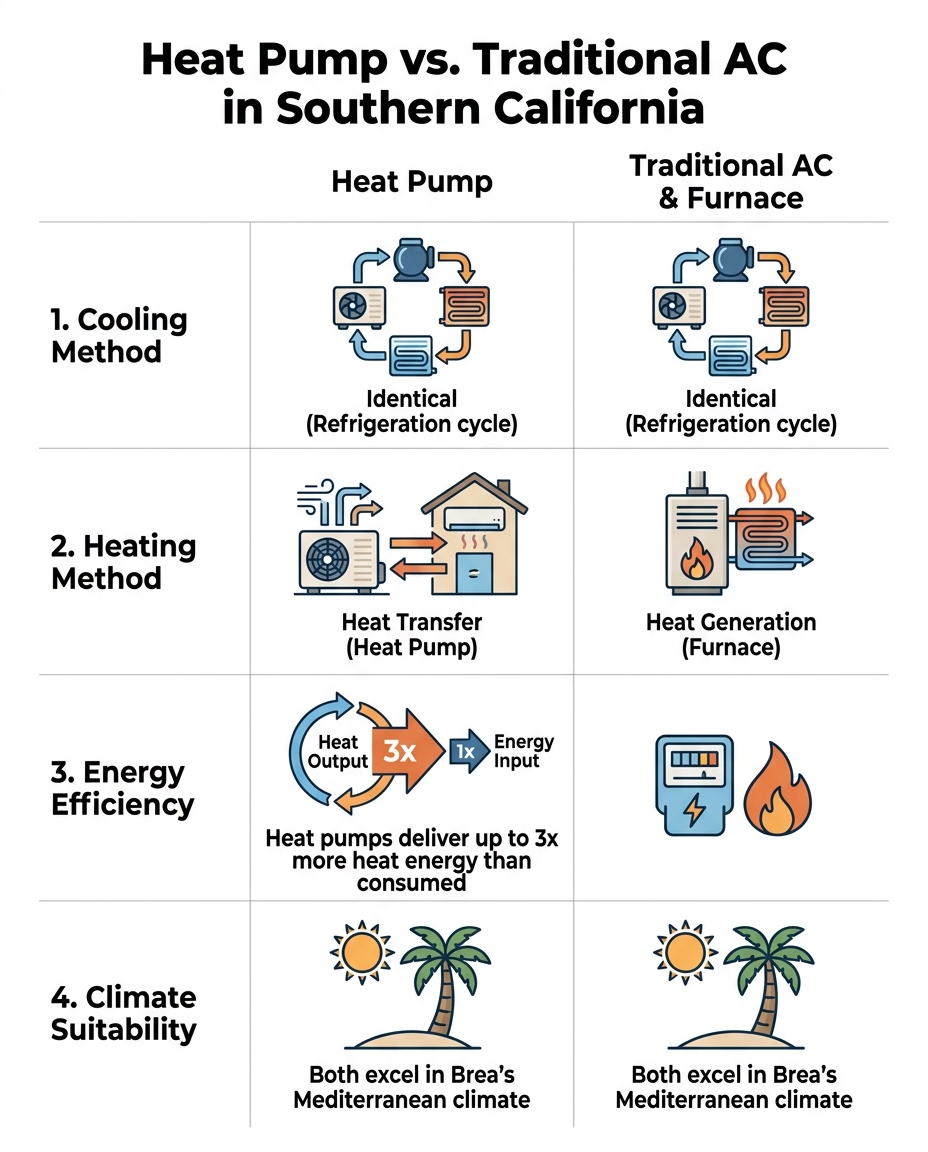
• Cooling Method — Traditional Split System (AC + Furnace): Refrigeration cycle (removes indoor heat) — Air-Source Heat Pump: Refrigeration cycle (removes indoor heat)
• Heating Method — Traditional Split System (AC + Furnace): Heat generation (burns natural gas) — Air-Source Heat Pump: Heat transfer (moves outdoor ambient heat indoors)
• Energy Efficiency — Traditional Split System (AC + Furnace): High cooling efficiency; heating limited by fuel combustion — Air-Source Heat Pump: High cooling efficiency; heating can exceed 300% efficiency
• Climate Suitability — Traditional Split System (AC + Furnace): Effective in all climates, including extreme sub-zero cold — Air-Source Heat Pump: Excels in Brea's mild Mediterranean climate
• Equipment Footprint — Traditional Split System (AC + Furnace): Requires outdoor AC unit and indoor gas furnace — Air-Source Heat Pump: Requires outdoor unit and indoor air handler

Navigating Upfront Investment and Generic Incentives
Upgrading your HVAC system is a major investment in your home's comfort and infrastructure. Because a heat pump replaces both your air conditioner and your furnace at the same time, the initial upfront investment typically differs from simply swapping out a standalone AC unit. You are essentially buying a comprehensive, year-round climate control system rather than just a summer cooling appliance.
To help offset these initial costs, there is a strong push toward residential electrification. High-efficiency heat pumps frequently qualify for generic federal tax credits and local utility rebates designed to encourage energy conservation. These incentives can significantly reduce the net cost of your installation, making the transition to advanced technology much more accessible.
Because incentive programs change frequently based on funding and local regulations, our team always recommends consulting with a tax professional or reviewing your local utility provider's website. They can provide the most current information on which high-efficiency models qualify for rebates, ensuring you maximize your long-term energy savings while lowering your upfront burden.
Installation Timelines and System Maintenance
Knowing what to expect during the installation process can help reduce the stress of a major home upgrade. Whether you choose a traditional system or a heat pump, the quality of the installation matters just as much as the equipment itself. A well-executed installation minimizes disruption and ensures the system operates at peak capacity for years to come.
The Installation Process:
1. Load Calculation and Assessment: A professional technician evaluates your home's square footage, insulation, and window layout to determine the exact system size required.
2. Electrical Evaluation: If you are transitioning from a gas furnace to a heat pump, the technician will check your electrical panel to ensure it can handle the dedicated circuit required for the new indoor air handler.
3. Ductwork Inspection: Both systems utilize your home's existing ductwork. The installation team will inspect the ducts for leaks or blockages that could hinder airflow.
4. Equipment Swap and Testing: The old equipment is safely removed, the new units are installed, and the system is rigorously tested for proper refrigerant charge and airflow balance.
The installation experience should be smooth and professional. During a recent late-summer project, our team at Piggies Air Conditioning helped a local family transition to a new heat pump system. After receiving a thorough estimate and having all their questions answered, the system was installed efficiently and with exceptional care for the house. If you are preparing for an upgrade before the seasons change, booking a professional AC installation in Brea guarantees that every technical detail is handled correctly.
Maintenance requirements also differ between the two systems. A traditional split system requires two separate check-ups: an AC tune-up in the spring and a furnace inspection in the fall. Because a heat pump works year-round to both heat and cool your home, it experiences more continuous wear. Therefore, a heat pump requires bi-annual maintenance—typically in the spring and fall—to clean the coils, check the reversing valve, and ensure the refrigerant levels are perfectly balanced.
Frequently Asked Questions About HVAC Replacements in Southern California
Is a heat pump better than an air conditioner in Southern California?
Neither system is objectively "better" at cooling your home during the summer. However, heat pumps offer a distinct advantage in Southern California by providing year-round efficiency. Because they handle both heating and cooling in a single system, they perfectly match our region's hot summers and mild winters.
Can a heat pump completely replace both a furnace and an AC?
Yes, a heat pump is designed to provide comprehensive climate control for your entire home. By using a reversing valve to switch between cooling and heating modes, it completely eliminates the need for a separate natural gas furnace. This streamlines your home's HVAC footprint into one unified system.
Do heat pumps work well in extreme summer heat?
Modern heat pumps are fully capable of handling extreme late-summer temperatures. They utilize the exact same refrigeration technology and components as traditional high-efficiency air conditioners. As long as the system is properly sized for your home, it will easily keep you comfortable on the hottest August afternoons.
Should I replace my AC with a heat pump in Brea?
The decision largely depends on the age of your current furnace and your long-term energy goals. If both your AC and furnace are aging and nearing the end of their lifespans, transitioning to a heat pump is a highly efficient, logical upgrade. If your furnace is brand new, replacing only the failed AC with a standard unit might make more immediate sense.
Are there tax credits available for switching to a heat pump?
Many high-efficiency heat pumps qualify for generic federal tax credits and local utility incentives aimed at improving home energy efficiency. Because these programs are subject to change, specific eligibility should always be verified with a tax professional or your local utility provider before finalizing your purchase.
Make the Right Choice for Your Home's Comfort
Deciding between a heat pump and a traditional air conditioning system comes down to balancing your upfront investment, available generic incentives, and long-term energy goals. Both systems will provide the powerful, reliable cooling relief you need when late-summer heatwaves push your home's comfort to the limit. However, the year-round efficiency and heat transfer capabilities of a modern heat pump make it an incredibly compelling option for our mild Southern California climate.
Every home has a unique layout, and every family has different comfort requirements. To ensure you make the most informed decision possible, it pays to have an expert evaluate your current ductwork, electrical capacity, and cooling demands. Reach out to our experts at Piggies Air Conditioning today to schedule a professional evaluation and determine the optimal, high-efficiency system tailored specifically to your home.
Other blogs


Customer Testimonials



CUSTOMER SERVICE!
I highly recommend this company for anyone needing AC repair or maintenance. I'll definitely be calling them again for any future needs!

I had the pleasure of experiencing outstanding service and professionalism from Ruben, and I am beyond impressed. From the moment I first contacted them, by phone and follow up communication via email for my quotes. The attention to detail and commitment to excellence were evident.
Ruben, was incredibly responsive, addressing all my inquiries promptly and with clear, thorough explanations. Their dedication to understanding and meeting my needs was remarkable.
Ruben, went above and beyond to ensure that everything was handled seamlessly, demonstrating not just professionalism, but also a sincere dedication to customer satisfaction.
I can't recommend Piggies air Conditioning/Ruben highly enough. If you're looking for someone who combines expertise with exceptional service, look no further. They are a true example of what outstanding professionalism should be.
The technician arrived on time, which I really appreciated given how crucial air conditioning is in this heat. Ruben was professional and friendly, explaining what he was doing throughout the process. The issue I had was diagnosed fairly quickly, and they provided me with a few options on how to fix it. The pricing was transparent, and I didn't feel like there were any hidden costs, which is always a plus when it comes to service calls like these. Highly recommend this company!
1st & foremost, huge shout out to Ruben thank u so so much for reaching out & making things happen SO FAST! I was so surprised since i had reached out to a couple different places who lagged on even answering calls, messages, etc.
Ruben was also very informative & taught me ALOT that i didnt know about.
Also cant leave the amazing Luis & Miles out of
this review.
They came, they saw, they conquered!
And they worked pretty swiftly too, felt very comfy around em, loved their personalities, great attitude, work ethic, professionalism, had some really good convos & they still got the job done lightning fast
SUPER HUGE SHOUT OUT & THANKS for everything guys! Definitely recommending u guys to everyone i know.
recommendations and feedback. The actual installation was painless and unremarkable, his AC experts got it done, got it cleaned and most importantly got it right. Rueben even went a step further to assure we had
protection from the coming rain, that is service unheard of these days. His price was competitive and a REAL value for the service we recieved. Using anyone else for your AC needs, would be a huge mistake. We thank them again and will recommend to everyone.
Echoing a lot of the other reviews here, Piggies Air Conditioning responds so quickly to requests (even though I actually accidentally sent in multiple requests on my side without responding, oops!)
They were able to come do a FREE energy audit and initial inspection on the same day and Ruben was amazing at explaining his thoughts on our house's situation and what he thought was worth the money and wasn't worth the money.
I truly felt like he was trying to help me find the best solution to our issues instead of just trying to upsell us on everything and anything.
I'm definitely recommending this business to anyone I know if they want a trustworthy and realistic service, value, and quality.