









What Makes Central Air Conditioning the Backbone of Home Comfort?
Understanding how does a central air conditioner work is the first step toward getting the most out of your home's cooling system — and catching problems before they cost you.
Here's the short answer:
- Warm indoor air is pulled through return ducts and passes over a cold evaporator coil.
- Refrigerant inside the coil absorbs the heat, turning from liquid to gas in the process.
- The blower fan pushes the now-cooled air back through supply ducts into your living spaces.
- The refrigerant carries the heat outside to the condenser coil in the outdoor unit.
- The compressor pressurizes the refrigerant, releasing the heat into the outdoor air.
- The refrigerant cools back down, returns indoors, and the cycle repeats.
Central air conditioning doesn't create cold air — it removes heat. That's the core idea behind every system cooling homes today.
Developed in the 1960s, central air has become the most common whole-home HVAC solution in the United States. And while the technology has advanced significantly since Willis Carrier's original 1902 invention, the underlying physics remain the same: move heat from inside to outside, and the home stays comfortable.
For homeowners in Baldwin Park and across the San Gabriel Valley, where summer temperatures regularly push into the triple digits, knowing how your system works isn't just interesting — it's practical. It helps you spot warning signs early, maintain your equipment properly, and make smarter decisions when it's time to repair or replace.
The Core Components: How Does a Central Air Conditioner Work?
To understand how does a central air conditioner work, we need to look at the system as a "heat subtraction" machine. Most homes in Pasadena and West Covina utilize what is known as a split-system. This means the system is literally split into two main locations: one inside the home and one outside.
The outdoor unit, often sitting on a concrete slab or mounted on the roof, is the "hot side" of the operation. It houses the compressor and the condenser coil. The compressor is often called the "heart" of the system because it pumps the refrigerant through the entire loop.
Inside the home, usually tucked away in a closet, attic, or basement, is the "cold side." This contains the evaporator coil and the expansion valve. Connecting these two halves is a network of copper tubing called refrigeration lines. These lines carry the refrigerant, a specialized chemical that changes states from liquid to gas and back again to transport heat efficiently.
The Role of the Air Handler
While the coils and refrigerant do the heavy lifting of heat transfer, the Air Handling Unit (AHU) or blower fan is the muscle that moves the air. In many San Gabriel Valley homes, this blower is part of the furnace system.
The air handler draws warm air from your rooms, pulls it through a filter to remove dust and allergens, and pushes it across the icy-cold evaporator coil. Without a healthy blower motor, that cold air would just sit inside your unit instead of reaching your living room.
The Importance of Ductwork and Thermostats
Your ductwork acts as the "circulatory system" of your home. Return ducts pull warm, stale air back to the unit, while supply ducts deliver the refreshed, chilled air to every corner of the house.
The "brain" of this entire operation is the thermostat. It monitors the indoor temperature and signals the system to kick on when things get too warm. If you find your AC system fails to power up, the thermostat or its wiring is often the first place we look.

The Refrigeration Cycle: A Step-by-Step Guide
The secret to modern cooling is the phase change. When a liquid turns into a gas, it absorbs a massive amount of heat. When that gas turns back into a liquid, it releases that heat. Your AC is a closed-loop system designed to exploit this physics trick over and over again.
Step 1: Heat Absorption and how does a central air conditioner work indoors
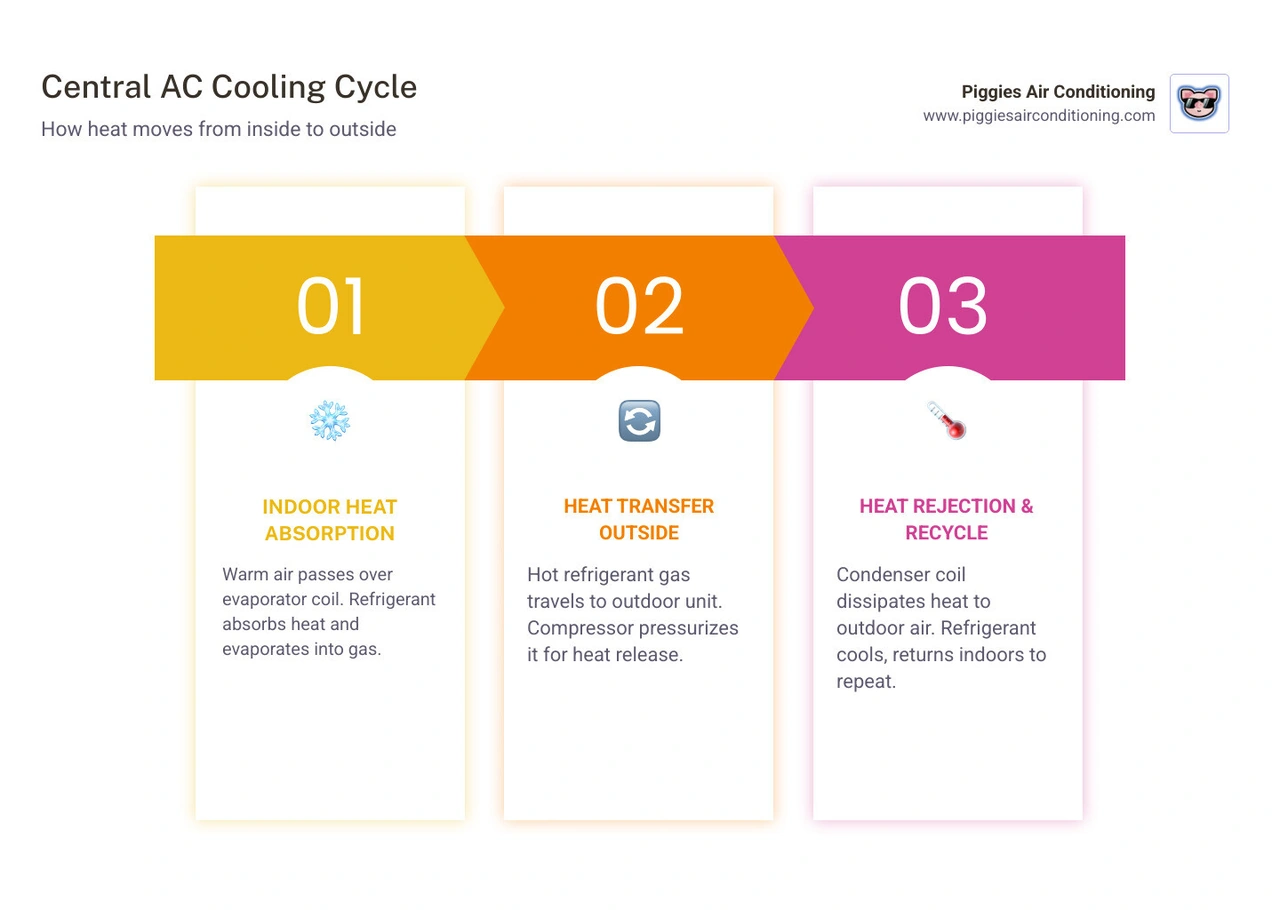
The process begins at the indoor evaporator coil. As warm air from your home blows over these cold copper coils, the liquid refrigerant inside begins to boil and evaporate into a gas. As it evaporates, it "soaks up" the heat from the air like a sponge.
This is also where dehumidification happens. When warm, humid air hits the cold coil, moisture condenses into liquid water — much like a cold soda can "sweats" on a July afternoon in Covina. This moisture is collected in a drain pan and sent outside. If this process is interrupted, you might find that your AC freezes up, which requires immediate AC service.
Step 2: Heat Rejection and how does a central air conditioner work outdoors
Now full of indoor heat, the gaseous refrigerant travels through the copper lines to the outdoor unit. Here, the compressor squeezes the gas, which raises its temperature and pressure significantly.
This high-pressure, hot gas enters the condenser coil. A large fan pulls outdoor air across the coils, allowing the heat to escape into the environment. As the refrigerant loses heat, it condenses back into a liquid. If you ever hear your AC unit making buzzing sounds, it could be a sign that the compressor is struggling with this high-pressure task.
Efficiency, SEER2 Ratings, and System Types
When selecting a system in May 2026, efficiency is the name of the game. We measure this using SEER2 (Seasonal Energy Efficiency Ratio 2). Newer systems can reach ratings as high as 26, and ENERGY STAR certified models are typically 15% more efficient than standard units.
| Feature | Split-System | Packaged Unit |
|---|---|---|
| Location | Indoor & Outdoor components | All-in-one outdoor cabinet |
| Best For | Homes with attics/closets | Homes with limited indoor space |
| Efficiency | Generally higher (up to 26 SEER2) | High efficiency available |
| Noise | Very quiet indoors | All noise stays outdoors |
Higher efficiency helps prevent those dreaded AC bill spikes in summer. You can also choose between single-stage (runs at 100% or off), two-stage (has a high and low setting), or variable capacity (adjusts precisely to your needs).
Understanding Heat Pumps vs. Traditional AC
In our moderate Southern California climate, we often recommend heat pumps. A heat pump looks just like a central AC, but it has a reversing valve. This allows it to move heat into the house during our chilly January nights, acting as both your heater and your air conditioner. Modern heat pumps now use low-GWP (Global Warming Potential) refrigerants like R-32, making them a future-proof choice for eco-conscious homeowners in Monrovia and Arcadia.
Maintaining Your System for Peak Performance
A central AC system is a major investment, typically lasting 10 to 15 years. However, that lifespan depends entirely on maintenance.
- Filter Replacement: This is the most important DIY task. A loaded filter makes the system work harder, consuming more than 2,000 kilowatt-hours of electricity per year in an average-sized home. Change them every 1–3 months.
- Coil Cleaning: Dust on the evaporator coil acts as insulation, preventing the refrigerant from absorbing heat.
- Drain Line Maintenance: We check for blockages in the condensate line to prevent water damage to your home.
For a complete checklist, see our AC tune-up guide for Baldwin Park.
Troubleshooting Common Mechanical Issues
If your system starts acting up, listen to the sounds it makes. A grinding noise often points to a failing blower motor bearing, while a lack of airflow could mean a leak in the ductwork. When these issues arise, professional AC repair in Pasadena is the safest way to get back to being cool.
Frequently Asked Questions about Central AC
Does central air pull in fresh air from outside?
No. This is a common myth. Most residential systems recirculate and filter the air already inside your home. Because the air inside is often more polluted than the air outside, high-quality filtration is essential for your health.
How does central AC remove humidity?
It’s a natural byproduct of the cooling process. As warm air hits the cold evaporator coil, the moisture in the air turns into liquid (condensation). This effectively "dries" the air, which is why a well-sized AC makes the room feel much more comfortable even at higher temperatures.
Is it better to leave the AC on all day?
It is generally more cost-effective to leave the system on but adjust the thermostat 7–10 degrees higher when you are away. This prevents the "thermal mass" of your home (walls, furniture, floors) from soaking up too much heat, which would require the AC to run for hours at maximum capacity to recover when you return.
Conclusion
At Piggies Air Conditioning, we’ve spent years helping our neighbors in Baldwin Park, West Covina, and the surrounding San Gabriel Valley stay cool. As a Daikin Comfort Pro dealer, we believe that the best air conditioner is the one you don’t have to think about because it’s running perfectly in the background.
Whether you need a routine service for your air conditioning or you're ready to upgrade to a high-efficiency heat pump with our 12-year full replacement and labor warranty, we are here to help. Don't wait for the next California heatwave to find out if your system is ready — give us a call today!
Other blogs


Customer Testimonials



CUSTOMER SERVICE!
I highly recommend this company for anyone needing AC repair or maintenance. I'll definitely be calling them again for any future needs!

I had the pleasure of experiencing outstanding service and professionalism from Ruben, and I am beyond impressed. From the moment I first contacted them, by phone and follow up communication via email for my quotes. The attention to detail and commitment to excellence were evident.
Ruben, was incredibly responsive, addressing all my inquiries promptly and with clear, thorough explanations. Their dedication to understanding and meeting my needs was remarkable.
Ruben, went above and beyond to ensure that everything was handled seamlessly, demonstrating not just professionalism, but also a sincere dedication to customer satisfaction.
I can't recommend Piggies air Conditioning/Ruben highly enough. If you're looking for someone who combines expertise with exceptional service, look no further. They are a true example of what outstanding professionalism should be.
The technician arrived on time, which I really appreciated given how crucial air conditioning is in this heat. Ruben was professional and friendly, explaining what he was doing throughout the process. The issue I had was diagnosed fairly quickly, and they provided me with a few options on how to fix it. The pricing was transparent, and I didn't feel like there were any hidden costs, which is always a plus when it comes to service calls like these. Highly recommend this company!
1st & foremost, huge shout out to Ruben thank u so so much for reaching out & making things happen SO FAST! I was so surprised since i had reached out to a couple different places who lagged on even answering calls, messages, etc.
Ruben was also very informative & taught me ALOT that i didnt know about.
Also cant leave the amazing Luis & Miles out of
this review.
They came, they saw, they conquered!
And they worked pretty swiftly too, felt very comfy around em, loved their personalities, great attitude, work ethic, professionalism, had some really good convos & they still got the job done lightning fast
SUPER HUGE SHOUT OUT & THANKS for everything guys! Definitely recommending u guys to everyone i know.
recommendations and feedback. The actual installation was painless and unremarkable, his AC experts got it done, got it cleaned and most importantly got it right. Rueben even went a step further to assure we had
protection from the coming rain, that is service unheard of these days. His price was competitive and a REAL value for the service we recieved. Using anyone else for your AC needs, would be a huge mistake. We thank them again and will recommend to everyone.
Echoing a lot of the other reviews here, Piggies Air Conditioning responds so quickly to requests (even though I actually accidentally sent in multiple requests on my side without responding, oops!)
They were able to come do a FREE energy audit and initial inspection on the same day and Ruben was amazing at explaining his thoughts on our house's situation and what he thought was worth the money and wasn't worth the money.
I truly felt like he was trying to help me find the best solution to our issues instead of just trying to upsell us on everything and anything.
I'm definitely recommending this business to anyone I know if they want a trustworthy and realistic service, value, and quality.