









The Critical Decision When Your A/C Breaker Keeps Tripping
You walk inside on a sweltering afternoon expecting cool relief, only to find silent vents—and you might not realize the danger of repeatedly resetting a tripped AC breaker as you reach for the electrical panel. The house is heating up quickly, and the instinct to simply flip the switch back to the "on" position is overwhelming.
Before you force the system to restart, it helps to understand how your Air Conditioning works and when to call for professional air conditioning service.
When intense, dry July heatwaves settle over Baldwin Park CA, our team at Piggies Air Conditioning sees cooling systems working overtime to maintain a comfortable indoor temperature. In this high-stakes environment, losing cooling during peak summer heat creates immediate frustration. Homeowners are often desperate to restore airflow, making the temptation to force a system reset incredibly high. However, if your a/c breaker keeps tripping, it is rarely a fluke. We consistently find that a flipped switch is masking a much deeper mechanical issue, most commonly a failed run capacitor that has caused the compressor to stall completely.
The Immediate Symptoms vs. the Hidden Reality
From the hallway, a tripped breaker looks like a minor electrical nuisance. You might assume the system just got a little too hot or experienced a temporary power surge. But out at the condenser unit, a much more severe situation is unfolding. When the compressor—the heavy-duty engine of your cooling system—loses its ability to turn, it becomes a dead weight on your electrical grid.
This creates a pivotal decision point for any homeowner. Choosing to reset the breaker a second or third time instead of leaving it off for a proper diagnostic can cause catastrophic damage. Every time you force that switch back on, you are sending a massive, unmitigated surge of electricity into a motor that cannot move, rapidly accelerating the breakdown of your system's most expensive components.
Understanding the Circuit Breaker as a Mechanical Safety Net
To make the right decision for your cooling system, you have to shift your perspective on what the electrical panel is actually doing. Circuit breakers are not designed to be an inconvenience; they are a vital mechanical protector for your home and your appliances. In our years of diagnosing electrical issues across Baldwin Park, we constantly remind homeowners that when an a c unit tripping circuit breaker becomes a recurring issue, the panel is doing exactly what it was engineered to do.
Breakers are strictly regulated by National Electrical Code (NEC) standards. They are calibrated to trip the moment electrical current exceeds safe, predefined limits. By severing the connection, the breaker prevents wiring from overheating, insulation from melting, and equipment from suffering a total meltdown. In short, it stops electrical fires before they can start.
How Your Electrical Panel Responds to Overloads
A tripped breaker is almost always a symptom of a larger mechanical overload out at the equipment, not a flaw in the electrical panel itself. While breakers can occasionally wear out or become weak over decades of use, a sudden tripping issue on a hot day points directly to the HVAC system.
• Thermal protection: Breakers contain a bimetallic strip that bends as it heats up from excessive electrical current, eventually snapping the circuit open.
• Magnetic protection: For sudden, massive surges, a magnetic electromagnet pulls the switch open instantly to stop the flow of power.
• Wiring defense: The breaker ensures that the wires running through your attic and walls do not carry more electricity than their physical gauge can safely handle.
A stalled AC compressor demands massive amounts of electricity as it struggles to start. When it fails to spin, that electrical demand spikes dangerously high, forcing the breaker to step in and sever the connection to protect the home.
The Hidden Culprit: How a Failing Run Capacitor Stalls the System
If the breaker is the safety net, what is causing the system to fall in the first place? In the vast majority of emergency calls our technicians handle during the peak summer months, the root cause of the overload is a small, inexpensive component called the run capacitor. Understanding this part is the key to fixing an AC that trips the circuit breaker safely.
The run capacitor acts like a heavy-duty battery for your air conditioner's motors. Its primary job is to store energy and provide a continuous, precisely timed electrical jolt that keeps the heavy compressor motor turning smoothly. The compressor requires a rotating magnetic field to operate, and the capacitor supplies the phase shift necessary to create that rotation.
The Anatomy of a Cooling Cycle Under High Heat
Peak July heat forces AC units into longer cycles with much shorter recovery times. The system barely gets a chance to rest before the thermostat demands cooling again. This relentless cycle significantly increases the thermal load on the capacitors. Over time, the internal oils and dielectric fluids inside the capacitor begin to break down, bulge, or leak.
The sequence of failure:
When the capacitor finally fails, it stops sending that vital electrical jolt. Without the capacitor's assistance, the compressor motor loses its rotational torque. It tries to start, but it simply cannot overcome the physical resistance of the pressurized refrigerant inside the lines. The motor stalls, sitting perfectly still while humming loudly. This is one of the most common reasons behind an AC unit abruptly losing power during peak season.
Locked Rotor Amps (LRA) and the Danger of Forcing a Restart
When the compressor stalls because of a dead capacitor, the electrical physics of your system change instantly. This brings us to a critical mechanical concept known as Locked Rotor Amps (LRA). Understanding LRA is essential to understanding why you must never force a struggling air conditioner to run.
Every electric motor has two main electrical ratings. The first is Running Load Amps (RLA), which is the normal, safe amount of electricity the motor uses while spinning and cooling your home. The second is Locked Rotor Amps (LRA), which is the massive surge of power the motor pulls for a fraction of a second just to get started.
The Mechanical Cascade of a Forced Restart
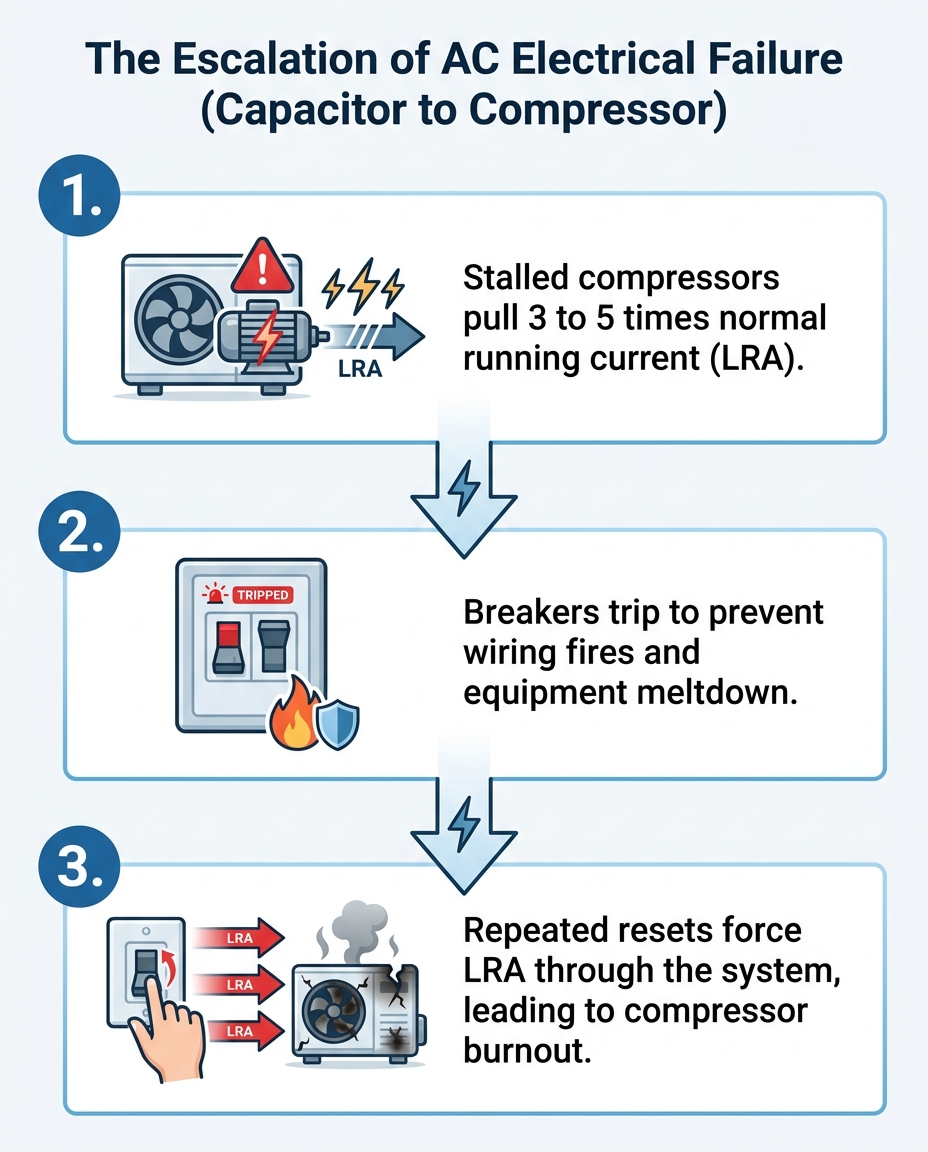
When a compressor is stalled (the rotor is "locked" in place), it continuously pulls Locked Rotor Amps. A stalled compressor pulls 3 to 5 times its normal running current. Because the motor isn't spinning, it isn't pumping the cool refrigerant that normally keeps its internal parts from overheating. Instead, all that massive electrical energy is converted directly into heat.
• Normal Operation — Electrical Draw: Low to Moderate (RLA) — Internal Motor Temperature: Stable (Cooled by refrigerant) — Breaker Response: Remains closed (Power ON)
• Stalled Compressor — Electrical Draw: Extreme Surge (LRA) — Internal Motor Temperature: Rapidly overheating — Breaker Response: Trips immediately to protect system
This is the exact danger of repeatedly resetting the breaker. Each reset forces another massive surge of LRA through a stalled motor, rapidly baking the copper compressor windings. The breaker is tripping to save the compressor from this exact scenario. If you keep resetting it, the breaker will eventually take longer to trip as it heats up, allowing more and more destructive heat to build up inside the compressor until the internal wiring physically melts.
The Escalation: From a Minor Part to Catastrophic Compressor Burnout
The difference between a system that is left off after the first breaker trip and a system that is repeatedly reset is monumental. What starts as a simple, highly affordable capacitor replacement quickly escalates if the system is repeatedly forced to restart.
At Piggies Air Conditioning, our transparent diagnostic care relies on catching these issues at the first stage. Our field experience shows a stark contrast between swapping out a minor part and dealing with the massive undertaking of a compressor replacement. When you leave the breaker off, a technician can simply test the capacitor, replace it, and restore the system to full health for a fraction of the cost of major repairs.
The Hidden Costs of Compressor Burnout
If the system is forced to run and the compressor windings melt, you experience a "burnout." This is a mechanical reality where the electrical insulation inside the motor disintegrates.
• Run Capacitor — Initial Failure Scope: Loss of rotational torque; motor stalls safely. — Repair Scale: Minor part swap; highly affordable. — Long-Term Impact: System runs normally with full lifespan intact.
• Compressor Windings — Initial Failure Scope: Melted insulation; short circuit to ground. — Repair Scale: Catastrophic component failure; massive undertaking. — Long-Term Impact: Requires acid flush, heavy labor, or full unit replacement.
When a burnout occurs, the extreme heat chemically alters the refrigerant and oil, turning them into a highly corrosive acid. This acid pumps through your entire cooling system, contaminating the copper line sets and the indoor coil. Fixing a burnout doesn't just mean replacing the expensive compressor; it requires hazardous acid cleanups, specialized filters, and extensive labor. Reinforcing the habit of leaving the breaker off preserves the integrity of the expensive compressor and saves you from this massive escalation.
What to Do When Your AC Trips the Breaker After a Few Minutes
When you find yourself staring at a dark electrical panel and feeling the heat rise in your home, the actions you take in the next few minutes dictate the future of your cooling system. Taking a calm, methodical approach protects your equipment and your wallet.
1. Stop resetting the breaker immediately: If you have already reset it once and it tripped again, do not touch it a third time. Leave the switch in the tripped or "off" position to permanently protect the compressor from pulling Locked Rotor Amps.
2. Turn the thermostat to the 'off' position: Go to your indoor thermostat and switch the system mode from "Cool" to "Off." This prevents the indoor control board from continuously sending low-voltage signals outside, asking a broken system to run.
3. Call for a professional diagnostic: Contact a licensed technician to test the capacitor and measure the electrical draw safely. High-voltage HVAC equipment holds lethal charges even when the breaker is off, requiring specialized multimeters and discharge tools to handle safely.
What a Professional Diagnostic Actually Checks
We recently helped a Baldwin Park homeowner who experienced this firsthand during a hot July weekend when their system kept shutting down under the heavy weather load. Instead of forcing the breaker, they reached out for help. Our technician arrived the same day, performed step-by-step troubleshooting starting with the electrical draw, identified a stressed capacitor, and repaired the AC without ever subjecting the compressor to dangerous heat.
Routine electrical inspections catch degrading capacitors before they cause a sudden outage. By measuring the microfarad output of a capacitor during a tune-up, technicians can replace weakening parts before they fail entirely. Enrolling in a preventative maintenance plan ensures these electrical tolerances are checked long before the peak heat arrives.
Frequently Asked Questions About AC Breaker Issues
Why does my a/c breaker keep tripping?
It is usually caused by an electrical overload, often due to a failed run capacitor, a short circuit, or a grounded compressor pulling excessive amps. When the system demands more electricity than the wiring can safely handle, the breaker snaps open to prevent a fire. Identifying the exact cause requires testing the outdoor components with a multimeter.
Is it safe to reset an AC breaker?
It is generally safe to reset it once to rule out a random power surge. If it trips a second time, it is unsafe to reset it again due to the risk of mechanical damage or electrical fire. Forcing it to run repeatedly will quickly destroy the internal wiring of your compressor.
Can a bad AC capacitor cause the breaker to trip?
Yes. A bad capacitor fails to provide the necessary torque to spin the compressor motor, causing the motor to stall and pull Locked Rotor Amps (LRA), which quickly trips the breaker. Because the motor cannot move, the electrical energy converts to heat, forcing the safety mechanisms to activate.
How many times can you reset a tripped breaker?
You should only attempt to reset a tripped AC breaker one time. Repeated resets can permanently damage the compressor and degrade the breaker mechanism itself. Each reset weakens the internal springs of the breaker, making it more prone to nuisance tripping in the future.
Why does my AC compressor trip the breaker immediately?
An immediate trip usually indicates a direct short to ground within the compressor windings or a completely failed breaker, requiring immediate professional testing. This happens when the internal insulation has already melted away, allowing bare copper wire to touch the metal casing of the unit.
Protecting Your Cooling System from Preventable Damage
Ultimately, an AC breaker tripping is a vital protective measure, most likely pointing to a stressed or failed run capacitor that has left your compressor stalled. While the loss of cooling is frustrating, respecting the breaker's warning saves you from severe financial and mechanical risks. Treating the electrical panel as a safety net rather than an obstacle is the best way to ensure your system survives the intense summer heat.
If your system is struggling to stay powered on, resist the urge to flip the switch again. Leaving the power off and seeking professional diagnostic help is the only way to resolve the danger of repeatedly resetting a tripped AC breaker safely, keeping a minor repair from turning into a total system replacement.
Other blogs


Customer Testimonials



CUSTOMER SERVICE!
I highly recommend this company for anyone needing AC repair or maintenance. I'll definitely be calling them again for any future needs!

I had the pleasure of experiencing outstanding service and professionalism from Ruben, and I am beyond impressed. From the moment I first contacted them, by phone and follow up communication via email for my quotes. The attention to detail and commitment to excellence were evident.
Ruben, was incredibly responsive, addressing all my inquiries promptly and with clear, thorough explanations. Their dedication to understanding and meeting my needs was remarkable.
Ruben, went above and beyond to ensure that everything was handled seamlessly, demonstrating not just professionalism, but also a sincere dedication to customer satisfaction.
I can't recommend Piggies air Conditioning/Ruben highly enough. If you're looking for someone who combines expertise with exceptional service, look no further. They are a true example of what outstanding professionalism should be.
The technician arrived on time, which I really appreciated given how crucial air conditioning is in this heat. Ruben was professional and friendly, explaining what he was doing throughout the process. The issue I had was diagnosed fairly quickly, and they provided me with a few options on how to fix it. The pricing was transparent, and I didn't feel like there were any hidden costs, which is always a plus when it comes to service calls like these. Highly recommend this company!
1st & foremost, huge shout out to Ruben thank u so so much for reaching out & making things happen SO FAST! I was so surprised since i had reached out to a couple different places who lagged on even answering calls, messages, etc.
Ruben was also very informative & taught me ALOT that i didnt know about.
Also cant leave the amazing Luis & Miles out of
this review.
They came, they saw, they conquered!
And they worked pretty swiftly too, felt very comfy around em, loved their personalities, great attitude, work ethic, professionalism, had some really good convos & they still got the job done lightning fast
SUPER HUGE SHOUT OUT & THANKS for everything guys! Definitely recommending u guys to everyone i know.
recommendations and feedback. The actual installation was painless and unremarkable, his AC experts got it done, got it cleaned and most importantly got it right. Rueben even went a step further to assure we had
protection from the coming rain, that is service unheard of these days. His price was competitive and a REAL value for the service we recieved. Using anyone else for your AC needs, would be a huge mistake. We thank them again and will recommend to everyone.
Echoing a lot of the other reviews here, Piggies Air Conditioning responds so quickly to requests (even though I actually accidentally sent in multiple requests on my side without responding, oops!)
They were able to come do a FREE energy audit and initial inspection on the same day and Ruben was amazing at explaining his thoughts on our house's situation and what he thought was worth the money and wasn't worth the money.
I truly felt like he was trying to help me find the best solution to our issues instead of just trying to upsell us on everything and anything.
I'm definitely recommending this business to anyone I know if they want a trustworthy and realistic service, value, and quality.