










Facing Late-Summer Heat: Understanding Your AC Replacement Options
Your air conditioner is running nonstop, but the house still feels uncomfortably warm. Navigating SEER2 ratings for new AC installations in Orange County can feel overwhelming when you are already dealing with a failing system during peak late-summer August cooling demands. You know you need a replacement to restore your family's comfort, but the technical jargon makes it hard to know what you are actually buying. The decision point often comes down to choosing between a standard, legally compliant baseline unit and investing in a higher-efficiency model that offers long-term performance benefits. At Piggies Air Conditioning, our team has helped countless homeowners across Baldwin Park and Orange County weigh these exact options. This guide serves as an objective, neutral resource to help you balance baseline compliance against high-efficiency upgrades so you can make the most informed choice for your home.
Whether you need comprehensive air conditioning services or are ready to schedule a new AC installation in Orange County, understanding these ratings is your first step toward lasting comfort.
The Reality of End-of-Season Breakdowns
As the cooling season drags on, the cumulative stress on an aging HVAC system peaks. By the time late summer arrives and the back-to-school transition begins, units that have been working overtime for months are highly susceptible to sudden failure. In our experience servicing the area, we see this pattern often: when a breakdown happens during this critical window, homeowners feel rushed to make a quick decision. However, replacing an air conditioner is a major commitment that impacts your daily comfort and energy consumption for the next ten to fifteen years. Taking the time to understand the updated efficiency standards ensures you do not end up with a system that struggles to keep up or costs too much to operate.
Before you approve a quote, you need a clear picture of what the modern efficiency ratings actually mean. The HVAC industry recently underwent a significant regulatory shift, and the metrics used to measure cooling performance have changed. By learning the basics of these new standards, you can approach your installation project with confidence, knowing exactly what to expect from your new equipment.
What the Transition from SEER to SEER2 Means for Homeowners
To make the right choice for your home, you first need to understand how efficiency is measured. The acronym SEER stands for Seasonal Energy Efficiency Ratio. This metric calculates the total cooling output of an air conditioner during a typical cooling season divided by the total electrical energy input during that same period. In simple terms, it measures how efficiently your system uses electricity to cool your home. The higher the rating, the less energy the system requires to do its job. However, in 2023, the Department of Energy (DOE) rolled out a comprehensive update to these standards, introducing the SEER2 metric.
The transition to SEER2 was designed to give homeowners a much truer picture of how systems perform under actual, real-world ductwork conditions. The older SEER testing procedures were often conducted under ideal laboratory settings that did not accurately reflect the environment inside a typical home. The new SEER2 testing protocols introduced stricter testing conditions with higher external static pressure. Static pressure is the resistance to airflow within your ductwork. Because most homes have some level of airflow resistance, testing equipment against higher pressure provides a much more accurate efficiency rating.
Comparing the Testing Standards
Understanding the difference between the old and new testing methods helps clarify why an 18-SEER2 high-efficiency unit today operates differently than an 18-SEER unit from a decade ago. Here is a breakdown of how the testing protocols shifted:
• External Static Pressure — Previous SEER Standard: 0.1 to 0.3 inches of water column — Updated SEER2 Standard: 0.5 inches of water column
• Real-World Accuracy — Previous SEER Standard: Often overestimated actual home efficiency — Updated SEER2 Standard: Closely mimics typical residential ductwork
• Overall Stringency — Previous SEER Standard: Lower barrier to achieve high ratings — Updated SEER2 Standard: Stricter requirements to earn the same numerical rating
Because the SEER2 testing conditions are more rigorous, a system rated at 14.3 SEER2 is actually equivalent to roughly a 15.0 under the old SEER system. This means that any new unit you install today is held to a much higher standard of performance and energy conservation than the systems manufactured just a few years ago.
Decoding California's Southwest Region Baseline Standards
The Department of Energy does not apply a single, blanket efficiency standard across the entire country. Instead, the DOE categorizes states into three distinct regions based on climate and cooling demands: the North, the Southeast, and the Southwest. California is categorized in the Southwest Region, which carries stricter energy efficiency mandates due to the prolonged, intense heat experienced across the state. If you live in Orange County, these regional rules dictate the absolute minimum efficiency rating you can legally install in your home.
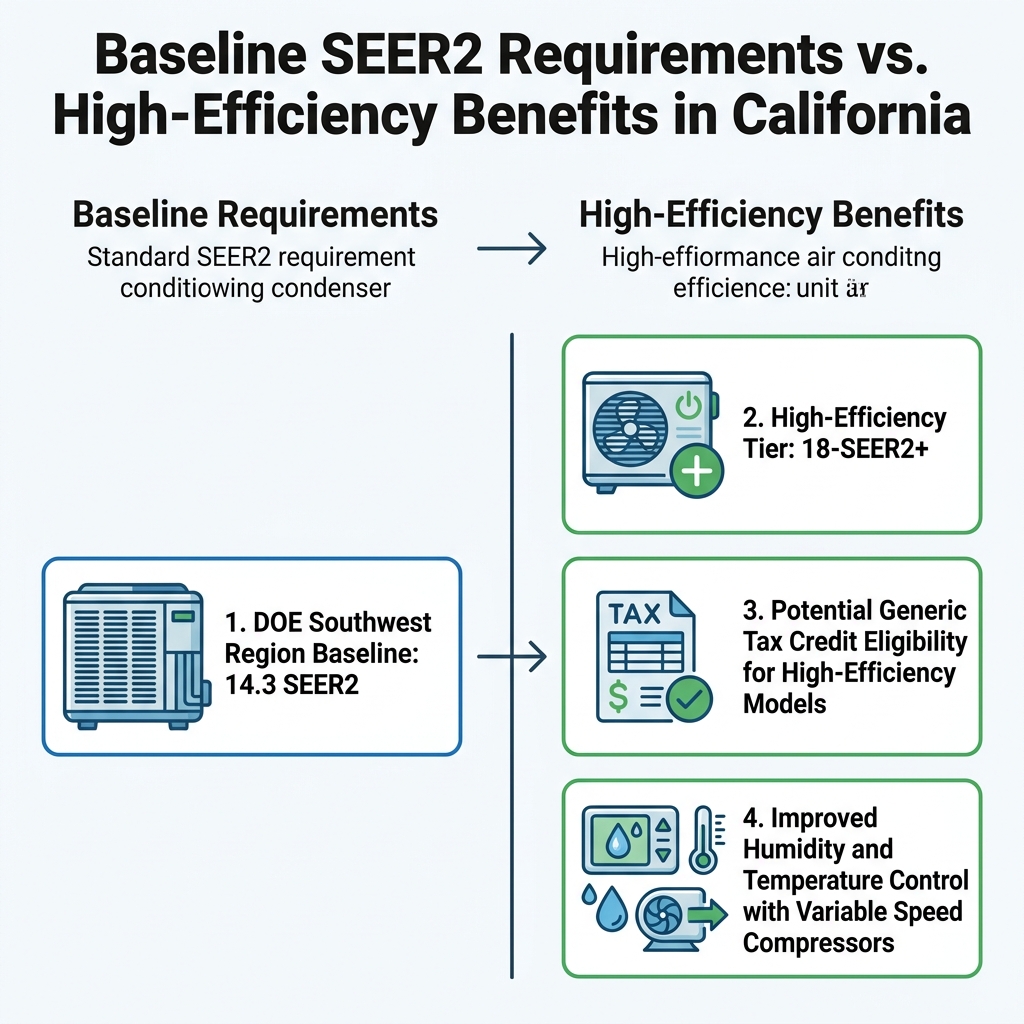
For residential split systems—the most common type of central air conditioning where one unit sits outside and another sits inside—the current baseline requirement in the Southwest Region is 14.3 SEER2 for systems under 45,000 BTU. Additionally, the region mandates a minimum Energy Efficiency Ratio (EER2) of 11.7. While SEER2 measures seasonal efficiency, EER2 measures efficiency at a specific peak operating temperature, ensuring the unit performs well during the hottest parts of the day.
The Value of Baseline Compliance
It is important to understand that a "baseline" system is not a low-quality system. Meeting the 14.3 SEER2 minimum requires advanced engineering and reliable components. For many homeowners, a baseline system provides reliable, compliant cooling without requiring a premium upfront investment. If your primary goal is to restore comfort quickly during late-summer August cooling demands, and you have a smaller home or lower overall cooling needs, a baseline unit is a perfectly sound choice.
These entry-level systems still represent a massive upgrade over the aging, inefficient units installed ten or fifteen years ago. A new 14.3 SEER2 system will cool your home faster, run quieter, and use less energy than a failing older model. The key is to evaluate your specific household habits and determine if the legal minimum is sufficient for your long-term comfort, or if a higher tier makes more sense for your lifestyle.
When Does an 18-SEER2 High-Efficiency Unit Make Sense?
While a baseline 14.3 SEER2 system meets state requirements, many homeowners choose to invest in an 18-SEER2 high-efficiency unit. The decision to upgrade usually comes down to the operational benefits and the specific climate challenges of your area. Orange County's intense, dry summer heat makes the jump to an 18-SEER2 unit significantly more impactful for consistent cooling than it would be in milder coastal zones where the temperature rarely spikes. Higher-tier units are engineered to handle prolonged heatwaves with far greater precision.
The primary difference between a baseline unit and a high-efficiency model lies in the compressor technology. Baseline units typically feature single-stage compressors, meaning they run at 100% capacity until the house reaches the target temperature, then shut off completely. High-efficiency units utilize two-stage or variable-speed compressors, which can adjust their cooling output in small increments to perfectly match the real-time demands of the home.
Operational Benefits of Upgrading
Here is a clear, side-by-side comparison of why an 18-SEER2 high-efficiency unit might be the right choice for your home:
• Consistent temperature control: Variable-speed compressors run continuously at lower speeds, eliminating the uncomfortable temperature swings associated with single-stage units turning on and off.
• Superior humidity management: Because high-efficiency systems run longer cycles at lower speeds, they spend more time pulling moisture out of the indoor air, making your home feel cooler and more comfortable.
• Quieter operation: Running at a reduced capacity for most of the day means the system generates significantly less noise, both indoors and outdoors.
• Reduced wear and tear: The constant starting and stopping of a single-stage unit puts heavy stress on the components. Variable-speed technology ramps up gently, extending the lifespan of the equipment.
• Better air filtration: Longer run times mean your indoor air is constantly circulating through the HVAC filter, leading to improved indoor air quality.
If you plan to stay in your home for many years, or if you frequently struggle with hot and cold spots across different rooms, the advanced performance of a high-efficiency model often justifies the initial investment.

Evaluating Long-Term Efficiency and Generic Incentive Eligibility
When weighing your options, it is helpful to look beyond the initial installation day and consider the long-term operational footprint of the equipment. Higher SEER2 ratings directly translate to reduced energy consumption over the lifespan of the system. Because an 18-SEER2 high-efficiency unit requires less electricity to produce the same amount of cooling as a baseline model, it inherently lowers the daily energy load on your home. If you are wondering how much electricity an AC unit uses daily, the answer changes dramatically when you upgrade from an aging single-stage system to a modern variable-speed model.
During late-summer August cooling demands, when the system runs for hours on end, the proportional efficiency gains of a higher SEER2 rating become highly visible in your home's overall energy profile. The less energy the system wastes, the more efficiently your household operates.
Navigating Incentives and Credits
Beyond the daily operational efficiency, upgrading to a higher tier often opens the door to generic federal energy efficiency tax credits and local utility incentive programs. Government agencies and utility providers frequently encourage homeowners to adopt greener technology by offering structural incentives for systems that exceed baseline mandates. Systems achieving 18-SEER2 or higher are often prime candidates for these programs.
Because incentive programs change frequently based on funding and legislation, it is always best to consult with a tax professional or your local utility provider to confirm current eligibility before making a final decision. By keeping the focus on the long-term value and the potential for these generic incentives, you can build a conceptual framework for your return on investment without getting bogged down in exact pricing promises.
Choosing the Right System Without the High-Pressure Sales Pitch
Ultimately, the right choice for your home depends on a unique combination of factors, including your specific cooling load, the condition of your existing ductwork, and your long-term residence plans. A massive, high-efficiency system is not automatically the best choice for every single property in Orange County. If your ductwork is undersized or heavily compromised, even the most advanced 18-SEER2 high-efficiency unit will struggle to perform correctly. This is why a customized approach is essential.
When you are facing a major AC replacement, the most important step is working with a contractor who provides objective facts and education rather than pushing the most expensive unit available. Transparent, honest guidance and clear ROI calculations help build trust and ensure you are making a decision based on your actual needs. For example, our team at Piggies Air Conditioning frequently helps homeowners who reach out during peak late-summer heatwaves seeking upgrades and information on their aging HVAC systems. Instead of facing aggressive upselling, our customers are provided with the exact technical information they need, educated on their options, and receive professional service that leaves them feeling comfortable and confident in their choice.
Bridging the Gap with Flexible Solutions
If you determine through careful evaluation that investing in a higher-efficiency system is the right move for your family's comfort and long-term goals, you do not have to let the initial scope of the project hold you back. Exploring HVAC financing options can provide flexible payment solutions that bridge the gap between a baseline unit and a premium system. By breaking the project into manageable terms, you can secure the variable-speed technology and advanced comfort controls your home needs to conquer the late-summer August cooling demands without unnecessary stress.
Frequently Asked Questions About SEER2 Ratings in California
What is the minimum SEER2 rating in California?
The minimum SEER2 rating in California is strictly regulated by the Department of Energy's Southwest Region mandates. For standard residential split-system air conditioners under 45,000 BTU, the baseline requirement is 14.3 SEER2. Systems must also meet an 11.7 EER2 rating to ensure efficiency during peak temperature spikes. Installing a system below these minimums is not legally permitted for new residential projects in the state.
Is an 18 SEER2 air conditioner worth it?
An 18 SEER2 air conditioner is generally worth the investment if you plan to stay in your home long-term and want superior comfort control. The value depends heavily on your household's cooling demands, how often you run the system, and your potential eligibility for generic tax credits. The variable-speed technology found in these units provides consistent temperatures and excellent humidity removal, making them highly effective during intense heatwaves.
What is a good SEER2 rating for a house?
A "good" SEER2 rating is one that strikes the perfect balance between meeting state minimums and achieving your personal comfort and efficiency goals. For many homes, a baseline 14.3 SEER2 unit is perfectly adequate for reliable cooling. However, if you prioritize advanced climate control, quieter operation, and maximized energy conservation, ratings of 16 to 18 SEER2 are considered excellent choices for residential applications.
How much electricity does a higher SEER2 unit save?
A higher SEER2 unit saves electricity by utilizing advanced compressor technology that requires less power to generate the same amount of cooling as a lower-rated unit. Instead of running at full capacity and shutting off, high-efficiency models run at lower, sustained speeds that consume less energy over time. These proportional efficiency gains translate to a smaller overall energy footprint for your home throughout the cooling season.
Do SEER2 ratings apply to both ACs and heat pumps?
Yes, the updated SEER2 testing standards apply to both central air conditioners and heat pumps. However, the specific baseline numbers and testing criteria may vary slightly depending on the exact type of equipment and its heating capabilities. Heat pumps are also measured by an additional metric called HSPF2 (Heating Seasonal Performance Factor), which calculates their efficiency during the winter months.
Take the Next Step Toward Reliable Home Comfort
Replacing an air conditioner does not have to be a stressful, high-pressure experience. By understanding the transition to SEER2 and the specific requirements for the Southwest Region, you can take control of your home's comfort. Whether you decide that a reliable baseline unit is all you need, or you choose to invest in the advanced climate control of an 18-SEER2 high-efficiency unit, the key is making a choice based on accurate, objective information.
You deserve a clear, neutral explanation of what SEER2 means for Southern California, how different models compare in efficiency, and a framework to make an informed choice without needing exact price figures upfront. If you are ready to evaluate your home's specific cooling needs and explore your options for conquering the late-summer heat, consult with a local expert who prioritizes honest education over aggressive sales tactics. At Piggies Air Conditioning, our team is standing by to help you navigate these choices with confidence.
Other blogs


Customer Testimonials



CUSTOMER SERVICE!
I highly recommend this company for anyone needing AC repair or maintenance. I'll definitely be calling them again for any future needs!

I had the pleasure of experiencing outstanding service and professionalism from Ruben, and I am beyond impressed. From the moment I first contacted them, by phone and follow up communication via email for my quotes. The attention to detail and commitment to excellence were evident.
Ruben, was incredibly responsive, addressing all my inquiries promptly and with clear, thorough explanations. Their dedication to understanding and meeting my needs was remarkable.
Ruben, went above and beyond to ensure that everything was handled seamlessly, demonstrating not just professionalism, but also a sincere dedication to customer satisfaction.
I can't recommend Piggies air Conditioning/Ruben highly enough. If you're looking for someone who combines expertise with exceptional service, look no further. They are a true example of what outstanding professionalism should be.
The technician arrived on time, which I really appreciated given how crucial air conditioning is in this heat. Ruben was professional and friendly, explaining what he was doing throughout the process. The issue I had was diagnosed fairly quickly, and they provided me with a few options on how to fix it. The pricing was transparent, and I didn't feel like there were any hidden costs, which is always a plus when it comes to service calls like these. Highly recommend this company!
1st & foremost, huge shout out to Ruben thank u so so much for reaching out & making things happen SO FAST! I was so surprised since i had reached out to a couple different places who lagged on even answering calls, messages, etc.
Ruben was also very informative & taught me ALOT that i didnt know about.
Also cant leave the amazing Luis & Miles out of
this review.
They came, they saw, they conquered!
And they worked pretty swiftly too, felt very comfy around em, loved their personalities, great attitude, work ethic, professionalism, had some really good convos & they still got the job done lightning fast
SUPER HUGE SHOUT OUT & THANKS for everything guys! Definitely recommending u guys to everyone i know.
recommendations and feedback. The actual installation was painless and unremarkable, his AC experts got it done, got it cleaned and most importantly got it right. Rueben even went a step further to assure we had
protection from the coming rain, that is service unheard of these days. His price was competitive and a REAL value for the service we recieved. Using anyone else for your AC needs, would be a huge mistake. We thank them again and will recommend to everyone.
Echoing a lot of the other reviews here, Piggies Air Conditioning responds so quickly to requests (even though I actually accidentally sent in multiple requests on my side without responding, oops!)
They were able to come do a FREE energy audit and initial inspection on the same day and Ruben was amazing at explaining his thoughts on our house's situation and what he thought was worth the money and wasn't worth the money.
I truly felt like he was trying to help me find the best solution to our issues instead of just trying to upsell us on everything and anything.
I'm definitely recommending this business to anyone I know if they want a trustworthy and realistic service, value, and quality.