









Why Poor Insulation Is Making Your AC Work Harder in San Gabriel Valley Homes
Poor insulation making your AC work harder is one of the most common — and most overlooked — causes of high summer energy bills and uncomfortable homes across the San Gabriel Valley.
Here's a quick breakdown of how it happens:
- Heat pours in through under-insulated attics, walls, and windows faster than your AC can remove it
- Your thermostat never gets satisfied, so the AC keeps running — and running
- Energy bills climb while comfort stays low
- Your AC wears out faster from the constant strain
- Humidity rises because the system can't complete proper cooling cycles
Many homeowners in West Covina, Baldwin Park, and surrounding areas assume a struggling AC means a broken or undersized unit. But the real culprit is often the home itself — specifically, a weak thermal envelope that lets outdoor heat win the battle before cooled air even reaches your living room.
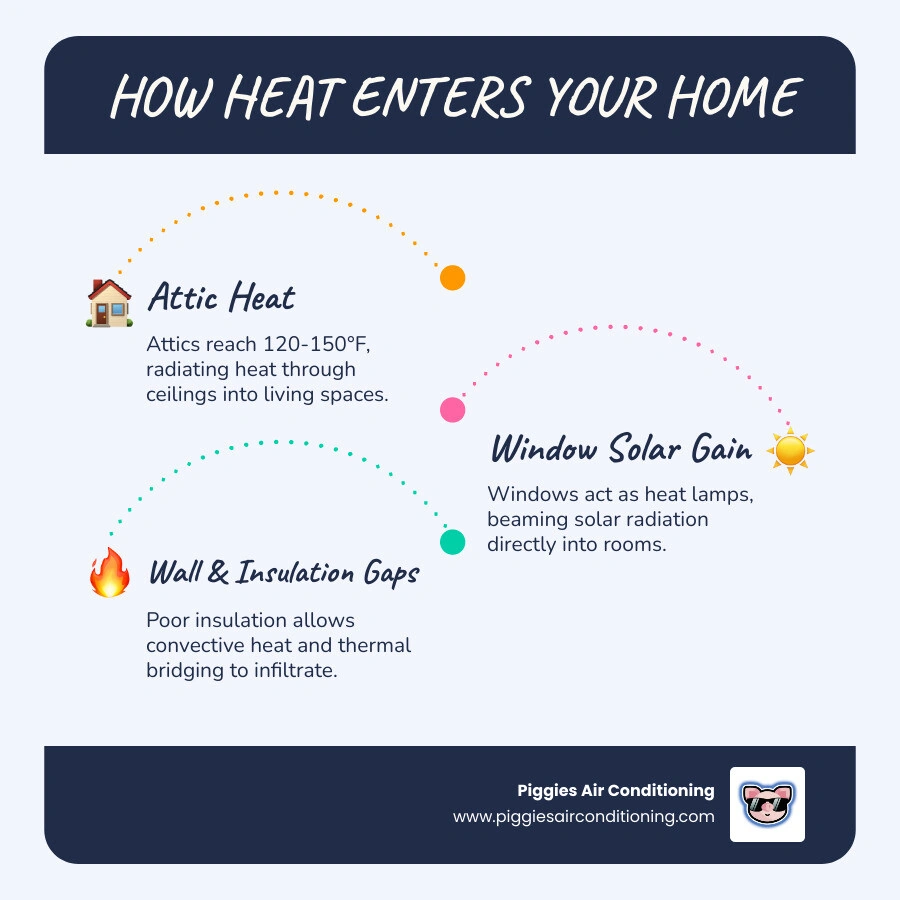
On a typical San Gabriel Valley summer day, attic temperatures can climb to 120–150°F. That heat radiates downward through your ceiling and into your living spaces around the clock. Meanwhile, windows without proper glazing act like heat lamps, beaming solar radiation directly into rooms. Your AC isn't failing — it's fighting a battle it was never designed to fight alone.
In this guide, we'll walk you through exactly how to identify insulation and window issues in your home, what they're costing you, and what you can do about it.
How Poor Insulation and Window Heat Gain Force Your AC to Work Harder
To understand why your cooling system is struggling, we first have to look at the physics of your home. Think of your house as a giant cooler. If you fill a cooler with ice but leave the lid cracked or use a cheap, thin-walled plastic box, that ice is going to melt in minutes. Your home works the same way.
Poor insulation making your AC work harder is essentially a failure of the "thermal envelope." This envelope is the barrier between your conditioned indoor air and the brutal Southern California sun. When this barrier is weak, several things happen:
- Thermal Bridging: This is a fancy way of saying heat finds a "bridge" to walk across. Heat is naturally attracted to cooler spaces. Without thick insulation, heat travels through the wood studs and drywall of your home, turning your walls into giant radiators.
- Solar Gain: This happens primarily through your windows. Even if your walls are well-insulated, standard glass allows solar radiation to pass through. This radiation hits your furniture and floors, turning into heat that stays trapped inside.
- Convective Heat: This is the movement of hot air through physical gaps. Tiny cracks around window frames or attic hatches allow pressurized cool air to escape while sucking in hot, humid air from the outside.
When these forces work together, your AC system enters a "constant catch-up" cycle. Instead of reaching your target temperature and resting, the unit stays on indefinitely because the home is gaining heat as fast as the AC can remove it. This is a primary reason for AC Bill Spikes in Summer, as your electricity meter spins faster than a hamster on a caffeine kick.
The Attic: A Major Source of Poor Insulation Making Your AC Work Harder
If your home were a person, the attic would be a dark, heavy wool hat worn in the middle of July. It is often the single biggest culprit for AC inefficiency. Statistics show that your attic is responsible for up to 25% of the heat that infiltrates your home during the summer.
In May 2026, as we head into another scorching season, it’s vital to realize that attic temperatures can reach 140–160°F. This creates a massive 70-degree temperature differential between the attic and your 72-degree living room. Without a thick layer of insulation (measured in R-value), that heat radiates downward through the ceiling.
Furthermore, many homes in the San Gabriel Valley have their ductwork located in the attic. If those ducts are sitting in 150-degree air with only thin insulation, the air inside them warms up before it even reaches your vents. This can add approximately 30,500 BTUs per hour of cooling load—that's more than 2.5 tons of AC capacity being wasted just to fight attic heat! This often manifests as weak airflow from your AC vents that feels lukewarm rather than crisp and cold.
Why Older Homes in West Covina Struggle with Thermal Resistance
We love the character of older homes in West Covina and Pasadena, but their insulation often leaves much to be desired. If your home was built before 1980, it likely only has R-10 to R-19 insulation in the attic—less than half of what modern efficiency standards recommend.
Over the decades, original fiberglass batts can settle, thin out, or be moved by previous contractors or pests. This leaves "bald spots" in your thermal protection. Additionally, older homes were not built with the advanced air-sealing techniques we use today. Structural gaps around plumbing stacks, recessed lights, and top plates allow air to bypass the insulation entirely. This lack of thermal resistance means your AC has to work double-time just to keep the house habitable. Regular HVAC maintenance in West Covina often reveals that the AC unit itself is fine, but the house's "skin" is simply too thin.
Identifying Inadequate Thermal Barriers in San Gabriel Valley Homes
How do you know if your home is the reason your AC is struggling? You don't always need a high-tech thermal camera to find the gaps. Your body and your utility bill are often the best diagnostic tools.
One of the most obvious signs is uneven cooling. If your living room feels like an icebox but the back bedrooms feel like a sauna, you likely have insulation gaps or significant window heat gain in those specific areas. We often see AC hot and cold spots in your home that correspond directly to where the attic insulation has shifted or where a west-facing window is letting in too much sun.
High indoor humidity is another red flag. Insulation and air sealing help keep moisture out. If your home feels "sticky" or "heavy" even when the AC is running, the system is likely struggling to remove moisture because hot, humid air is leaking in faster than the AC can dehumidify it.
Common Signs of Failing Window Seals and Insulation Gaps
Windows are often the "weakest link" in your home's thermal defense. Keep an eye out for these telltale signs:
- Moisture Buildup: If you see fog or condensation between double-pane glass, the seal has failed. That window is no longer providing the thermal barrier it was designed for.
- The "Touch Test": On a hot afternoon, touch your interior walls and ceilings. If they feel warm to the touch, heat is conducting directly through your insulation (or lack thereof).
- Drafts: Hold a lit incense stick or a thin tissue near window frames and electrical outlets. If the smoke or tissue flickers, you have air leaks that are undermining your AC's hard work.
- Localized Heat Zones: If you step into a room and feel a "wall of heat" near a window, that's solar gain in action.
Addressing these issues early is key, as they are often the top signs your AC needs help before the peak of summer hits.
The Impact of Window Heat Gain on Cooling Efficiency
While we've talked a lot about the attic, windows are essentially holes in your insulation. Standard single-pane glass has almost zero R-value. In Southern California, the "Solar Heat Gain Coefficient" (SHGC) is the number that matters most. This measures how well a window blocks heat caused by sunlight.
Upgrading to Low-E (low-emissivity) glass or double-pane windows can be a game-changer. Low-E glass has a microscopic metallic coating that reflects infrared heat back outside while still letting visible light in. This prevents your home from turning into a greenhouse. If you have rooms that never seem to stay cool, window upgrades are often the most effective solutions for systems with uneven cooling.
Long-Term Damage from Poor Insulation Making Your AC Work Harder
The cost of poor insulation making your AC work harder goes beyond just your monthly bill. It's about the "mechanical health" of your cooling system.
AC units are designed to run in cycles. They turn on, cool the house down, and then turn off to rest. When your insulation is poor, those cycles become longer and more frequent. This leads to:
- Compressor Wear: The compressor is the "heart" of your AC. Constant operation leads to overheating and premature mechanical failure.
- Motor Strain: Fan motors that run 20 hours a day instead of 8 will burn out years before they should.
- Shortened Lifespan: A central AC unit should last about 15 years. In a poorly insulated home, that lifespan can drop to 10 years or less due to cumulative stress.
Following a West Covina AC maintenance guide is important, but even the best-maintained unit will eventually buckle under the pressure of a poorly insulated home.
Step-by-Step Guide: How to Inspect Your Home’s Insulation
You don't have to be a professional to get a good idea of your home's insulation health. Follow these steps to perform your own "Energy Audit":
- Check Joist Visibility: Head up into your attic. If you can see the wooden floor joists, you don't have enough insulation. In Southern California, your insulation should be deep enough to completely bury those joists.
- The Ruler Test: Use a standard ruler to measure the depth of your attic insulation. For our climate, the Department of Energy often recommends an R-38 to R-49 rating. For blown-in fiberglass, that's about 13 to 15 inches deep.
- Inspect the Attic Hatch: Is the door to your attic insulated? If not, it’s a giant hole in your thermal barrier. Check for weatherstripping around the edges of the hatch as well.
- Look for "Dirty" Insulation: If you see patches of fiberglass that look gray or black, that's usually a sign of an air leak. The insulation is acting like a filter as air rushes through a gap in the structure.
- Check Light Fixtures: Look for gaps around recessed "can" lights. These are notorious for leaking conditioned air into the attic.
- The Window Sills: Check for "rattling" panes or visible gaps in the exterior caulking.
Upgrading Your Home’s Efficiency for the 2026 Summer Season
If your inspection reveals that your home is essentially "wearing a t-shirt in a blizzard," it’s time for an upgrade. Homeowners can save an average of 15% on heating and cooling costs just by air sealing and adding attic insulation.
There are several materials to consider:
- Blown-in Cellulose: Made from recycled paper treated with fire retardants, this is great for filling every nook and cranny.
- Fiberglass Batts: The traditional choice, affordable and easy to install in open spaces.
- Spray Foam: The gold standard for air sealing and insulation. It expands to fill gaps and provides a very high R-value per inch.
Comparison: Insulation Performance
| Feature | Fiberglass Batts | Blown-in Cellulose | Spray Foam (Closed Cell) |
|---|---|---|---|
| R-Value per Inch | ~3.2 | ~3.5 - 3.8 | ~6.0 - 7.0 |
| Air Sealing | Poor | Moderate | Excellent |
| Moisture Resistance | Moderate | Moderate | High |
| Lifespan | 80-100 years | 20-30 years | Lifetime |
Don't forget that insulation is only half the battle; air sealing is the other half. Using expandable foam or caulk to seal gaps around plumbing and wiring can be just as effective as adding more inches of fiberglass. Combining these upgrades with regular AC maintenance in West Covina ensures your home stays a sanctuary of cool air all summer long.
Frequently Asked Questions about AC Performance and Insulation
How does poor insulation affect indoor humidity levels?
Poor insulation allows hot, moisture-laden outdoor air to seep into your home through gaps and thin barriers. Because your AC has to work harder just to lower the temperature, it may not run long enough or efficiently enough to properly remove this excess moisture. This results in that "clammy" or "sticky" feeling, even if the air coming out of the vents is cold.
What R-value is recommended for homes in Southern California?
For most homes in the San Gabriel Valley and West Covina area, the Department of Energy recommends an attic R-value between R-38 and R-60. Given our intense solar radiation, aiming for the higher end (around 15-20 inches of insulation) is often the smartest move for long-term AC health and energy savings.
Can I add new insulation on top of my existing attic material?
Yes, in most cases, you can "top off" your insulation. However, you should never lay new insulation over material that is wet, moldy, or infested with pests. It’s also crucial to perform air sealing before adding more insulation, as the new material will make it much harder to find those air leaks later.
Conclusion
At Piggies Air Conditioning, we’ve seen it a thousand times: a homeowner thinks they need a brand-new AC, but what they really need is a better-protected home. Poor insulation making your AC work harder is a silent budget-killer, but it’s one you can fix.
By upgrading your attic insulation and addressing window heat gain, you aren't just saving money on your next bill—you’re protecting your cooling system from a premature trip to the scrapyard. Whether you’re in Baldwin Park, Pasadena, or Whittier, our team is here to help you achieve total home comfort.
As a certified Daikin Comfort Pro dealership, we stand behind our work with an industry-leading 12-year full replacement and labor warranty on Daikin units. We are owner-operated, offer same-day availability, and take pride in our 5-star community reputation across the San Gabriel Valley.
Don't let your AC fight a losing battle this summer. Schedule your professional AC performance evaluation with Piggies Air Conditioning today and let us help you turn your home into the efficient, cool oasis you deserve.
Other blogs


Customer Testimonials



CUSTOMER SERVICE!
I highly recommend this company for anyone needing AC repair or maintenance. I'll definitely be calling them again for any future needs!

I had the pleasure of experiencing outstanding service and professionalism from Ruben, and I am beyond impressed. From the moment I first contacted them, by phone and follow up communication via email for my quotes. The attention to detail and commitment to excellence were evident.
Ruben, was incredibly responsive, addressing all my inquiries promptly and with clear, thorough explanations. Their dedication to understanding and meeting my needs was remarkable.
Ruben, went above and beyond to ensure that everything was handled seamlessly, demonstrating not just professionalism, but also a sincere dedication to customer satisfaction.
I can't recommend Piggies air Conditioning/Ruben highly enough. If you're looking for someone who combines expertise with exceptional service, look no further. They are a true example of what outstanding professionalism should be.
The technician arrived on time, which I really appreciated given how crucial air conditioning is in this heat. Ruben was professional and friendly, explaining what he was doing throughout the process. The issue I had was diagnosed fairly quickly, and they provided me with a few options on how to fix it. The pricing was transparent, and I didn't feel like there were any hidden costs, which is always a plus when it comes to service calls like these. Highly recommend this company!
1st & foremost, huge shout out to Ruben thank u so so much for reaching out & making things happen SO FAST! I was so surprised since i had reached out to a couple different places who lagged on even answering calls, messages, etc.
Ruben was also very informative & taught me ALOT that i didnt know about.
Also cant leave the amazing Luis & Miles out of
this review.
They came, they saw, they conquered!
And they worked pretty swiftly too, felt very comfy around em, loved their personalities, great attitude, work ethic, professionalism, had some really good convos & they still got the job done lightning fast
SUPER HUGE SHOUT OUT & THANKS for everything guys! Definitely recommending u guys to everyone i know.
recommendations and feedback. The actual installation was painless and unremarkable, his AC experts got it done, got it cleaned and most importantly got it right. Rueben even went a step further to assure we had
protection from the coming rain, that is service unheard of these days. His price was competitive and a REAL value for the service we recieved. Using anyone else for your AC needs, would be a huge mistake. We thank them again and will recommend to everyone.
Echoing a lot of the other reviews here, Piggies Air Conditioning responds so quickly to requests (even though I actually accidentally sent in multiple requests on my side without responding, oops!)
They were able to come do a FREE energy audit and initial inspection on the same day and Ruben was amazing at explaining his thoughts on our house's situation and what he thought was worth the money and wasn't worth the money.
I truly felt like he was trying to help me find the best solution to our issues instead of just trying to upsell us on everything and anything.
I'm definitely recommending this business to anyone I know if they want a trustworthy and realistic service, value, and quality.