










Facing a Dead Compressor in the Glendora Heat?
If you are staring at a climbing thermostat and asking, repair or replace? How we advise Glendora homeowners facing a dead compressor always starts with taking a deep breath before making a rushed decision in the late-summer heat. It is one of the most frustrating moments a homeowner can experience, especially with the back-to-school transition underway. When the house is quickly heating up and your family is uncomfortable, the pressure to make a fast, expensive decision can feel overwhelming. You need your cooling restored immediately, but you also want to make sure you are making a smart long-term investment.
When our team at Piggies Air Conditioning receives these frantic calls, our recommendation always comes down to objective, percentage-based math rather than high-pressure sales tactics. A dead compressor is a major failure, often compared to the engine of a car giving out. Deciding whether to invest heavily in an aging unit or put those resources toward a modern system requires a clear head and a solid framework.
Our goal is to provide you with that exact framework. By looking at objective criteria like the age of your equipment, the type of refrigerant it uses, and the percentage ratio of the repair cost, you can make the right choice for your home. If you are dealing with a sudden breakdown and need immediate help, exploring professional air conditioning services is the first step toward getting your home comfortable again.
Why Compressors Fail During the August Late-Summer Heat
To understand why your system failed, it helps to understand what the compressor actually does. The compressor is the heart of your cooling system. It is responsible for pumping refrigerant back and forth between the indoor and outdoor units, compressing the gas so it can release the heat it absorbed from inside your home. Because it works so hard, it endures an incredible amount of mechanical and thermal stress.
The San Gabriel Valley Microclimate Factor
The microclimates of the San Gabriel Valley create a unique challenge for HVAC equipment. During the relentless August late-summer heat, daytime temperatures soar and the sun beats down on your outdoor condenser unit. This sustained heat forces aging compressors to run much longer cooling cycles just to maintain a basic level of comfort indoors. Instead of cycling on and off normally, a 12-year-old system might run continuously for hours during peak afternoon heat.
This constant operation maximizes thermal stress on the internal components. Over a decade of these intense summer cycles, the electrical windings inside the compressor begin to break down, the internal valves wear out, and the lubricating oils degrade. Eventually, the component simply locks up or shorts out entirely. It is a predictable pattern of wear and tear, peaking right when you need your cooling the most.
Real-World Summer Breakdowns
In our years of serving the San Gabriel Valley, our team typically sees this exact pattern every August. During a recent late-summer heatwave, one local homeowner's system went completely down during the hottest part of the day. A Piggies Air Conditioning technician was routed quickly, properly diagnosed the underlying issue, and performed the necessary repairs to get the unit back up and running like new despite the extreme weather. Fast, reliable diagnostics are critical because they separate a catastrophic failure from a manageable fix. If your system is struggling through the end of the season, looking into AC replacement in Glendora can provide a permanent solution to these late-summer breakdowns.
The 50% Rule: Calculating Repair vs. Replacement Ratios
When you are faced with a major component failure, it is easy to let frustration guide your choice. To remove the emotion from a stressful financial decision, industry professionals rely on a mathematical guideline known as the 50% rule. This objective formula helps determine whether a repair is a sound investment or a waste of resources on a dying machine.
How the Percentage Math Works
The 50% rule is simple: you multiply the age of your equipment by the repair cost percentage relative to the cost of a brand-new system. If the resulting number exceeds a certain threshold, replacement is almost always the better financial move. Because we prioritize transparent, honest financial breakdowns, a trustworthy technician will always show you this exact math rather than just pushing a new unit.
• Assess the unit's age: A 12-year-old system is already nearing the end of its expected 15-year lifespan.
• Calculate the repair ratio: Determine what percentage of a new system's cost the compressor repair represents. A major compressor replacement often accounts for a massive chunk of a new unit's total value.
• Apply the rule: If the repair cost equals or exceeds 50% of the cost of a new system, investing in the old unit is a poor choice.
Why 12 Years is the Tipping Point
At 12 years old, your system has already depreciated significantly. Sinking a massive percentage of a new system's value into a decade-old machine is like putting a brand-new transmission into a car with 250,000 miles on it. The new compressor might work perfectly, but the indoor coil, the blower motor, and the electrical controls are still 12 years old and highly susceptible to failure. By strictly using percentages and ratios, you can clearly see that a major compressor repair on an aging system often exceeds the logical threshold for reinvestment.
How Refrigerant Phaseouts Impact a 12-Year-Old System
Beyond the mechanical wear and tear, there is a massive regulatory factor that complicates repairing older compressors. The type of chemical refrigerant your system uses plays a huge role in its long-term viability, and the industry is currently undergoing significant changes mandated by the Environmental Protection Agency (EPA).
The Problem with Legacy Refrigerants
If you have a 12-year-old system, it likely uses an older generation of refrigerant. Many systems installed over a decade ago utilized R-22, which has been completely phased out of production due to environmental regulations. Even systems that use the newer R-410A are now facing their own gradual phaseout as the industry shifts toward more eco-friendly alternatives. When a compressor dies, the repair process often requires recovering the old refrigerant, replacing the component, and recharging the system.
The Cause of Rising Maintenance Friction
Because legacy refrigerants are no longer being manufactured in large quantities, the remaining supply is strictly reclaimed and recycled stock. This makes recharging an older, repaired system increasingly difficult. Furthermore, putting a brand-new compressor into a system that relies on outdated, phased-out refrigerant creates a severe mismatch in technology. The new component is forced to operate within an obsolete framework, which can compromise its efficiency and shorten its lifespan.
The Solution for Long-Term Viability
Investing in a major repair on a system tied to obsolete refrigerant is often just a temporary band-aid. If the system develops a leak in the indoor coil a year from now, you will face the same difficult choices all over again. Upgrading to a modern system ensures your equipment uses current, widely available refrigerants that meet modern environmental standards, protecting your investment for the next decade or more.
When a Compressor Repair is the Right Call
While replacing a 12-year-old system is often the most logical choice, there are absolutely scenarios where repairing the unit is the honest and correct recommendation. An ethical HVAC partner will always recommend a repair if the math, the system health, and the diagnostic facts support it.
Warranty Coverage and System Health
If your system is younger than you thought, or if the original manufacturer warranty is still active, a repair makes perfect sense. Manufacturer warranties often cover major components like compressors for up to 10 years (and sometimes longer, depending on the brand and registration status). If the part is covered, your financial burden drops significantly, changing the math of the 50% rule entirely. Additionally, if the unit has a pristine history of regular, professional maintenance, the surrounding components may still have plenty of life left in them.
The Misdiagnosed "Dead" Compressor
One of the most common patterns we see is a homeowner being told their compressor is dead, when the reality is much less severe. Compressors rely on external electrical components to start and run.
• Failed Capacitors: The capacitor provides the initial jolt of electricity to start the compressor. If it fails, the compressor will not turn on, mimicking a dead unit.
• Burnt Contactors: The contactor acts as a switch communicating with the thermostat. If it burns out, power never reaches the compressor.
• Hard Start Issues: Sometimes an aging compressor just needs a hard start kit to overcome mechanical resistance.
In one instance, a local customer reached out regarding an AC problem they feared would require a massive overall replacement. Technicians inspected the system, fixed the unit by addressing a much smaller electrical component, and remained completely transparent about the process. The problem was resolved with clear communication, proving that a second opinion is always valuable. If you suspect your system might just need a minor fix, scheduling professional AC repair in Glendora can provide the clarity you need.
When AC Replacement Offers Better Long-Term Value
If your 12-year-old system truly has a dead compressor, is out of warranty, and fails the 50% rule, replacement is the most responsible path forward. While the upfront commitment is higher, the long-term value of a new installation dramatically outweighs the constant stress of nursing a dying system through the August late-summer heat.
Massive Efficiency Gains
Modern air conditioning systems are vastly more efficient than technology from a decade ago. Efficiency is measured by the Seasonal Energy Efficiency Ratio (SEER2). A 12-year-old system might operate at a SEER rating of 10 or 12, especially after years of wear and tear. Today's base models start much higher, and high-efficiency variable-speed units can reach into the 20s. This means a new system uses a fraction of the electricity to produce the exact same amount of cooling, lowering your monthly utility burden significantly.
Comprehensive Warranties and Incentives
A new installation resets the clock on your peace of mind. Modern systems come with comprehensive manufacturer warranties that cover parts and compressors for a decade or more. Furthermore, upgrading to high-efficiency equipment often unlocks access to generic energy rebates, utility incentives, and federal tax credits. While you should always verify current programs with your utility provider or a tax professional, these incentives can help offset the initial investment of a new system.
Exploring Alternative Cooling Solutions
A breakdown is also an opportunity to rethink how you cool your home. If you have been dealing with hot and cold spots, or if you want to move away from natural gas heating in the winter, modern alternatives are worth exploring. For example, a professional heat pump installation provides both high-efficiency air conditioning in the summer and powerful heating in the winter, all from a single electrically driven unit.
4 Objective Criteria for Your Repair vs. Replace Decision
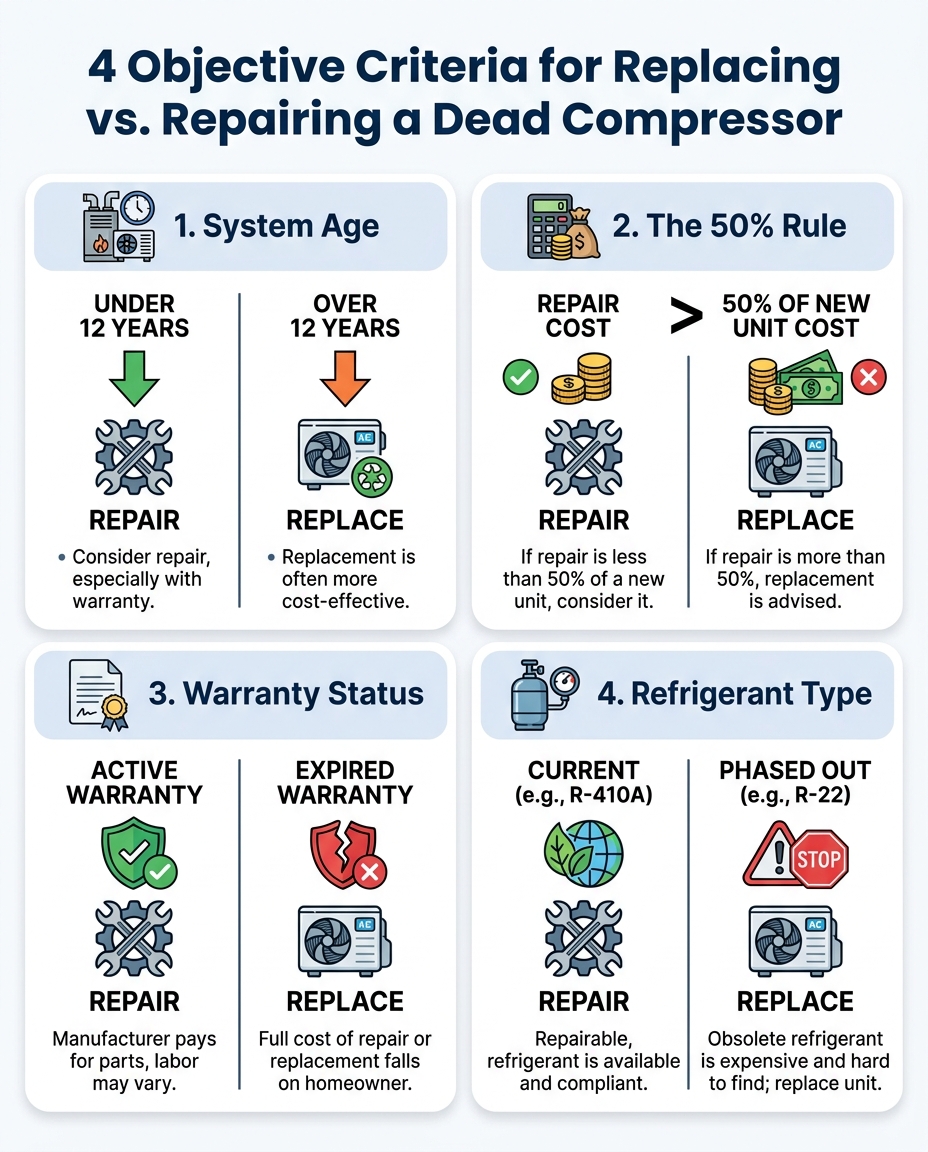
To help you synthesize these factors, we have broken down the decision into four objective criteria. Use this comparison framework to evaluate your current situation and determine the best path forward for your home's comfort. For a deeper dive into this evaluation process, you can review our comprehensive AC repair vs replace decision guide.
• Age of the Unit — Signs You Should Repair: System is under 10 years old and has a strong history of regular maintenance. — Signs You Should Replace: System is approaching or past the 10-15 year mark (e.g., a 12-year-old system).
• Cost Ratio (50% Rule) — Signs You Should Repair: The repair cost is a small fraction of the cost of a complete new system installation. — Signs You Should Replace: The repair cost exceeds 50% of the replacement value, making it a poor investment.
• Warranty Status — Signs You Should Repair: The compressor and major parts are still fully covered by the manufacturer warranty. — Signs You Should Replace: The warranty has expired, leaving you responsible for the full burden of parts and labor.
• Refrigerant Type — Signs You Should Repair: System uses current, widely available refrigerants with no phaseout restrictions. — Signs You Should Replace: System relies on phased-out, legacy refrigerants that are difficult to source and maintain.

Get Honest Advice for Your Glendora Home Today
Deciding between repair and replacement does not have to be a stressful guessing game. By relying on objective math, clear percentages, and a thorough understanding of your system's age and warranty status, you can make a confident choice that protects your home and your budget. We are committed to providing transparent, math-backed recommendations that put your best interests first.
If you are suffering through the Glendora heat with a system that refuses to turn on, do not wait for the house to get hotter. Schedule an immediate, professional diagnostic today. Our technicians will evaluate your equipment, walk you through the exact criteria discussed above, and help you restore your home's comfort quickly and reliably.
Frequently Asked Questions
Is it worth replacing a compressor on a 12-year-old AC?
In most cases, replacing a compressor on a 12-year-old AC is not a wise investment. Because the average lifespan of an air conditioner is 15 to 20 years, a 12-year-old unit is nearing the end of its functional life. Sinking a large percentage of a new system's value into an aging unit often leads to further breakdowns of other old components shortly after the repair.
What is the 50 percent rule for AC repair?
The 50 percent rule is a financial guideline used to determine if an HVAC repair is worth the cost. You calculate the ratio of the repair cost against the cost of a brand-new system. If the repair requires an investment that equals or exceeds 50 percent of the replacement value, industry standards recommend replacing the entire unit instead.
How does refrigerant type affect AC replacement?
Refrigerant type heavily impacts the long-term viability of your cooling system. Older systems often rely on phased-out refrigerants like R-22, which are no longer produced and are increasingly difficult to source. Upgrading to a new system ensures your equipment uses modern, environmentally compliant refrigerants, making future maintenance much simpler and more efficient.
Should I replace my AC or just the compressor?
If your system is relatively new and still under the manufacturer's warranty, replacing just the compressor is usually the right choice. However, if the system is over a decade old, out of warranty, and uses outdated refrigerant, replacing the entire AC unit provides better long-term reliability and significantly higher energy efficiency.
How long do AC compressors usually last in the San Gabriel Valley?
In the San Gabriel Valley, AC compressors typically last between 10 and 15 years. The intense, sustained heat of late summer forces local cooling systems to run longer, more frequent cycles. This continuous operation accelerates mechanical wear and tear, often shortening the lifespan of the compressor compared to milder climates.
Are there energy rebates available for upgrading an older AC unit?
Yes, there are often generic energy rebates, utility incentives, and federal tax credits available for homeowners who upgrade to high-efficiency cooling systems. Because these programs change frequently and vary by location, it is always best to verify current incentive eligibility with your local utility provider or a qualified tax professional before installation.
Other blogs


Customer Testimonials



CUSTOMER SERVICE!
I highly recommend this company for anyone needing AC repair or maintenance. I'll definitely be calling them again for any future needs!

I had the pleasure of experiencing outstanding service and professionalism from Ruben, and I am beyond impressed. From the moment I first contacted them, by phone and follow up communication via email for my quotes. The attention to detail and commitment to excellence were evident.
Ruben, was incredibly responsive, addressing all my inquiries promptly and with clear, thorough explanations. Their dedication to understanding and meeting my needs was remarkable.
Ruben, went above and beyond to ensure that everything was handled seamlessly, demonstrating not just professionalism, but also a sincere dedication to customer satisfaction.
I can't recommend Piggies air Conditioning/Ruben highly enough. If you're looking for someone who combines expertise with exceptional service, look no further. They are a true example of what outstanding professionalism should be.
The technician arrived on time, which I really appreciated given how crucial air conditioning is in this heat. Ruben was professional and friendly, explaining what he was doing throughout the process. The issue I had was diagnosed fairly quickly, and they provided me with a few options on how to fix it. The pricing was transparent, and I didn't feel like there were any hidden costs, which is always a plus when it comes to service calls like these. Highly recommend this company!
1st & foremost, huge shout out to Ruben thank u so so much for reaching out & making things happen SO FAST! I was so surprised since i had reached out to a couple different places who lagged on even answering calls, messages, etc.
Ruben was also very informative & taught me ALOT that i didnt know about.
Also cant leave the amazing Luis & Miles out of
this review.
They came, they saw, they conquered!
And they worked pretty swiftly too, felt very comfy around em, loved their personalities, great attitude, work ethic, professionalism, had some really good convos & they still got the job done lightning fast
SUPER HUGE SHOUT OUT & THANKS for everything guys! Definitely recommending u guys to everyone i know.
recommendations and feedback. The actual installation was painless and unremarkable, his AC experts got it done, got it cleaned and most importantly got it right. Rueben even went a step further to assure we had
protection from the coming rain, that is service unheard of these days. His price was competitive and a REAL value for the service we recieved. Using anyone else for your AC needs, would be a huge mistake. We thank them again and will recommend to everyone.
Echoing a lot of the other reviews here, Piggies Air Conditioning responds so quickly to requests (even though I actually accidentally sent in multiple requests on my side without responding, oops!)
They were able to come do a FREE energy audit and initial inspection on the same day and Ruben was amazing at explaining his thoughts on our house's situation and what he thought was worth the money and wasn't worth the money.
I truly felt like he was trying to help me find the best solution to our issues instead of just trying to upsell us on everything and anything.
I'm definitely recommending this business to anyone I know if they want a trustworthy and realistic service, value, and quality.