









Is Your AC Running Endlessly Without Cooling Your Home?
Why is my AC running constantly but not cooling the house? If you are asking this question during the intense late-summer August heat, you are already familiar with the profound frustration of a system that refuses to shut off while the indoor temperature remains uncomfortably warm. At Piggies Air Conditioning, our team fields dozens of these exact calls right as families are transitioning back to school and end-of-season cooling demands push aging systems to their breaking point. The thermostat registers 80 degrees, the vents are pushing out tepid air, and the outdoor unit is humming endlessly, driving up your energy usage without delivering any actual comfort to your living space.
The first critical decision point in this scenario is distinguishing between a simple airflow restriction that you can resolve yourself and a severe mechanical failure that requires immediate professional intervention. When a cooling system operates continuously without dropping the temperature, the central thesis is simple: the equipment has lost its ability to transfer heat out of your home. The internal components responsible for this process—specifically the evaporator coils, condenser coils, and fan motors—are either suffocated, starved, or failing under the heavy seasonal load.
To truly understand the health of your air conditioning system, you need to look past the thermostat and examine the mechanical reality of how heat is moved from inside your home to the outside air.
The Core Issue: A Complete Breakdown in Heat Transfer
Most homeowners assume that an air conditioner acts like a refrigerator with an open door, actively "creating" cold air and pumping it into the rooms. In reality, cooling systems do not create cold air at all. Instead, they operate on the principle of heat transfer. They absorb ambient heat from the indoor air and reject that heat into the outdoor atmosphere. When this continuous cycle is interrupted, the system will run endlessly in a desperate, failing attempt to reach the target temperature set on your thermostat.
If you have already read about what it means when your AC runs constantly, you know that continuous operation is a symptom of a system under severe stress. However, when that continuous running is paired with a total lack of actual cooling in your Baldwin Park home, it indicates a complete breakdown in the heat transfer cycle.
How Heat Transfer Works in a Healthy System
The indoor evaporator coil: Located inside your home (often in the attic, garage, or utility closet), the evaporator coil is filled with cold, low-pressure liquid refrigerant. As warm indoor air is blown across this coil, the refrigerant absorbs the heat from the air. The newly cooled air is then pushed back through your ductwork, while the refrigerant—now carrying the absorbed heat—travels outside.
The outdoor condenser coil: Once the heated refrigerant reaches the outdoor unit, the compressor pressurizes it, turning it into a hot gas. The condenser fan motor then pulls cooler outdoor air across the condenser coils, allowing the heat trapped inside the refrigerant to dissipate into the outside air. The refrigerant cools, turns back into a liquid, and returns indoors to repeat the cycle. If any part of this sequence is blocked, heat transfer stops, and your house stays warm regardless of how long the machinery runs.
How Accumulated Dust Impacts Your Condenser Coils
The outdoor condenser unit acts as the primary exhaust point for all the heat removed from your house. Because this unit sits outside, it is constantly exposed to the elements. Baldwin Park's intense, dry summer climate accelerates the buildup of dust, dirt, pollen, and yard debris on these outdoor coils. In our experience servicing local HVAC systems, by the time late-summer August arrives, months of accumulated grime can completely coat the delicate aluminum fins of the condenser.
When condenser coils are caked in dirt, that layer of debris acts exactly like a thick insulating blanket. Instead of allowing the heat from the refrigerant to escape into the outside air, the dirt traps the heat inside the system. The refrigerant returns to the indoor unit still carrying a heavy heat load, rendering it completely incapable of absorbing any more heat from your living space. The system continues to run, burning electricity, but the indoor temperature never drops.
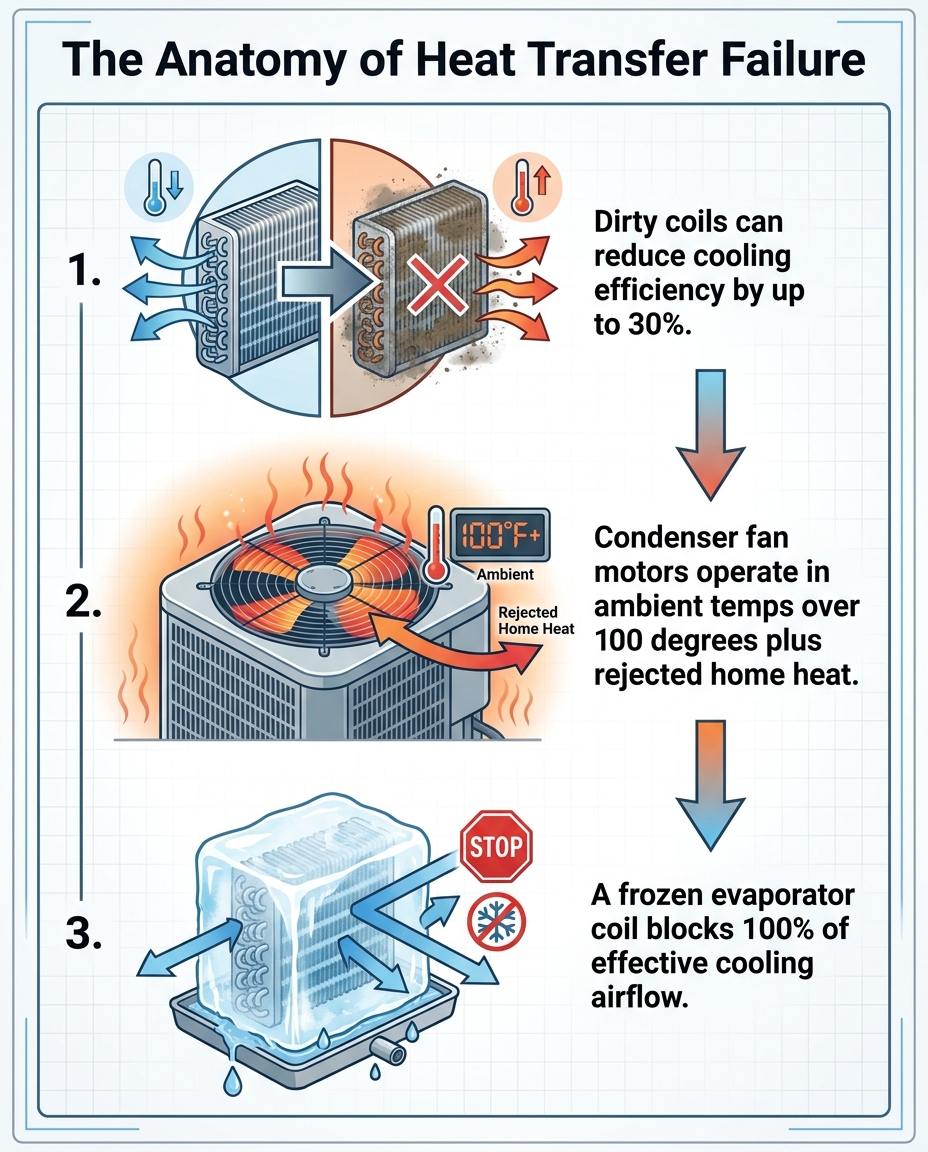
The cost of neglect: Heavily soiled coils can cause an air conditioner to lose up to 30% of its cooling efficiency. This forces the compressor to work harder and run longer, drastically increasing the risk of premature mechanical failure. Proactive care is the only reliable way to prevent this severe buildup. One local homeowner reached out to our team for help during a recent heat wave when their system struggled to cool, ultimately needing a professional to clean the coils. Our technician responded promptly, provided a clear diagnostic, and completed the cleaning timely, restoring the system's performance and proving the value of routine maintenance.
Staying ahead of this seasonal wear requires a proactive approach, which is why enrolling in a routine maintenance plan is a critical step in keeping those outdoor coils clear and functional before the late-summer heat peaks.
The Role of a Failing Condenser Fan Motor in Extreme Heat
Even if your coils are perfectly clean, heat transfer will fail instantly if the condenser fan motor stops doing its job. The condenser fan motor sits at the top of your outdoor unit, spinning the large fan blades that pull ambient air through the side grilles, across the hot coils, and out through the top of the unit.
This motor operates under immense strain. During late-summer August heat waves, it must function flawlessly in ambient temperatures exceeding 100 degrees, all while being constantly bathed in the additional 20 to 30 degrees of heat being rejected from your home. This continuous duty cycle pushes aging, heat-stressed motors to their absolute limits.
Recognizing a struggling motor: A failing condenser fan motor rarely dies quietly. It usually exhibits clear warning signs before failing completely.
• Sluggish fan blade rotation — Underlying Cause: Failing run capacitor or worn motor bearings — Impact on Cooling: Reduces airflow, causing heat to build up inside the unit.
• Loud grinding or screeching noises — Underlying Cause: Metal-on-metal friction from destroyed internal bearings — Impact on Cooling: Motor is overheating and nearing total mechanical seizure.
• Fan stops completely, unit hums — Underlying Cause: Burned out motor windings or blown capacitor — Impact on Cooling: Zero heat transfer. Compressor runs continuously in vain.
When the fan motor fails entirely, the cooling process halts immediately. The compressor will continue to run, attempting to pump refrigerant, but without the fan to dissipate the heat, the compressor will quickly overheat and shut down on a thermal overload safety switch. Repeatedly resetting the system in this state will eventually destroy the compressor entirely.
Refrigerant Leaks and the Threat of Frozen Coils
Another highly common reason for a system running continuously without cooling is a loss of refrigerant. Refrigerant is the lifeblood of the heat transfer process. Unlike gas in a car, refrigerant is never "consumed" or burned away. It operates in a closed loop. If your system is low on refrigerant, it means there is a physical leak somewhere in the copper lines, the indoor coil, or the outdoor coil.
The paradox of a frozen coil: It seems counterintuitive, but low refrigerant levels actually cause the indoor evaporator coil to become too cold. Because there is not enough refrigerant to properly absorb the heat from the indoor air, the temperature of the remaining refrigerant drops below freezing. The natural humidity in your Baldwin Park home's air then condenses on this super-chilled coil and instantly freezes into solid ice.
Once a block of ice forms over the evaporator coil, it creates an impenetrable barrier. The indoor blower motor will continue to run, trying to push air through the ductwork, but the ice blocks the airflow entirely. The result is a system that runs constantly while blowing warm or tepid air out of the vents. Handling refrigerant requires specialized gauges, recovery equipment, and professional licensing. Attempting a DIY fix on a refrigerant leak is both dangerous and illegal under environmental regulations.
Safe Troubleshooting: What to Check Before Calling a Pro
Before you schedule a service call with us for a major mechanical breakdown in late-summer August, there are a few safe, basic checks you should perform. Sometimes, what appears to be a total system failure is actually a simple airflow restriction or a thermostat error that you can resolve in minutes without risking injury or system damage.
• Verify your thermostat settings: Ensure the thermostat is explicitly set to "COOL" and the temperature is set lower than the current room temperature. Most importantly, check that the fan setting is on "AUTO" rather than "ON". If the fan is set to "ON", the indoor blower will run continuously 24/7, even when the outdoor compressor cycles off, which will cause the vents to blow warm room-temperature air.
• Inspect the indoor air filter: A severely clogged air filter is the number one cause of restricted airflow. When the filter is packed with dust and pet dander, the system cannot pull enough warm return air across the indoor coils. This mimics major mechanical failures and can even cause the coils to freeze. Pull the filter out and hold it up to a light; if you cannot see light through it, replace it immediately.
• Check for blocked vents: Walk through your home and ensure that all supply registers and return grilles are fully open and unobstructed by rugs, heavy furniture, or curtains. Closing vents in unused rooms does not save energy; it actually increases pressure inside the ductwork and starves the system of necessary airflow.
What NOT to do: Explicitly avoid opening the outdoor unit to clean internal coils with high-pressure washers, and never attempt to test electrical motors or capacitors with a multimeter unless you are a trained technician. The capacitors inside an AC unit hold a lethal electrical charge even after the power is disconnected at the breaker.
Transparent Diagnostics: How Experts Pinpoint Heat Transfer Failure
If your basic troubleshooting steps do not resolve the issue, it is time to bring in an expert. Guessing at the problem leads to wasted money, unnecessary parts replacements, and prolonged discomfort. A proper, methodical diagnosis is required to uncover the exact cause of the cooling failure.
At Piggies Air Conditioning, we believe clear communication and transparent diagnostics are essential. You deserve to know exactly what is failing and why, rather than just being handed a bill. During a hot end-of-summer weekend in Baldwin Park, our crew responded to a customer whose AC stopped cooling entirely. Our technician arrived and performed step-by-step troubleshooting to find and solve the problem, ensuring the homeowner understood the exact mechanical failure before any repairs were recommended. The AC was repaired efficiently and is now working flawlessly.
The professional diagnostic process:
1. Measuring electrical draw: Technicians use specialized multimeters to test the amperage draw on the compressor and the condenser fan motor. A motor pulling higher-than-normal amps is struggling mechanically and is on the verge of failure.
2. Testing capacitors: The technician will measure the microfarad reading of the run capacitor to ensure it is delivering the proper electrical jolt to keep the motors spinning at the correct speed.
3. Checking temperature differentials: By measuring the temperature of the air entering the return grilles versus the air exiting the supply vents, professionals can calculate the system's precise cooling capacity.
4. Evaluating refrigerant pressures: Using digital manifolds, the technician will check the superheat and subcooling levels to verify that the refrigerant charge is exact and that the heat transfer cycle is functioning efficiently.
A transparent, step-by-step diagnostic ensures you are fully informed. When you need this level of thorough testing, you can rely on our experts who serve the local service areas with integrity and precision.
Frequently Asked Questions About ACs Running Without Cooling
Why is my AC running but not lowering the temperature?
The short answer is that your system has lost its heat transfer capability. While the internal fans and motors are operating, they are no longer successfully removing heat from your indoor air. Common causes include heavily impacted outdoor coils, a failing condenser fan motor that cannot reject heat, or a severely clogged indoor air filter that restricts necessary airflow.
How do you fix an AC that is running but not cooling?
Start by checking the most accessible components: replace your indoor air filter and verify that your thermostat is set to "COOL" with the fan on "AUTO". If those basic checks do not restore the cooling power, a professional must step in. A licensed technician will need to diagnose the outdoor coils, test the fan motors, and verify the refrigerant levels to perform the necessary mechanical repairs.
Can a dirty filter cause my AC to not cool?
Yes, a heavily clogged filter severely restricts airflow, effectively choking the system. This prevents the air conditioner from pulling enough warm indoor air over the cold evaporator coils to cool the home. Without adequate airflow, the system runs continuously without making an impact, and the indoor coils may eventually freeze solid.
Why is my AC blowing warm air?
Warm air blowing from your vents indicates that the heat transfer process has completely stalled. This usually means the outdoor compressor isn't running, the outdoor condenser coils are too dirty to reject heat, or the system is dangerously low on refrigerant. It can also happen if your thermostat fan setting is accidentally switched to "ON" instead of "AUTO".
How does a dirty condenser coil affect AC cooling?
Dirt acts as an insulating blanket over the delicate aluminum fins of the condenser coil, trapping heat inside the system. When the hot refrigerant cannot release its heat into the outdoor air, it returns indoors still hot, making it impossible to absorb more heat from your living space. This forces the system to run constantly without successfully lowering the indoor temperature.
Restore Your Home's Comfort Before the Heat Peaks
Allowing your air conditioner to run endlessly without cooling the house is a recipe for disaster, especially during the punishing late-summer August heat. Continuous operation under these strained conditions will inevitably lead to a complete compressor breakdown, turning a manageable repair into a catastrophic system failure.
Do not wait for the system to shut down entirely. Transparent diagnostics will uncover the exact cause of your cooling failure, whether it is a suffocated coil, a dying fan motor, or a hidden refrigerant leak. Reach out to our team for professional AC repair services to get a clear, technical, and accessible explanation of the problem, ensuring your home is restored to full comfort quickly and safely.
Other blogs


Customer Testimonials



CUSTOMER SERVICE!
I highly recommend this company for anyone needing AC repair or maintenance. I'll definitely be calling them again for any future needs!

I had the pleasure of experiencing outstanding service and professionalism from Ruben, and I am beyond impressed. From the moment I first contacted them, by phone and follow up communication via email for my quotes. The attention to detail and commitment to excellence were evident.
Ruben, was incredibly responsive, addressing all my inquiries promptly and with clear, thorough explanations. Their dedication to understanding and meeting my needs was remarkable.
Ruben, went above and beyond to ensure that everything was handled seamlessly, demonstrating not just professionalism, but also a sincere dedication to customer satisfaction.
I can't recommend Piggies air Conditioning/Ruben highly enough. If you're looking for someone who combines expertise with exceptional service, look no further. They are a true example of what outstanding professionalism should be.
The technician arrived on time, which I really appreciated given how crucial air conditioning is in this heat. Ruben was professional and friendly, explaining what he was doing throughout the process. The issue I had was diagnosed fairly quickly, and they provided me with a few options on how to fix it. The pricing was transparent, and I didn't feel like there were any hidden costs, which is always a plus when it comes to service calls like these. Highly recommend this company!
1st & foremost, huge shout out to Ruben thank u so so much for reaching out & making things happen SO FAST! I was so surprised since i had reached out to a couple different places who lagged on even answering calls, messages, etc.
Ruben was also very informative & taught me ALOT that i didnt know about.
Also cant leave the amazing Luis & Miles out of
this review.
They came, they saw, they conquered!
And they worked pretty swiftly too, felt very comfy around em, loved their personalities, great attitude, work ethic, professionalism, had some really good convos & they still got the job done lightning fast
SUPER HUGE SHOUT OUT & THANKS for everything guys! Definitely recommending u guys to everyone i know.
recommendations and feedback. The actual installation was painless and unremarkable, his AC experts got it done, got it cleaned and most importantly got it right. Rueben even went a step further to assure we had
protection from the coming rain, that is service unheard of these days. His price was competitive and a REAL value for the service we recieved. Using anyone else for your AC needs, would be a huge mistake. We thank them again and will recommend to everyone.
Echoing a lot of the other reviews here, Piggies Air Conditioning responds so quickly to requests (even though I actually accidentally sent in multiple requests on my side without responding, oops!)
They were able to come do a FREE energy audit and initial inspection on the same day and Ruben was amazing at explaining his thoughts on our house's situation and what he thought was worth the money and wasn't worth the money.
I truly felt like he was trying to help me find the best solution to our issues instead of just trying to upsell us on everything and anything.
I'm definitely recommending this business to anyone I know if they want a trustworthy and realistic service, value, and quality.