





Is That Burning Smell During Your First Fall Heater Startup Normal?
Are you wondering why your house suddenly smells like a dusty radiator the moment you turn on the furnace? You are not alone—in fact, this is one of the most common homeowner questions answered by our team at Piggies Air Conditioning during a chilly October heating-startup. You wait all year for the weather to finally cool down, you switch your thermostat from cool to heat, and within minutes, an alarming burning odor fills your living room. It is a stressful moment that forces an immediate decision: do you wait it out, or do you shut the system down before something catches fire?
The short answer is that a brief burning smell during the first few uses of the season is usually completely normal. However, knowing the difference between harmless settling dust and a dangerous electrical failure is critical for your home's safety. If you are concerned about how your heating and air conditioning systems are performing as the seasons change, understanding what these odors mean is your first step toward peace of mind. As we move deeper into the fall season, we also have to look at how upcoming industry changes—like the new refrigerant regulations—might impact your decisions if that burning smell turns out to be a major mechanical failure rather than just burning dust.
Why Baldwin Park's Climate Causes Heavy Dust Burn-Off
To understand why your heater smells so strongly when you first turn it on, you have to look at the unique environment we live in. Having serviced homes throughout Baldwin Park CA for years, our technicians know firsthand that our Mediterranean climate dictates a very specific pattern of HVAC usage. Unlike homeowners in the Midwest or Northeast who might run their heaters for half the year, Southern California residents typically rely heavily on their air conditioning through the intense summer heat and well into the early fall. This means the heating components of your system sit completely dormant for eight to nine consecutive months.
During this long period of inactivity, several environmental factors combine to create the perfect conditions for a heavy dust burn-off:
1. The Long Dormancy Period: While your air conditioner is running constantly to battle the summer heat, the heat exchanger (the metal component that actually gets hot to warm your air) is sitting cold and unused in the dark cabinet of your furnace. Over eight or nine months, airborne particles naturally settle on this surface.
2. The Santa Ana Wind Factor: Late summer and early fall in our region are notorious for dry, dusty Santa Ana winds. These winds drastically increase the amount of airborne particulates inside your home. Even with a good air filter, microscopic dust, pet dander, and lint will inevitably find their way into the ductwork and settle onto the dormant heating components.
3. The Ignition and Burn-Off: When that chilly October evening finally arrives and you activate the heater, the heat exchanger rapidly heats up to temperatures exceeding 140 degrees Fahrenheit. All of that accumulated dust and debris literally bakes and burns off the metal surface. The blower motor then pushes that scorched-dust air directly into your living spaces.
Because our heating systems sit unused for so much longer than those in colder climates, the layer of dust is thicker, and the resulting burn-off smell is often much more pronounced. This specific type of odor is a normal, expected byproduct of our region's long, intense cooling season.
How to Tell Harmless Dust from Dangerous Electrical Odors
While a dusty odor is normal, your HVAC system relies on high-voltage electrical components and powerful motors to operate. When these parts begin to fail, they emit distinct, dangerous smells that should never be ignored. Distinguishing between a routine October heating-startup quirk and a hazardous mechanical failure comes down to recognizing the specific type of odor and timing how long it lasts.
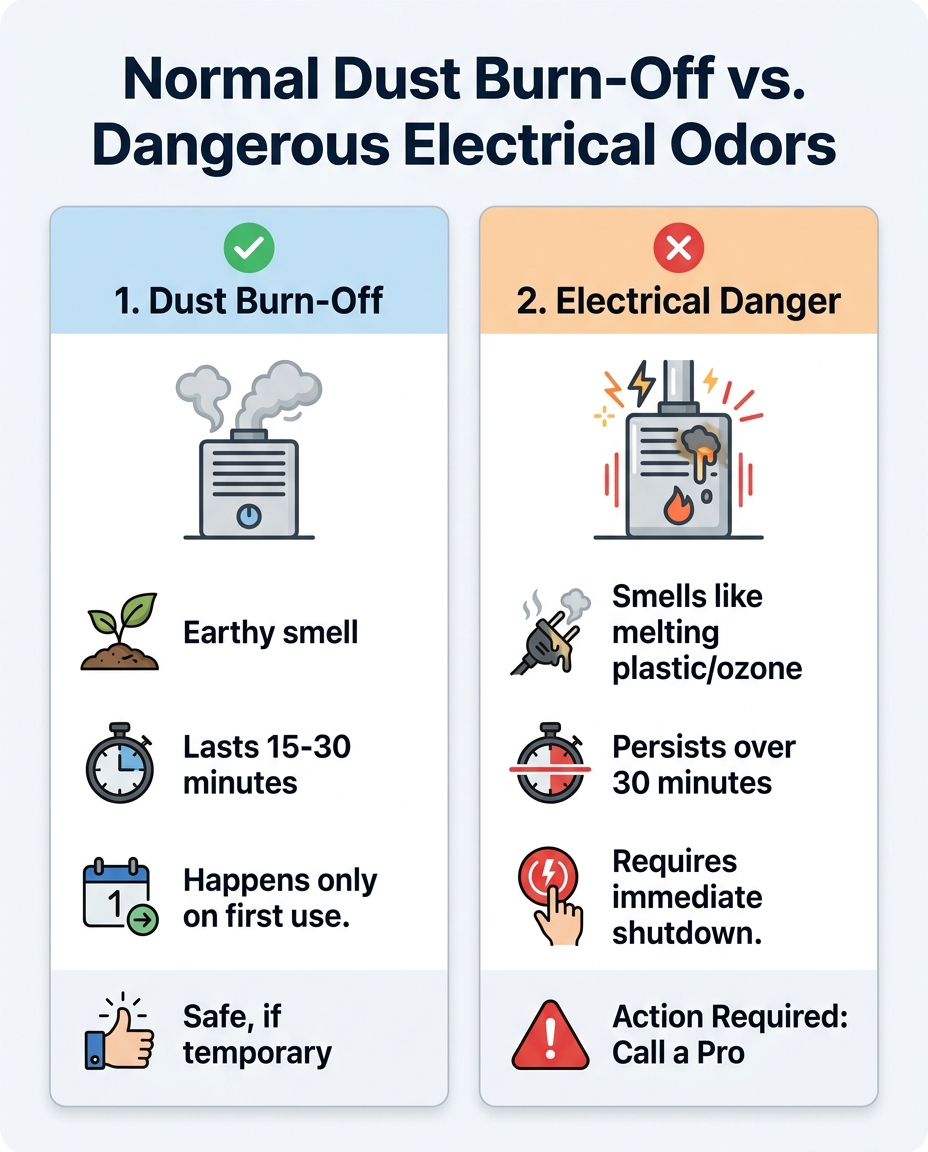
Normal Dust Burn-Off Characteristics
• The Scent Profile: It smells earthy, like a hot, dusty radiator, or slightly like singed lint. It does not smell chemical or toxic.
• The Timeline: The smell should begin to fade within 15 to 30 minutes of continuous operation.
• The Frequency: This should only happen during the first one or two times you run the heater for the season. If it happens every time you turn the heater on in December, you have a different problem.
Dangerous Odors to Watch For
• The Scent Profile: Acrid, harsh chemical smells. If you smell melting plastic, burning rubber, or the distinct metallic scent of electrical ozone, your system is experiencing a failure.
• The Timeline: The odor persists or actively worsens after 30 minutes of operation.
• The Symptoms: The smell is accompanied by loud grinding noises, screeching, or the system rapidly turning itself on and off (short-cycling).
The quick fix: If you detect any of the dangerous odors listed above, walk to your thermostat immediately and switch the system to the "Off" position. Do not wait to see if it improves.
• Earthy, dusty, singed lint — Likely Cause: Normal dust settling on the heat exchanger — Expected Duration: 15 to 30 minutes — Required Action: Monitor safely; no action needed
• Melting plastic or burning rubber — Likely Cause: Failing capacitor, melting wire insulation — Expected Duration: Persists and worsens — Required Action: Shut down system immediately
• Electrical ozone or metallic burning — Likely Cause: Overheating blower motor or electrical short — Expected Duration: Persists and worsens — Required Action: Shut down system immediately
• Musty, dirty sock smell — Likely Cause: Bacterial growth on the evaporator coil — Expected Duration: Constant when running — Required Action: Schedule professional maintenance
When a Burning Smell Means It's Time to Evaluate Your Aging System
If you have ruled out harmless dust and determined that your system is emitting an electrical or chemical burning smell, you are likely dealing with a failing component. In our experience responding to fall maintenance calls, a burning smell that lasts longer than an hour or smells distinctly of melting plastic requires a professional diagnosis. Often, this points directly to a failing blower motor, a burnt-out capacitor, or compromised wiring.
It is important to understand the transition your equipment goes through during this time of year. The blower motor inside your furnace or air handler works year-round. It pushes cold air through your vents all summer, and it pushes warm air through your vents all winter. If you spent the hot months trying to figure out why your AC is running constantly, that same overworked blower motor is now being asked to carry the load for your heating-startup. The stress of a long, brutal summer often reveals itself as a burned-out motor during the first chilly week of fall.
Ignoring an electrical burning smell can lead to catastrophic system failure. A failing motor that is left to overheat can melt surrounding wire insulation, short out your control board, or cause irreversible damage to the heat exchanger. Catching these warning signs early is the difference between a targeted repair and being forced into a complete system replacement.
Understanding the Upcoming 410A Phase Out Date
If your older system experiences a major failure this fall, you need to be aware of a massive shift happening in the HVAC industry before you decide how to proceed. The refrigerant that has powered most residential air conditioners and heat pumps for the last two decades, known as R-410A, is being phased out nationwide. Understanding this transition is crucial for any homeowner facing significant equipment repairs in Baldwin Park CA.
What Exactly is the 410A Phase-Out?
R-410A is a hydrofluorocarbon (HFC) refrigerant. While it was a massive environmental improvement over the older Freon (R-22) it replaced, R-410A still has a high Global Warming Potential (GWP). Under federal regulations aimed at reducing greenhouse gas emissions, the manufacturing of new HVAC systems that use R-410A is ending. The industry is shifting toward newer, more environmentally friendly refrigerants, primarily R-454B and R-32, which have significantly lower global warming impacts.
Does This Mean My Current System is Obsolete?
No, your current R-410A system is not illegal to own, operate, or repair. The phase-out targets the manufacturing of new equipment, not the continued use of existing units. If your system is running perfectly fine, or if it just needs routine maintenance like a new capacitor or a blower motor replacement, the phase-out date does not immediately affect you. Routine maintenance does not require replacing the refrigerant unless there is a physical leak in the copper lines or coils.
How Will This Affect Future Repairs?
While you can still use your current system, the phase-out will gradually impact the cost of specific repairs. Because the production of R-410A refrigerant is being drastically reduced over the coming years, the supply will shrink. As supply shrinks, the cost of the chemical itself will rise. If your aging heat pump develops a severe refrigerant leak three years from now, recharging that older system with R-410A will become increasingly expensive. This changing economic landscape is a major factor to consider if your current system is already showing signs of failure.
Repair vs. Replace: Navigating Fall Upgrades Without the Pressure
When you combine a major component failure—signaled by a dangerous burning smell during your October heating-startup—with the reality of the 410A phase-out, the math behind repairing versus replacing your system begins to shift. Making this decision should never involve pushy sales tactics or fear-mongering. It requires transparent, honest guidance that empowers you to weigh the costs objectively.
For example, our team at Piggies Air Conditioning helped a local customer last fall who reached out when they realized they needed a new AC installation and wanted their old, failing unit removed before the cold weather fully set in. We provided a clear assessment, installed the new system, and removed the old unit within one single day, ensuring a smooth transition without unnecessary pressure or hidden surprises.
When to Repair Your Current System
Repairing makes the most financial sense under a few specific conditions. If your system is less than 10 years old, it likely has plenty of reliable life left in it. If the burning smell was caused by a minor, inexpensive electrical fix—like a dusty sequencer or a single frayed wire—a repair is the logical choice. Furthermore, if your system has a strong track record and no history of refrigerant leaks, keeping your current R-410A unit running is perfectly safe and economical.
When to Consider a System Replacement
On the other hand, if your system is over 10 to 12 years old and uses R-410A, a major breakdown changes the equation. If that burning smell indicates a seized compressor or a cracked heat exchanger, sinking thousands of dollars into an obsolete unit is rarely a good investment. Upgrading to a modern system allows you to bypass the rising costs of older refrigerants and take advantage of newer, high-efficiency technology. In many cases, generic energy rebates and federal tax credits may be available for qualifying high-efficiency upgrades, helping to offset the initial investment of a professional AC replacement. Always verify current incentive programs with your utility provider or a tax professional to see what generic rebates apply to your home.
Frequently Asked Questions About Fall Heating Startups and Refrigerant Changes
Whether you are troubleshooting a strange odor during your October heating-startup or considering a heat pump installation to stay ahead of the new regulations, having accurate information is critical. Here are direct answers from our experienced technicians to the most common questions we receive during the fall transition.
How long should the burning dust smell last after turning on the heater?
A normal dust burn-off smell should begin to fade within 15 to 30 minutes of continuous operation. The odor is caused by microscopic particles baking off the heat exchanger, and once that layer is gone, the smell will disappear. If the odor persists for more than an hour, or if it returns every time the heater cycles on, you should turn the system off and have it inspected.
What does an electrical issue in a furnace smell like?
An electrical issue typically smells like melting plastic, burning rubber, or a sharp, metallic ozone scent. Unlike the earthy smell of burning dust, an electrical fire or melting wire insulation produces an acrid, harsh chemical odor that is immediately alarming. This scent will usually grow stronger the longer the system runs.
Should I turn off my heater if it smells like burning?
If the smell is dusty and fades quickly, you can safely let it run. However, if the smell is chemical, metallic, or resembles melting plastic, you should turn the heater off immediately at the thermostat. Continuing to run a system with failing electrical components can cause severe damage to the unit and poses a significant safety risk to your home.
Why does my heater smell like burning when I first turn it on?
Your heater smells like burning because dust, pet dander, and lint have settled on the internal heating components during the long months it sat dormant over the summer. When the heat exchanger rapidly warms up during the first use of the fall, it literally incinerates this thin layer of debris. The blower motor then pushes that singed-dust smell through your air vents.
Does the 410A phase out date affect my natural gas furnace?
No, the R-410A phase-out strictly applies to the refrigerant used in air conditioners and heat pumps. Natural gas furnaces do not use refrigerant to generate heat; they use combustion. However, if you have a split system where your furnace shares an indoor coil and blower motor with an older air conditioner, you will eventually need to consider the phase-out when replacing the cooling side of the system.
Are heat pumps impacted by the R-410A refrigerant changes?
Yes, heat pumps are heavily impacted by the phase-out because they use refrigerant to both heat and cool your home. All new heat pumps manufactured after the regulatory cutoff will utilize the new, lower-GWP refrigerants like R-454B or R-32. If you have an existing R-410A heat pump, it can still be serviced, but major refrigerant repairs will become more expensive over time as supplies decrease.
Enjoy Peace of Mind with Safe, Reliable Heating This Fall
Navigating the transition from cooling to heating doesn't have to be a stressful experience. The key takeaway is simple: a brief, dusty smell during your first fall startup is a normal part of living in Baldwin Park CA, but persistent chemical or electrical odors require immediate action. By understanding how your system operates and staying informed about industry shifts like the 410A phase-out, you are perfectly positioned to make smarter, long-term decisions for your home. If you are ever unsure about a strange noise, a lingering smell, or the overall efficiency of your aging system, reaching out to our team for an objective, professional evaluation is the best way to ensure your family stays safe and comfortable all season long.
Other blogs


Customer Testimonials



CUSTOMER SERVICE!
I highly recommend this company for anyone needing AC repair or maintenance. I'll definitely be calling them again for any future needs!

I had the pleasure of experiencing outstanding service and professionalism from Ruben, and I am beyond impressed. From the moment I first contacted them, by phone and follow up communication via email for my quotes. The attention to detail and commitment to excellence were evident.
Ruben, was incredibly responsive, addressing all my inquiries promptly and with clear, thorough explanations. Their dedication to understanding and meeting my needs was remarkable.
Ruben, went above and beyond to ensure that everything was handled seamlessly, demonstrating not just professionalism, but also a sincere dedication to customer satisfaction.
I can't recommend Piggies air Conditioning/Ruben highly enough. If you're looking for someone who combines expertise with exceptional service, look no further. They are a true example of what outstanding professionalism should be.
The technician arrived on time, which I really appreciated given how crucial air conditioning is in this heat. Ruben was professional and friendly, explaining what he was doing throughout the process. The issue I had was diagnosed fairly quickly, and they provided me with a few options on how to fix it. The pricing was transparent, and I didn't feel like there were any hidden costs, which is always a plus when it comes to service calls like these. Highly recommend this company!
1st & foremost, huge shout out to Ruben thank u so so much for reaching out & making things happen SO FAST! I was so surprised since i had reached out to a couple different places who lagged on even answering calls, messages, etc.
Ruben was also very informative & taught me ALOT that i didnt know about.
Also cant leave the amazing Luis & Miles out of
this review.
They came, they saw, they conquered!
And they worked pretty swiftly too, felt very comfy around em, loved their personalities, great attitude, work ethic, professionalism, had some really good convos & they still got the job done lightning fast
SUPER HUGE SHOUT OUT & THANKS for everything guys! Definitely recommending u guys to everyone i know.
recommendations and feedback. The actual installation was painless and unremarkable, his AC experts got it done, got it cleaned and most importantly got it right. Rueben even went a step further to assure we had
protection from the coming rain, that is service unheard of these days. His price was competitive and a REAL value for the service we recieved. Using anyone else for your AC needs, would be a huge mistake. We thank them again and will recommend to everyone.
Echoing a lot of the other reviews here, Piggies Air Conditioning responds so quickly to requests (even though I actually accidentally sent in multiple requests on my side without responding, oops!)
They were able to come do a FREE energy audit and initial inspection on the same day and Ruben was amazing at explaining his thoughts on our house's situation and what he thought was worth the money and wasn't worth the money.
I truly felt like he was trying to help me find the best solution to our issues instead of just trying to upsell us on everything and anything.
I'm definitely recommending this business to anyone I know if they want a trustworthy and realistic service, value, and quality.