










Is That Burning Smell Normal When Starting Your Heater?
Are you wondering why your heater smells like burning dust when you turn it on for the first time? If you just switched your thermostat from cooling to heating and were immediately met with a startling, earthy odor spreading through your vents, you are not alone. That sudden burning smell often causes immediate anxiety for homeowners during the September pre-heating season. The immediate decision point is figuring out whether this is a normal, temporary seasonal burn-off or a dangerous electrical failure that puts your home at risk. While it is alarming, a temporary dust burn-off is a completely standard part of the transition into cooler weather.
To ensure your system is operating safely and efficiently, it is always wise to learn more about how your heating systems function and know exactly when to call for a professional heating service.
Let's break down exactly what happens inside your HVAC equipment when the seasons change. When a heating system sits dormant for months, the right next step is not to panic, but rather to observe and diagnose the situation calmly. By understanding the distinct differences between harmless household dust incinerating and the acrid stench of melting wire insulation, you can make safe, confident decisions for your household. This guide provides a calm, diagnostic breakdown of HVAC odors so you know exactly what is happening behind the vents and when it is time to shut the system down.
Why Dust Accumulates During the Long Southern California Summer
In a typical Mediterranean climate like we experience around Baldwin Park, heating systems sit completely dormant for six to eight months out of the year. Our long, hot, and dry summers maximize the amount of uninterrupted dust buildup compared to regions with shorter, milder cooling seasons. During these extended stretches of warm weather, your furnace is essentially a resting giant. Even if you run your air conditioning daily, the specific components responsible for generating heat remain entirely inactive, turning them into a prime landing pad for airborne debris.
Understanding the physics of this dust accumulation helps explain the intense odor. When your furnace finally kicks on, the internal metal components heat up incredibly fast. The heat exchanger reaches temperatures well above the combustion point of standard household dust. When that settled debris meets the hot metal, it literally incinerates in a matter of seconds. The resulting odor is this accumulated debris burning off, which produces a distinct, earthy, or "toast-like" smell that the blower motor then distributes throughout your home.
The Anatomy of a Dormant Furnace
To understand why this happens, it helps to look at how internal components act as dust traps when the heating cycle isn't actively running. Even with a meticulously clean home and regular vacuuming, microscopic particles inevitably find their way into the ductwork and the main unit housing. The continuous circulation of indoor air guarantees that fine particulates will eventually settle on the cold metal surfaces of the heat exchanger.
Common particles that settle on your heat exchanger include:
• Pet dander and hair: Microscopic skin flakes from dogs and cats easily bypass standard, low-quality filters when the system is off and settle deep inside the cabinet.
• Pollen and outdoor allergens: Summer breezes carry fine particulates inside, which eventually find their way into the return vents.
• Household lint: Fibers from clothing, carpets, and upholstery constantly circulate in the air and land inside the furnace.
• Dead skin cells: A major component of everyday household dust that builds up over the long Baldwin Park summer months.
When the system is off, there is no thermal upward draft to push these particles away. They simply rest on the metal until the first cold snap arrives and the burners ignite.
The 15 to 30 Minute Rule for Normal Burn-Off
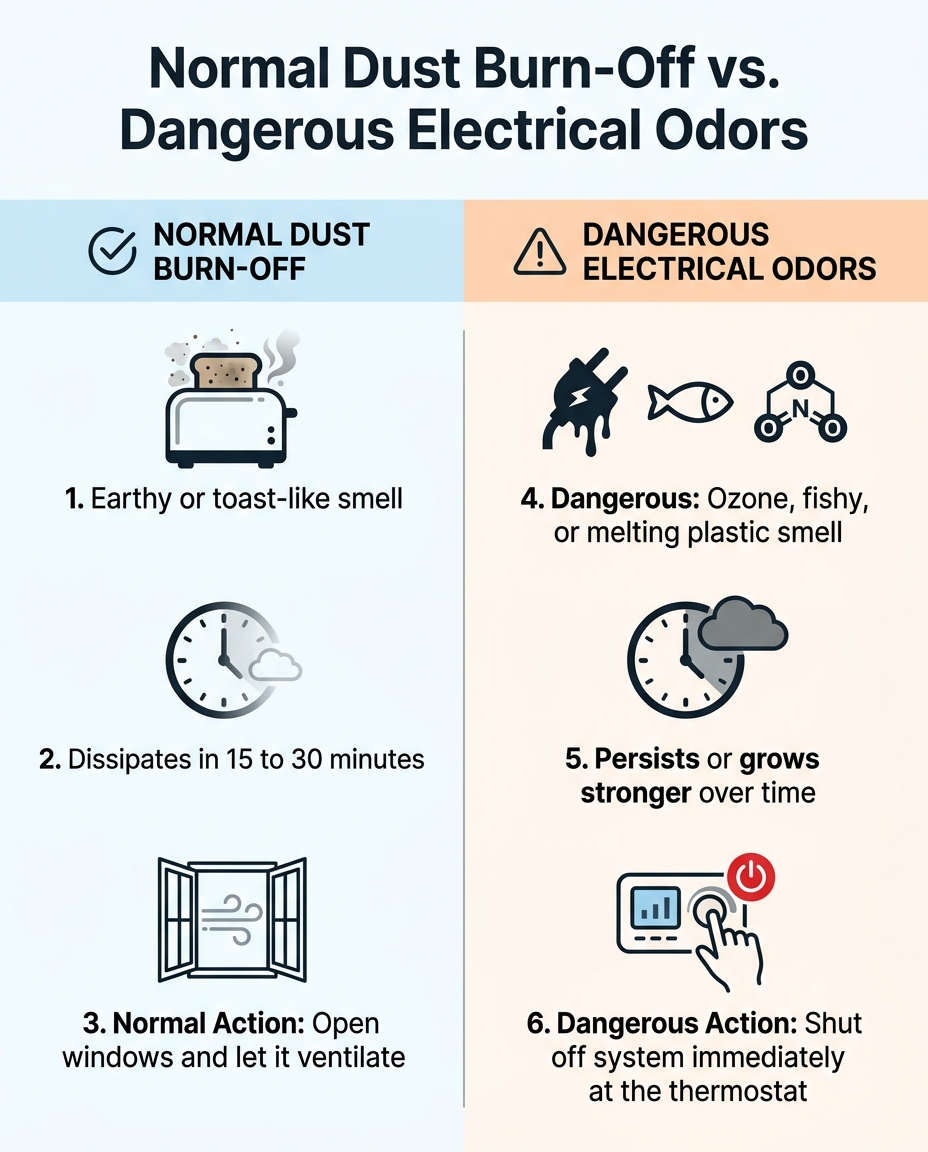
If you are testing your system during the September pre-heating season, you need a reliable way to gauge whether the odor is harmless. The most critical metric for diagnosing a furnace smell is time. Normal dust burn-off typically dissipates within 15 to 30 minutes of the first startup. Because the volume of dust is usually limited to a very thin microscopic layer, it simply does not take very long for the high temperatures to completely incinerate it.
Follow these steps to monitor the burn-off process safely:
1. Turn on the system and observe: When you initiate the first heating cycle of the season, stay near the vents. Note the exact time the earthy smell begins to flow into the room.
2. Open a few windows: Allow the harmless, though unpleasant, odor to ventilate outside. Cross-ventilation helps clear the air rapidly and prevents the smell from lingering in your upholstery or curtains.
3. Monitor the intensity: The smell should steadily decrease in intensity during this 15 to 30-minute window. As the settled dust finishes incinerating off the metal components, the air blowing from the vents should gradually smell cleaner and more neutral.
4. Enforce the time limit: Establish a firm rule for your household. If the smell persists beyond 30 minutes, or if it grows stronger instead of fading, it crosses the line from normal to abnormal. At this point, you are no longer smelling surface dust.
The heat exchanger reaches its maximum operating temperature within just a few minutes of the burners igniting. Therefore, the burn-off process is rapid. If the odor continues to pump through your vents after half an hour, it means something other than surface dust is actively burning, and you must take immediate action.
Dangerous Odors: When to Shut Down the System Immediately
While a dusty, toast-like smell is normal, other odors are massive red flags. Heating equipment is a leading cause of home fires, making it critical to never ignore a severe electrical burning smell. You must clearly delineate between harmless dust and dangerous electrical or component failure smells to prioritize your family's safety.
Dangerous smells have very specific olfactory profiles. If you smell ozone (which smells like a harsh, metallic thunderstorm), fishy odors, or the distinct scent of melting plastic, you have a serious problem. These smells indicate burning wire insulation, failing electrical components, or a severely overheated blower motor. If you detect these specific odors in your Baldwin Park home, immediately turn off the heating system at the thermostat. Do not wait to see if it improves, and do not attempt to open the furnace cabinet yourself.
Identifying Electrical Fire Hazards
The sharp, acrid nature of electrical fires is vastly different from the dull, earthy smell of dust. When wire insulation melts, it releases harsh chemicals into the air that can sting your eyes or throat. DIY electrical diagnostics are highly dangerous, and a qualified technician must inspect the system if these odors are present. This is exactly when you need to call for a professional heating service.
• Earthy, dusty, or like burnt toast — Likely Source: Household dust on the heat exchanger — Duration: Fades within 15 to 30 minutes — Required Action: Open windows and let it ventilate normally.
• Harsh, metallic ozone — Likely Source: Overheating blower motor or sparking wires — Duration: Persists or worsens over time — Required Action: Shut off at thermostat immediately. Call a pro.
• Melting plastic or burning rubber — Likely Source: Failing capacitor, melting wire insulation — Duration: Persists and smells highly toxic — Required Action: Shut off at thermostat immediately. Call a pro.
• Fishy or urine-like smell — Likely Source: Overheating electrical components/circuit boards — Duration: Persists and grows stronger — Required Action: Shut off at thermostat immediately. Call a pro.

How Clogged Air Filters Contribute to Furnace Smells
While the initial dust burn-off is normal, persistent low-grade odors are often tied directly to routine maintenance habits. Specifically, a clogged or dirty air filter plays a massive role in how your furnace smells and operates. When an air filter is saturated with months of summer dust, it severely restricts the airflow entering the system.
Because the furnace relies on a steady volume of cool return air to keep its internal components from overheating, a restricted filter causes the system to run much hotter than intended. Excessive heat exacerbates burning smells and puts undue strain on the heat exchanger. The metal expands further than it should, and any dust present burns much more aggressively, creating a stronger, harsher odor during the September pre-heating season.
The cascading effects of a clogged filter include:
• Stressed blower motors: When the motor has to fight to pull air through a wall of dirt, it overheats, which can eventually create the dangerous electrical burning smells discussed earlier.
• Short-cycling: The furnace gets so hot that the internal safety limit switch trips, shutting the system down prematurely before your home reaches the target temperature.
• Increased energy consumption: A struggling system draws more power, stressing electrical relays and wiring while driving up your monthly utility costs.
• Poor indoor air quality: A saturated filter can no longer trap the very dust that is causing the burning smell, meaning those particles continue to circulate through your living spaces.
Replacing the air filter before the first startup of the season is the easiest way to minimize odors, improve indoor air quality, and ensure proper airflow. This simple step highlights the importance of ongoing seasonal care, such as scheduling routine HVAC maintenance to keep the system running efficiently year-round.
Upgrading Aging Equipment to Prevent Chronic Issues
If your heating system consistently produces unpleasant smells every time it runs, or if the odors persist well past the 30-minute mark despite a clean filter, you may be dealing with failing equipment. Older furnaces naturally degrade over time. Persistent smells can be caused by cracked heat exchangers, failing internal electrical components, or a blower motor that is on its last legs. A cracked heat exchanger is particularly dangerous because it can allow carbon monoxide to mix with your breathing air.
When an older system becomes a chronic source of anxiety, it is often time to bridge the gap from constant troubleshooting to modern HVAC solutions. Upgrading provides absolute peace of mind and significantly better year-round climate control for your Baldwin Park home. Modernizing the system also comes with educational guidance from technicians to ensure you fully understand how to operate and maintain your new equipment safely.
One winter, a local homeowner reached out needing significant upgrades and detailed information about their aging, problematic HVAC system. The attending technician provided the exact information needed, carefully explained the available upgrades, and took the time to teach the customer about how their new system would operate. The outcome was a homeowner who gained valuable knowledge and felt completely comfortable with the modernization process.
Exploring Modern Heat Pump Solutions
Modern heat pumps serve as a safer, highly efficient alternative that eliminates many of the risks associated with older gas combustion furnaces. Because heat pumps use electricity to transfer heat rather than burning fossil fuels, they do not have a traditional combustion chamber or gas-fired heat exchanger. This removes the risk of carbon monoxide leaks entirely. Furthermore, heat pumps offer dual-functionality, providing both powerful cooling in the summer and efficient heating in the winter from a single unit. Keeping these advanced systems in top condition requires specialized heat pump maintenance, ensuring they operate safely and efficiently for years to come.
Frequently Asked Questions About Furnace Odors
During the September pre-heating season, homeowners frequently search for answers when their vents start emitting strange smells. If you are considering replacing your furnace with a heat pump to avoid these issues entirely, or simply want to know if your current system is safe, review these common questions.
Is it normal for a heater to smell like burning?
Yes, it is entirely normal during the first use of the season. As the system sits unused for months, household dust settles on the heat exchanger. When the furnace turns on, the extreme heat incinerates this dust, causing a temporary burning smell.
How long does a heater smell like burning?
The normal dust burn-off odor should last no longer than 15 to 30 minutes after the initial startup. If you open a few windows, the smell will clear out of your home very quickly. If it lasts longer than half an hour, it requires investigation.
Can a burning smell from a heater cause a fire?
While burning dust is harmless and will not cause a fire, other smells are highly dangerous. Smells resembling melting plastic, harsh ozone, or fishy electrical odors indicate severe component failure that can absolutely lead to an electrical fire.
What does a bad furnace smell like?
A failing furnace often emits sharp, acrid smells rather than dull, dusty ones. You might notice the scent of burning wire insulation, fishy electrical odors, or the harsh chemical smell of formaldehyde and melting plastic.
Should I turn off my heater if it smells like burning?
If the smell is simply dusty and fades within 30 minutes, you can leave it running. However, if the smell persists past 30 minutes, or if it smells like electrical ozone rather than dusty toast, shut the system off at the thermostat immediately.
Why does my heater smell like ozone?
An ozone smell typically indicates an overheated blower motor or sparking electrical wires inside the cabinet. This is a serious electrical hazard requiring immediate professional attention, and the system should not be operated until it is inspected.
Ensure Your Home's Safety with a Professional Heating Inspection
While a brief dust burn-off is a completely normal part of preparing your home for cooler weather, persistent or acrid smells should never be ignored. Your family's safety relies on heating equipment that operates exactly as designed, without stressing electrical components or risking a cracked heat exchanger. The long Baldwin Park summers guarantee that your system will need a moment to clear its throat, but it should never leave your home smelling like an electrical hazard.
If you are ever in doubt about an odor coming from your vents, the safest route is a thorough, professional inspection to rule out dangerous mechanical or electrical failures. Piggies Air Conditioning maintains a core focus on customer safety, providing absolute peace of mind through rigorous, diagnostic heating inspections. Do not wait for a strange smell to turn into a mid-winter breakdown; schedule a comprehensive evaluation today to guarantee your system is safe, clean, and fully ready for the colder months ahead.
Other blogs


Customer Testimonials



CUSTOMER SERVICE!
I highly recommend this company for anyone needing AC repair or maintenance. I'll definitely be calling them again for any future needs!

I had the pleasure of experiencing outstanding service and professionalism from Ruben, and I am beyond impressed. From the moment I first contacted them, by phone and follow up communication via email for my quotes. The attention to detail and commitment to excellence were evident.
Ruben, was incredibly responsive, addressing all my inquiries promptly and with clear, thorough explanations. Their dedication to understanding and meeting my needs was remarkable.
Ruben, went above and beyond to ensure that everything was handled seamlessly, demonstrating not just professionalism, but also a sincere dedication to customer satisfaction.
I can't recommend Piggies air Conditioning/Ruben highly enough. If you're looking for someone who combines expertise with exceptional service, look no further. They are a true example of what outstanding professionalism should be.
The technician arrived on time, which I really appreciated given how crucial air conditioning is in this heat. Ruben was professional and friendly, explaining what he was doing throughout the process. The issue I had was diagnosed fairly quickly, and they provided me with a few options on how to fix it. The pricing was transparent, and I didn't feel like there were any hidden costs, which is always a plus when it comes to service calls like these. Highly recommend this company!
1st & foremost, huge shout out to Ruben thank u so so much for reaching out & making things happen SO FAST! I was so surprised since i had reached out to a couple different places who lagged on even answering calls, messages, etc.
Ruben was also very informative & taught me ALOT that i didnt know about.
Also cant leave the amazing Luis & Miles out of
this review.
They came, they saw, they conquered!
And they worked pretty swiftly too, felt very comfy around em, loved their personalities, great attitude, work ethic, professionalism, had some really good convos & they still got the job done lightning fast
SUPER HUGE SHOUT OUT & THANKS for everything guys! Definitely recommending u guys to everyone i know.
recommendations and feedback. The actual installation was painless and unremarkable, his AC experts got it done, got it cleaned and most importantly got it right. Rueben even went a step further to assure we had
protection from the coming rain, that is service unheard of these days. His price was competitive and a REAL value for the service we recieved. Using anyone else for your AC needs, would be a huge mistake. We thank them again and will recommend to everyone.
Echoing a lot of the other reviews here, Piggies Air Conditioning responds so quickly to requests (even though I actually accidentally sent in multiple requests on my side without responding, oops!)
They were able to come do a FREE energy audit and initial inspection on the same day and Ruben was amazing at explaining his thoughts on our house's situation and what he thought was worth the money and wasn't worth the money.
I truly felt like he was trying to help me find the best solution to our issues instead of just trying to upsell us on everything and anything.
I'm definitely recommending this business to anyone I know if they want a trustworthy and realistic service, value, and quality.