









The Hidden Toll of Late Summer Heat and Dust on Your AC
Late August in the San Gabriel Valley brings the familiar back-to-school transition, relentless heatwaves, and a sudden drop in indoor comfort. The impact of late summer dust on your HVAC filter and coil is something most homeowners do not think about until their vents start blowing weak, warm air. Systems that ran perfectly fine in June often begin to struggle as summer drags on. In our years of keeping Baldwin Park homes cool, our team typically sees that the culprit is rarely a sudden mechanical failure; instead, it is an invisible, creeping threat of microscopic dust and particulate matter accumulating much faster than expected.
If you are already dealing with a struggling system, exploring professional air conditioning services is the best way to restore your home's comfort quickly.
The Mid-Summer Shift in Performance
When the cooling season begins, your air filter starts with a clean slate. However, by the time late August arrives, that same filter has processed millions of cubic feet of air. The core decision many homeowners face during this time is determining if their home's weak airflow is just a dirty filter that needs swapping, or a deeper, more stubborn issue with the indoor evaporator coil. Recognizing the difference is vital for protecting your system during the hottest, dustiest weeks of the year.
Proactive maintenance is your best defense. By understanding how late-summer environmental factors strain your equipment, you can take action before a simple airflow restriction turns into a complete system breakdown. Waiting until the system stops cooling entirely puts unnecessary stress on expensive components.
Why Late August Air Quality Demands Extra HVAC Vigilance
The standard advice you find online often suggests changing your air filter every 90 days. While that might work in milder climates, those national averages fail to account for the reality of the San Gabriel Valley. As the team at Piggies Air Conditioning, we have spent years working on residential cooling systems across the region. A pattern we see often is how our local micro-climates put unique strains on HVAC components compared to national averages. The environmental factors here demand a much more vigilant approach to air quality and system maintenance.
The Problem: Baked Ground and Airborne Particulates
By late August, prolonged dry spells have baked the ground across Baldwin Park and the surrounding areas. Without regular rainfall to wash away dust, pollen, and pollutants, the amount of airborne particulate matter spikes dramatically. Every time a car drives by, or the wind picks up, massive amounts of invisible debris are launched into the air. Your home acts as a vacuum, pulling this dusty air inside every time a door or window opens.
The Cause: Early Seasonal Wind Events
Adding to the dry conditions is the onset of early seasonal wind events. These gusts kick up heavy debris, ash, and fine dirt, forcing it directly toward your home's exterior. The pressure changes caused by these winds push dusty air through tiny gaps in weatherstripping and insulation. If you want to understand more about this specific phenomenon, you can read about how Santa Ana winds affect your AC. When this dust enters your home, your HVAC system becomes the only line of defense.
The Solution: Adjusting Your Maintenance Timeline
Because standard 90-day filter replacement rules often fail under these extreme, localized conditions, your system ends up working overtime. It is trying to cool your home while simultaneously battling a thicker, heavier wall of airborne contaminants. The solution is to increase your filter-checking frequency during late summer. Inspecting your filter every 30 days during peak dry spells ensures that your blower motor isn't suffocating behind a wall of San Gabriel Valley dust.
The First Line of Defense: When Filters Hit Their Limit
Your HVAC air filter has a very specific, often misunderstood job. While many homeowners believe the filter is there primarily to purify the indoor air for breathing, its actual primary purpose is to protect the sensitive internal HVAC equipment from debris. When the filter hits its limit, the entire system is put at risk.
Understanding Filter Capacity
Every air filter has a maximum capacity for holding dust. Once that capacity is reached, the filter media becomes a solid wall. Airflow restriction begins immediately. The blower motor, which is designed to pull a specific volume of air through the return vents, suddenly has to work much harder to pull air through the clogged filter material. This severe restriction forces the motor to run hotter and longer, leading to a noticeable spike in energy consumption.
The Danger of Ignoring a Loaded Filter
Ignoring a loaded filter is the leading cause of premature system failure during peak cooling season. When the system cannot breathe, the internal temperature of the equipment fluctuates dangerously. Our service technicians see this pattern frequently every August. In fact, one local homeowner called us for help on a hot weekend when their AC unit suddenly needed checking and repair due to severely reduced airflow. One of our technicians came out the same day, performed troubleshooting, and found the exact problem we expected—a completely overloaded filter and a restricted airflow cascade. Once the restriction was fixed and the system serviced, the AC unit was repaired and working like new.
Protecting your system means recognizing that poor indoor air quality and reduced airflow are not just annoyances; they are urgent warning signs that your first line of defense has failed.
The Mechanical Cascade: How Dust Bypasses the Filter
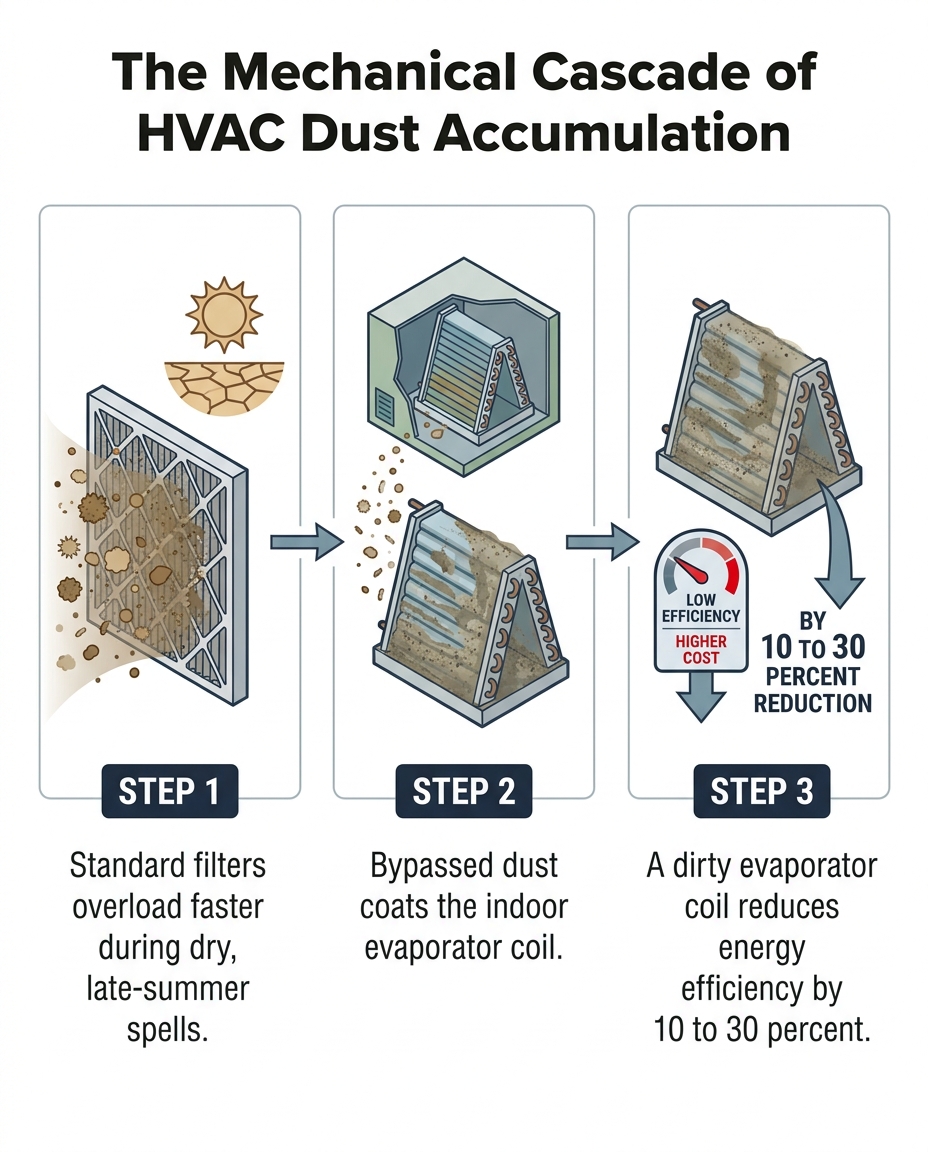
When a filter is pushed past its absolute limit, the dust does not simply stop accumulating. Instead, the HVAC system undergoes a mechanical cascade—a chain reaction of component stress caused by blocked airflow. Understanding this process explains exactly why a dirty filter eventually destroys your cooling power.
1. Filter Saturation: The pleated media of the air filter fills completely with dirt, pet dander, and late-summer dust from the San Gabriel Valley. Air can no longer pass through the center of the filter.
2. Pressure Imbalance: The blower motor continues to run, creating an intense suction in the return duct. Because air cannot flow through the filter, this suction seeks the path of least resistance.
3. Air Bypass: The intense vacuum pressure begins to pull unfiltered air through the tiny, microscopic gaps around the cardboard frame of the filter, or through the seams of the filter housing itself.
4. Coil Contamination: This bypassed dust travels straight past the filter housing and blows directly into the delicate, closely spaced fins of the indoor evaporator coil.
It is important to contrast this indoor evaporator coil choking with outdoor condenser coil clogging. Your outdoor unit gets clogged by leaves, grass clippings, and outdoor dirt, requiring a heavy wash. The indoor coil, however, gets coated in fine, sticky household dust and moisture, requiring a completely different, delicate cleaning solution.
The Evaporator Coil: Suffocating Your Cooling Power
The indoor evaporator coil is the heart of your air conditioning system's cooling ability. Shaped like an "A" or an "N" and filled with cold chemical refrigerant, this coil sits inside your ductwork. Its job is to absorb heat from the warm indoor air blowing across it. When the mechanical cascade allows dust to bypass the filter, this critical component is the first casualty.
The Insulating Blanket Effect
As bypassed dust hits the cold, damp fins of the evaporator coil, it sticks. Over weeks of heavy late-summer use, this dust builds up into a thick, felt-like layer. This layer of grime acts as an insulating blanket. Heat transfer is severely disrupted because the warm indoor air can no longer make direct contact with the cold metal of the coil. According to the U.S. Department of Energy, a dirty evaporator coil can reduce energy efficiency by 10 to 30 percent, meaning you are paying significantly more money for a lot less cooling.
The Risk of a Frozen System
When the coil is insulated by dust, the refrigerant inside stays too cold because it isn't absorbing heat from your home. The natural condensation that forms on the coil during the cooling process begins to freeze. Eventually, the entire evaporator coil can become encased in a solid block of ice. Once the coil freezes over entirely, restricted airflow becomes zero airflow, and the system stops cooling your home completely. This is why addressing poor indoor air quality and airflow issues early is so critical.
Recognizing the Signs of a Choked System
You do not have to wait for your system to freeze solid to know there is a problem. Your HVAC equipment will give you several physical warning signs that the filter is clogged or the evaporator coil is coated in dust. Acting on these signs early can save you from a complete breakdown during a late August heatwave.
• Constant running with weak output: The primary symptom of a choked system is the AC running constantly, but blowing weak or noticeably warm air from the vents.
• Spiking utility bills: If you notice higher-than-normal energy bills despite making no changes to your thermostat settings, your system is likely working overtime to push air through a restriction.
• Visible dust buildup: Check your supply vents. If you see heavy, dark dust accumulating on the grilles or the ceiling immediately surrounding the vents, unfiltered air is blowing through the ductwork.
• Musty odors: A damp, musty, or "dirty sock" smell when the system kicks on often indicates that dust and moisture are trapped on the indoor coil, creating a breeding ground for biological growth.
We recently had another Baldwin Park customer request an AC unit inspection for a potential repair after noticing these exact signs. Our technician inspected the unit, identified a small, simple fix related to airflow restriction, and was completely upfront about the solution. The unit was fixed efficiently without any unnecessary upselling. If you notice these symptoms in your home, reaching out to a professional who serves the San Gabriel Valley service areas ensures you get an honest assessment before a minor restriction becomes a major failure.
Filter Swap vs. Professional Intervention: Making the Right Call
When you notice reduced airflow during the back-to-school transition period, the first step is always to check the air filter. However, knowing when a simple DIY filter change is sufficient and when you need professional coil cleaning is crucial for the health of your system.
When to DIY and When to Call a Pro
Always start by pulling out your current filter. If it is visibly caked in dust, replace it with a fresh one and monitor the system for a few hours. If the airflow improves immediately and the house cools down, you likely caught the problem in time. However, if a new filter doesn't restore your cooling power, the evaporator coil is likely already coated in dust.
Evaporator coil cleaning is not a DIY job. We recommend professional intervention over DIY attempts because it requires specialized foaming chemicals, fin combs, and a licensed expert to avoid bending or damaging the highly delicate aluminum fins. Furthermore, having a professional address the coil now provides a dual benefit: it restores your current cooling capacity for the rest of summer, and it serves as vital heating system preparation before the temperatures eventually drop.
• DIY Filter Swap — Common Symptoms: Slightly reduced airflow, filter looks dark/clogged, normal cooling temps. — Required Tools: New correct-size pleated air filter. — Expected Outcome: Immediate return to normal airflow and efficiency.
• Professional Coil Cleaning — Common Symptoms: Weak/warm airflow even with a clean filter, musty smells, frozen lines. — Required Tools: Specialized coil cleaners, fin combs, professional access tools. — Expected Outcome: Restored heat transfer, prevented freezing, prepared for winter heating.
Restore Your Airflow Before the Season Ends
Understanding exactly how late summer dust impacts your specific system empowers you to make better maintenance decisions. The transition from a dirty filter to a suffocated evaporator coil happens quickly during the dry, dusty weeks of late August. By the time you notice your home isn't cooling properly, the mechanical cascade is already well underway.
Addressing restricted airflow right now prevents larger, more stressful breakdowns during the final, intense heatwaves of the year. Do not wait for your system to freeze over completely. Schedule a thorough inspection to ensure your equipment is clean, efficient, and ready to handle whatever the changing seasons bring. Securing a routine HVAC maintenance plan is the smartest way to guarantee your filter and coils are professionally monitored, keeping your home comfortable and your air quality pristine all year long.
Frequently Asked Questions
What happens when an AC evaporator coil gets dirty?
When an AC evaporator coil gets dirty, the dust acts as an insulating blanket over the cold metal fins. This prevents the refrigerant inside from absorbing heat from your home's air. As a result, the system loses cooling capacity, energy efficiency drops by up to 30 percent, and the coil can eventually freeze over completely.
Why is my AC airflow weak in late summer?
Weak airflow in late summer is usually caused by a severely clogged air filter that has reached its maximum capacity. Months of heavy use, combined with dry, dusty outdoor conditions, cause filters to load up faster than they do in the spring. If replacing the filter doesn't fix the airflow, the indoor coil may be choked with bypassed dust.
Does a dirty filter affect AC cooling?
Yes, a dirty filter directly impacts AC cooling by restricting the volume of air the blower motor can pull through the system. When less air moves over the cooling coil, less cold air is pushed out of your vents. This forces the system to run longer cycles to reach the set temperature, increasing wear and tear.
How do I know if my evaporator coil is clogged?
You can tell your evaporator coil is clogged if your AC runs constantly but blows weak or warm air, even after you have installed a brand-new air filter. Other common signs include a musty odor coming from the vents, unusually high energy bills, or visible ice forming on the copper refrigerant lines outside.
Why do standard 90-day filter replacement rules fail in August?
Standard 90-day filter replacement rules fail in August because prolonged dry spells and seasonal winds drastically increase the amount of airborne particulate matter. The system runs more frequently to combat the heat, filtering a higher volume of heavily contaminated air. Under these extreme conditions, filters often reach capacity in just 30 to 45 days.
Other blogs


Customer Testimonials



CUSTOMER SERVICE!
I highly recommend this company for anyone needing AC repair or maintenance. I'll definitely be calling them again for any future needs!

I had the pleasure of experiencing outstanding service and professionalism from Ruben, and I am beyond impressed. From the moment I first contacted them, by phone and follow up communication via email for my quotes. The attention to detail and commitment to excellence were evident.
Ruben, was incredibly responsive, addressing all my inquiries promptly and with clear, thorough explanations. Their dedication to understanding and meeting my needs was remarkable.
Ruben, went above and beyond to ensure that everything was handled seamlessly, demonstrating not just professionalism, but also a sincere dedication to customer satisfaction.
I can't recommend Piggies air Conditioning/Ruben highly enough. If you're looking for someone who combines expertise with exceptional service, look no further. They are a true example of what outstanding professionalism should be.
The technician arrived on time, which I really appreciated given how crucial air conditioning is in this heat. Ruben was professional and friendly, explaining what he was doing throughout the process. The issue I had was diagnosed fairly quickly, and they provided me with a few options on how to fix it. The pricing was transparent, and I didn't feel like there were any hidden costs, which is always a plus when it comes to service calls like these. Highly recommend this company!
1st & foremost, huge shout out to Ruben thank u so so much for reaching out & making things happen SO FAST! I was so surprised since i had reached out to a couple different places who lagged on even answering calls, messages, etc.
Ruben was also very informative & taught me ALOT that i didnt know about.
Also cant leave the amazing Luis & Miles out of
this review.
They came, they saw, they conquered!
And they worked pretty swiftly too, felt very comfy around em, loved their personalities, great attitude, work ethic, professionalism, had some really good convos & they still got the job done lightning fast
SUPER HUGE SHOUT OUT & THANKS for everything guys! Definitely recommending u guys to everyone i know.
recommendations and feedback. The actual installation was painless and unremarkable, his AC experts got it done, got it cleaned and most importantly got it right. Rueben even went a step further to assure we had
protection from the coming rain, that is service unheard of these days. His price was competitive and a REAL value for the service we recieved. Using anyone else for your AC needs, would be a huge mistake. We thank them again and will recommend to everyone.
Echoing a lot of the other reviews here, Piggies Air Conditioning responds so quickly to requests (even though I actually accidentally sent in multiple requests on my side without responding, oops!)
They were able to come do a FREE energy audit and initial inspection on the same day and Ruben was amazing at explaining his thoughts on our house's situation and what he thought was worth the money and wasn't worth the money.
I truly felt like he was trying to help me find the best solution to our issues instead of just trying to upsell us on everything and anything.
I'm definitely recommending this business to anyone I know if they want a trustworthy and realistic service, value, and quality.