










The Wildfire Smoke Dilemma: Better Filtration vs. System Health
Buying the thickest, highest-rated air filter on the hardware store shelf seems like the smartest move when the sky turns orange. However, understanding the difference between MERV 8 and MERV 13 filters for smoke season is critical, because thicker isn't always better for your heating and cooling equipment. In our years serving Baldwin Park homes, our team at Piggies Air Conditioning constantly sees well-meaning homeowners accidentally choke their HVAC systems. Standard residential systems are engineered for a very specific amount of airflow. When outdoor air quality plummets, the immediate instinct is to block every microscopic particle, but doing so without considering system compatibility can lead to disastrous mechanical failures right before the heating season begins.
The central conflict here is capturing microscopic smoke particles versus maintaining adequate airflow across your indoor coil. While dense, highly rated filters do an excellent job of blocking soot and ash, they can also suffocate systems designed for standard, low-resistance airflow. This is especially true during the intense September Southern California smoke season, as we transition into early fall and systems are prepping for cooler weather while still managing daytime heat. To keep your home comfortable and your equipment safe, you need a strategy that protects both your lungs and your blower motor. If you are looking to upgrade your Air Conditioning setup or want to ensure your system can handle the strain of the fall transition, enrolling in a comprehensive HVAC maintenance plan is the best first step toward year-round peace of mind.
Comparing Particle Capture: MERV 8 vs. MERV 13
To make an informed decision, you first need to understand what the Minimum Efficiency Reporting Value (MERV) scale actually measures. The MERV rating system, developed by the American Society of Heating, Refrigerating and Air-Conditioning Engineers (ASHRAE), grades a filter's ability to capture particles between 0.3 and 10 microns in size. The higher the number, the finer the filtration. However, higher numbers also mean denser filter media, which physically changes how air moves through your ductwork.
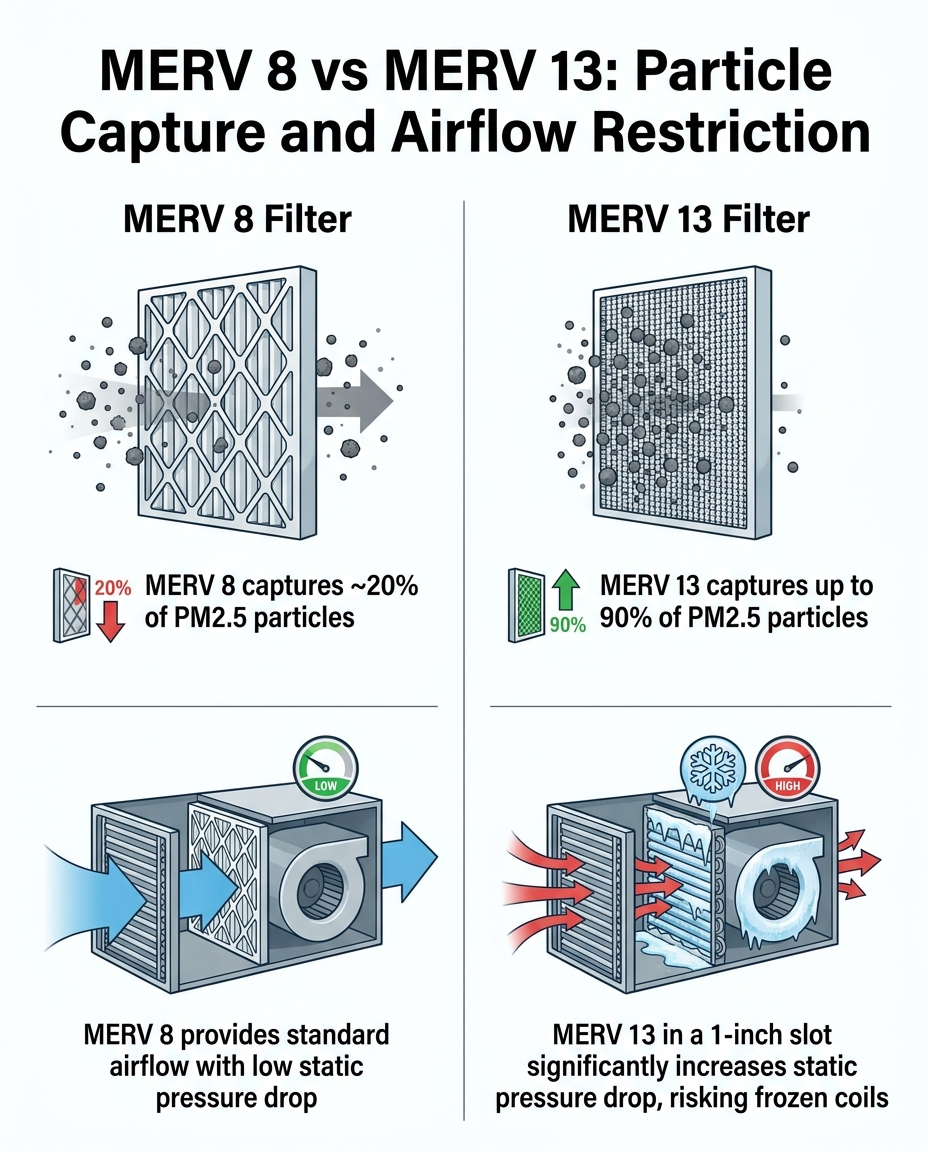
When our technicians inspect ductwork across the area, we find that MERV 8 filters are the standard recommendation for most residential systems. They are excellent at capturing common household irritants like dust mites, pollen, and mold spores. However, they only capture about 20% of the ultra-fine particles found in wildfire smoke. On the other hand, MERV 13 filters are significantly denser. They can capture up to 90% of those ultra-fine smoke particles, making them highly effective against smog, bacteria, and virus carriers. The physical difference lies in the pleat density and material thickness, which directly impacts the MERV 8 vs MERV 13 static pressure drop—a measurement of how hard the blower motor has to work to pull air through the filter.
• PM2.5 Capture Rate — MERV 8: Approximately 20% (low efficiency for fine smoke) — MERV 13: Up to 90% (high efficiency for fine smoke)
• Primary Targets — MERV 8: Dust, pollen, mold spores, pet dander — MERV 13: Wildfire smoke, smog, bacteria, fine dust
• Airflow Resistance — MERV 8: Low (safe for standard 1-inch filter slots) — MERV 13: High (often requires deeper media cabinets)
• System Strain Risk — MERV 8: Minimal — MERV 13: Significant in undersized return drops

Tackling PM2.5: Why Wildfire Smoke Requires Special Attention
Wildfire smoke is not like ordinary household dust. It is primarily composed of PM2.5, which stands for particulate matter that is 2.5 micrometers in diameter or smaller. To put that into perspective, a single strand of human hair is about 70 micrometers across—meaning these smoke particles are nearly 30 times smaller. Because they are so microscopic, they can easily bypass standard 1-inch MERV 8 pleated filters, traveling through your ductwork and circulating continuously throughout your living spaces.
The danger of PM2.5 lies in its ability to penetrate deep into the lungs and even enter the bloodstream. The Environmental Protection Agency (EPA) explicitly warns about the health hazards of indoor PM2.5 exposure during severe outdoor smoke events. Validating a homeowner's desire to upgrade their filtration to protect their family's health is entirely reasonable, especially given local weather patterns. In our experience servicing homes throughout Baldwin Park and the San Gabriel Valley, early fall wind events frequently trap particulate matter in the basin, leading to heavily compromised Air Quality Index (AQI) levels for days or weeks at a time.
While the health concerns are real and pressing, addressing them simply by slotting the densest filter into an uncalibrated system creates an entirely new set of problems. You have to find a way to remove these microscopic threats without destroying the very equipment you rely on as seasons change.
The Hidden Danger of Dense Filters on System Airflow
To understand why a better filter can break a good air conditioner or furnace, we have to talk about static pressure. In HVAC terms, static pressure is the resistance to airflow within your duct system. Blower motors are calibrated at the factory to operate against a specific, maximum level of resistance. When you increase that resistance, the motor has to work exponentially harder to move the same volume of air.
The Problem with 1-Inch Slots
Most residential homes are built with standard 1-inch filter grilles. When you place a highly restrictive MERV 13 filter into a 1-inch slot that was designed for a MERV 8, you drastically reduce the amount of air the system can pull in. The MERV 8 vs MERV 13 static pressure drop in a 1-inch format is severe because there simply isn't enough surface area on the filter media to allow air to pass through easily while still catching microscopic soot.
Symptoms of a Suffocating Blower
When your system is starved for air, you will start to notice clear mechanical symptoms. The blower motor will run longer cycles trying to satisfy the thermostat, driving up your energy bills. You might notice significantly reduced air coming from your supply vents, or hear unusual whistling and straining noises coming from the return grille. The motor itself will run hotter, accelerating wear and tear on electrical components just when you need it ready for winter.
The Recipe for Mechanical Failure
The timing of early fall smoke season makes this restriction particularly dangerous. Lingering daytime heat requires occasional cooling, while cool nights mean preparing for heating. When you combine an air conditioner running to handle a warm afternoon with severely restricted airflow, you create the perfect environment for a breakdown. Understanding why your air conditioner freezes over is critical here, as starving the system of warm indoor air is the leading cause of catastrophic coil freeze-ups.
How a Restrictive Filter Leads to a Frozen Evaporator Coil
The idea that an air conditioner can turn into a block of ice while it's hot outside sounds contradictory, but it happens frequently when airflow is compromised. The cooling process relies on a delicate balance of temperature and pressure, and a dense filter disrupts that balance entirely. Here is exactly how a restrictive filter causes your system to freeze:
1. The Cooling Cycle Begins: Your air conditioner doesn't actually "make" cold air; it removes heat from the air inside your home. Warm indoor air must blow over the indoor evaporator coil (which is filled with cold refrigerant) for the system to work.
2. Airflow is Blocked: When a thick MERV 13 filter is installed in a slot that can't handle the static pressure, it acts like a wall. The volume of warm air passing over the evaporator coil drops dramatically.
3. Temperatures Plummet: Without that constant flow of warm air to absorb the cold from the refrigerant, the temperature of the evaporator coil drops below freezing.
4. Condensation Freezes: Air conditioners naturally pull humidity out of the air as condensation. When the coil drops below 32 degrees, that condensation freezes directly onto the metal fins instead of dripping into the drain pan.
5. Total System Lockup: The ice buildup eventually encases the entire coil, completely blocking any remaining airflow. If the system continues to run, liquid refrigerant can flow backward into the outdoor compressor, destroying the most expensive part of your unit.
Our technicians at Piggies Air Conditioning see the consequences of restricted airflow on a weekly basis during the early fall transition. Recently, we responded to a Baldwin Park homeowner who installed a heavy-duty smoke filter, only to hear unusual straining noises from their unit. We found a completely frozen coil caused by the severe pressure drop. By completing a thorough evaporator coil cleaning and restoring proper airflow with the correct filter, we got their system running safely again. Especially during the September Southern California smoke season, keeping the coil clean and the airflow unrestricted is non-negotiable.
Prioritizing Long-Term System Health Over Quick Upsells
Many big-box home improvement stores and generic online guides blindly recommend buying the highest MERV rating available as soon as wildfire smoke appears. They focus entirely on the filtration rating without ever mentioning system compatibility or static pressure. This is a massive oversight. True indoor air quality shouldn't come at the cost of destroying your HVAC equipment.
At Piggies Air Conditioning, our team prioritizes long-term system health over quick upsells. We frequently consult with homeowners who are tempted to buy the most restrictive filters on the market to combat fall smoke. Instead of letting them risk their equipment, our technicians take the time to evaluate their ductwork and recommend the right balance of filtration and airflow. A quick, straightforward diagnostic test can reveal exactly how much resistance your blower motor can safely overcome.
This commitment to honest, practical advice is a cornerstone of our daily operations. We want to ensure that your system is prepared for both smoke events and the impending heating season. We bring that same level of care to our air conditioning services, ensuring that when you face heavy smoke in Baldwin Park, you get solutions that protect your lungs without frying your compressor.
Alternative Indoor Air Quality Solutions for Smoke Season
If forcing a 1-inch MERV 13 filter into your system is too risky, our IAQ experts recommend several highly effective alternatives for protecting your home's air quality. You can achieve excellent PM2.5 removal by using strategies that don't rely solely on your HVAC blower motor to do all the heavy lifting.
• Deploy standalone HEPA air purifiers: Using portable HEPA filters in high-traffic rooms (like bedrooms and the living room) is one of the safest ways to tackle PM2.5. These units have their own dedicated fans and do not add any resistance to your central HVAC system.
• Retrofit a media filter cabinet: If you want whole-home MERV 13 filtration, the correct mechanical solution is having a professional install a 4-inch or 5-inch media filter cabinet. Because these filters are much thicker, they have significantly more surface area (pleating). This drastically reduces the MERV 8 vs MERV 13 static pressure drop, allowing your system to capture smoke without suffocating the motor.
• Manage your thermostat settings: Keep windows and doors tightly sealed during high AQI days. Run your AC fan on "auto" rather than "on." Leaving the fan "on" continuously can actually re-evaporate moisture back into the house and pull unfiltered air through tiny leaks in your ductwork.
• Schedule seasonal maintenance: Ensuring your entire system is clean and tuned up helps it handle the extra workload of extreme weather. Comprehensive heating services and cooling tune-ups verify that your blower is operating at peak efficiency before the smoke rolls in.
Frequently Asked Questions About HVAC Filters and Smoke Season
Is MERV 13 too restrictive for my AC?
It depends entirely on your system's design and ductwork. In a standard 1-inch filter slot, a MERV 13 filter often creates too much static pressure drop, severely restricting airflow. This strains the blower motor, increases energy consumption, and can lead to premature mechanical failure. Systems equipped with 4-inch or 5-inch media cabinets can typically handle MERV 13 filters without issue.
Will a MERV 13 filter freeze my AC?
Yes, it is a very real possibility if the filter restricts airflow significantly. When a dense filter prevents enough warm indoor air from blowing over the indoor evaporator coil, the refrigerant temperature drops rapidly. The coil can drop below freezing, causing normal condensation to turn into a solid block of ice that completely disables the system.
Does MERV 13 filter wildfire smoke?
Yes, MERV 13 is highly effective at capturing the microscopic particles associated with wildfire smoke. It can trap up to 90% of PM2.5 particles, which make up the vast majority of smoke pollution. However, it must be used in a system capable of handling the increased airflow resistance to be safe and effective.
Can I use MERV 13 in a 1-inch slot?
While it is physically possible to slide a 1-inch MERV 13 filter into a standard slot, our technicians generally do not recommend it without a professional static pressure test. The dense pleats packed into such a narrow frame severely limit air passage. Doing so during the September Southern California smoke season drastically increases the risk of system breakdowns.
Is MERV 8 good enough for smoke?
MERV 8 is excellent for standard household dust, lint, and pollen, but it only captures about 20% of fine smoke particles. This makes it insufficient on its own for severe smoke events. If you must use a MERV 8 to protect your system's airflow, you should supplement your indoor air quality with standalone HEPA air purifiers.
How often should I change my filter during wildfire season?
During heavy smoke events, filters clog much faster than they do under normal conditions. You should check your filter every few weeks rather than waiting for the standard 90-day mark. Replace the filter as soon as it appears visibly dark, gray, or restricted to ensure your system maintains proper airflow.
Make an Informed Decision for Your Home's Air Quality
Protecting your family from the health hazards of wildfire smoke shouldn't mean sacrificing your HVAC equipment in the process. The difference between MERV 8 and MERV 13 filters for smoke season ultimately comes down to balancing superior particle capture with the mechanical realities of static pressure. Blindly upgrading to the densest filter available can lead to frozen coils, suffocated blower motors, and expensive repairs right when you need your system the most.
Proper system maintenance and professional monitoring are the keys to keeping your indoor air clean and your equipment running smoothly. If you live in Baldwin Park and are concerned about managing indoor air quality during the fall smoke season, our team at Piggies Air Conditioning is here to help. Let our professionals evaluate your ductwork and recommend the safest, most effective filtration strategy tailored to your specific home.
Other blogs


Customer Testimonials



CUSTOMER SERVICE!
I highly recommend this company for anyone needing AC repair or maintenance. I'll definitely be calling them again for any future needs!

I had the pleasure of experiencing outstanding service and professionalism from Ruben, and I am beyond impressed. From the moment I first contacted them, by phone and follow up communication via email for my quotes. The attention to detail and commitment to excellence were evident.
Ruben, was incredibly responsive, addressing all my inquiries promptly and with clear, thorough explanations. Their dedication to understanding and meeting my needs was remarkable.
Ruben, went above and beyond to ensure that everything was handled seamlessly, demonstrating not just professionalism, but also a sincere dedication to customer satisfaction.
I can't recommend Piggies air Conditioning/Ruben highly enough. If you're looking for someone who combines expertise with exceptional service, look no further. They are a true example of what outstanding professionalism should be.
The technician arrived on time, which I really appreciated given how crucial air conditioning is in this heat. Ruben was professional and friendly, explaining what he was doing throughout the process. The issue I had was diagnosed fairly quickly, and they provided me with a few options on how to fix it. The pricing was transparent, and I didn't feel like there were any hidden costs, which is always a plus when it comes to service calls like these. Highly recommend this company!
1st & foremost, huge shout out to Ruben thank u so so much for reaching out & making things happen SO FAST! I was so surprised since i had reached out to a couple different places who lagged on even answering calls, messages, etc.
Ruben was also very informative & taught me ALOT that i didnt know about.
Also cant leave the amazing Luis & Miles out of
this review.
They came, they saw, they conquered!
And they worked pretty swiftly too, felt very comfy around em, loved their personalities, great attitude, work ethic, professionalism, had some really good convos & they still got the job done lightning fast
SUPER HUGE SHOUT OUT & THANKS for everything guys! Definitely recommending u guys to everyone i know.
recommendations and feedback. The actual installation was painless and unremarkable, his AC experts got it done, got it cleaned and most importantly got it right. Rueben even went a step further to assure we had
protection from the coming rain, that is service unheard of these days. His price was competitive and a REAL value for the service we recieved. Using anyone else for your AC needs, would be a huge mistake. We thank them again and will recommend to everyone.
Echoing a lot of the other reviews here, Piggies Air Conditioning responds so quickly to requests (even though I actually accidentally sent in multiple requests on my side without responding, oops!)
They were able to come do a FREE energy audit and initial inspection on the same day and Ruben was amazing at explaining his thoughts on our house's situation and what he thought was worth the money and wasn't worth the money.
I truly felt like he was trying to help me find the best solution to our issues instead of just trying to upsell us on everything and anything.
I'm definitely recommending this business to anyone I know if they want a trustworthy and realistic service, value, and quality.