









Is Your Aging Tract-Home AC Running Out of Time?
Your air conditioner is running nonstop, but the house still feels uncomfortably warm. You keep adjusting the thermostat, hoping the system will finally catch up to the rising afternoon temperatures. For many homeowners living in mature Diamond Bar tract developments, this is a familiar daily struggle. You might be wondering about the true lifespan of a builder-grade air conditioner in Diamond Bar, especially as your original unit gets older and seemingly less reliable.
Determining whether an aging system is genuinely on its last legs or just in need of a tune-up can be frustrating. You do not want to replace a system prematurely, but you also want to avoid a catastrophic breakdown during a heatwave. If you are tired of patching up an old unit, it is wise to explore professional air conditioning services to evaluate its true health. Taking action during the September fall-prep shoulder season gives you a strategic advantage. By scheduling an evaluation before the weather shifts entirely, you gain the time needed to make an objective, neutral analysis of your system's longevity without the stress of an emergency.
The Reality of Original Builder-Grade AC Systems
The original builder-grade AC systems installed when your neighborhood was constructed were designed to meet baseline standards, not to provide decades of premium performance. Many homeowners assume that any central air conditioning unit should last up to two decades, but the reality for tract homes is often quite different.
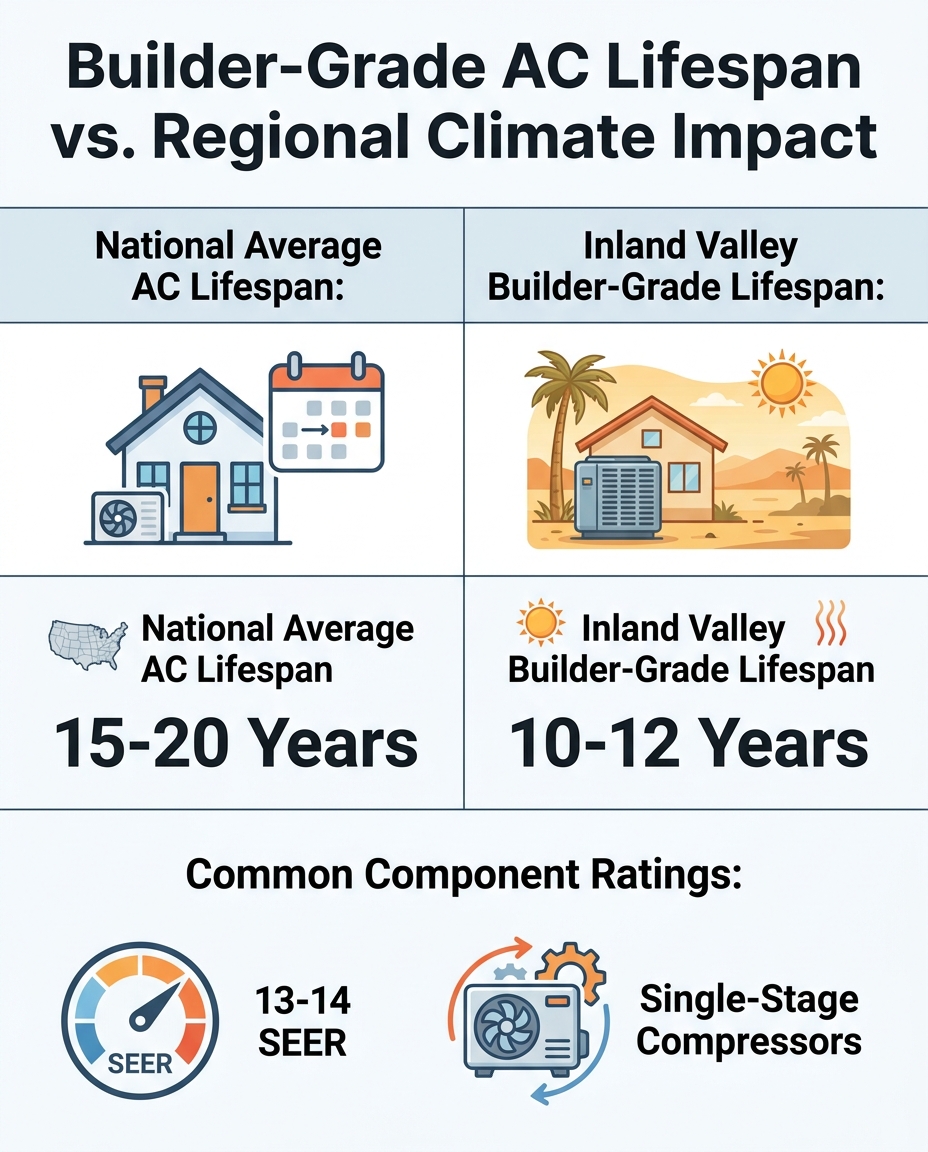
The problem: Initial tract home installations typically utilize lower-tier, single-stage units to keep construction costs manageable. While the Department of Energy suggests a baseline lifespan of 15 to 20 years for standard air conditioners, this national average includes premium, high-efficiency models operating in mild climates. In demanding environments, lower-tier components often trend toward a much shorter functional life, typically around 10 to 12 years.
The cause: Single-stage compressors operate on a very simple mechanism: they are either running at 100% capacity or they are completely off. Every time the system kicks on, it draws maximum power and places maximum mechanical stress on the internal components. Over thousands of cycles, this heavy load wears down contactors, capacitors, and the compressor itself much faster than a variable-speed unit would.
The solution: Acknowledging the mechanical limitations of your current setup is the first step. If your unit is approaching that 10-to-12-year mark and showing signs of strain, looking into AC replacement in Diamond Bar can save you from mounting repair bills and wasted energy.
Understanding SEER Ratings in Tract Homes
SEER stands for Seasonal Energy Efficiency Ratio. It is a measurement of how efficiently your air conditioner uses electricity to cool your home over a typical cooling season. A higher SEER rating means greater energy efficiency and lower utility bills.
When large residential developments are built, contractors often select units that meet the minimum legally required SEER rating at the time of construction—often 13 or 14 SEER. These baseline efficiency models manage upfront construction costs effectively. However, as these units age, their efficiency drops even lower. A 13-SEER unit that is ten years old may now be operating at a 10-SEER level, forcing the system to work harder, consume more electricity, and degrade faster just to provide the same amount of cooling.
• Compressor Type — Original Builder-Grade AC: Single-stage (100% on or off) — Modern High-Efficiency AC: Two-stage or Variable-speed
• Typical SEER Rating — Original Builder-Grade AC: 13 to 14 SEER — Modern High-Efficiency AC: 16 to 20+ SEER
• Realistic Lifespan — Original Builder-Grade AC: 10 to 12 years (in hot climates) — Modern High-Efficiency AC: 15 to 20 years
• Temperature Control — Original Builder-Grade AC: Noticeable temperature swings — Modern High-Efficiency AC: Consistent, even cooling
How the San Gabriel Valley Heat Accelerates Wear
National averages for HVAC lifespans rarely account for specific regional microclimates. The inland San Gabriel Valley experiences weather patterns that are drastically different from the milder coastal areas of Los Angeles. This unique climate plays a massive role in how quickly your system degrades.
Prolonged intense heat: Diamond Bar experiences intense summer heat waves that can stretch for weeks at a time. Unlike coastal homes that benefit from the marine layer, inland homes face relentless afternoon sun. This drastically increases the annual run hours of your air conditioner. Instead of running for a few hours a day, your system might run continuously from noon until late evening just to maintain a basic level of comfort.
Thermal stress on components: Because most original builder-grade AC systems in Diamond Bar tract developments use single-stage compressors, they are forced to run continuously at maximum capacity during peak heat. This constant operation prevents the system from resting and cooling down. The intense thermal stress placed on the compressor, condenser coils, and fan motors accelerates metal fatigue and electrical wear.
Accelerated timeline: This environmental strain is the primary reason local systems fail years before the national average. When a 13-14 SEER unit is subjected to endless 95-degree days, the internal lubricants break down faster, and the electrical components face constant heavy loads. It is perfectly normal for a tract-home unit in this specific microclimate to reach the end of its useful life shortly after its tenth birthday.
Telltale Signs Your System is Nearing the End of Its Lifespan
Moving from abstract lifespan numbers to observable evidence is crucial for making an informed decision. Original builder-grade AC systems rarely fail completely out of nowhere; they usually leave a trail of warning signs. Knowing what to look for can help you transition from reacting to emergencies to planning a smooth upgrade.
1. Increased frequency of mechanical breakdowns: If you find yourself calling a technician multiple times a year for different issues—a blown capacitor in July, a frozen coil in August, a failing fan motor in September—your system is showing systemic failure. A reliable unit should only need seasonal maintenance, not constant triage.
2. Rising utility bills despite consistent usage: Compare your energy bills from this summer to the same months last year. If your usage habits have not changed but your costs are steadily climbing, your AC is losing its efficiency. As internal parts wear out, the system draws more electricity to produce the same amount of cooling.
3. Uneven cooling and struggling to maintain set points: A healthy system should easily reach and hold the temperature you set on the thermostat. If your unit runs constantly but the house never gets below 78 degrees on a hot afternoon, the compressor may be losing its ability to pressurize refrigerant effectively.
4. Strange, disruptive noises: While all air conditioners make some noise, grinding, squealing, or loud banging sounds indicate serious mechanical wear. These noises often point to failing bearings in the blower motor or a compressor that is tearing itself apart internally.
It is important to remember that not every symptom means the entire unit is dead. Honest, transparent diagnostics are vital when evaluating these signs. A reputable technician will not immediately leap to a replacement recommendation if a simple, cost-effective fix will safely extend the life of the unit. This is why professional Diamond Bar AC repair should always start with a thorough, objective inspection.
Sometimes, the issue extends beyond the main unit itself. One homeowner purchasing a new house discovered their system was completely failing to keep the property comfortable. After a thorough evaluation, a higher-end AC unit was installed, and missing air vents were added at no extra cost to ensure proper airflow throughout the home. This proves that proper evaluation looks at the entire system, not just the box outside.
Why the Fall Shoulder Season is the Ideal Time to Evaluate
Most homeowners only think about their air conditioner when it is 100 degrees outside and the vents are blowing warm air. However, waiting for a mid-summer breakdown puts you in a highly stressful situation where you are forced to make rushed decisions. The September fall-prep shoulder season is the ideal time to take control of your home's comfort.
The shoulder season advantage: The "shoulder season" refers to the transitional period between the intense heat of summer and the cold of winter. During this time, the weather is milder, and HVAC systems are generally under less strain. Proactive evaluations during this window remove the urgency and panic of an emergency breakdown.
Comprehensive system health checks: Scheduling routine AC maintenance before transitioning to winter heating allows a technician to thoroughly inspect the wear and tear accumulated over the summer. They can clean the coils, check the refrigerant levels, test the electrical components, and give you an honest assessment of how much life is left in the equipment.
Time to research and plan: If your evaluation reveals that your original builder-grade system is indeed on its last legs, the milder weather gives you the luxury of time. You can carefully research your options, compare different SEER ratings, and look into generic energy rebates and federal tax credits that may apply to qualifying high-efficiency installations. Navigating these incentives without the pressure of a sweltering house ensures you make the best long-term financial decision for your property.
Navigating the Repair vs. Replacement Decision
When a technician hands you a diagnostic report showing significant issues with your aging unit, you face a critical decision. Providing an objective framework helps you make a confident choice about your home's infrastructure.
The problem: You are facing a substantial repair bill for a system that is already a decade old. You need to know if fixing it is a smart investment or just throwing good money after bad.
The cause: As original builder-grade components age in Diamond Bar tract developments, major parts like the compressor or the evaporator coil become highly susceptible to failure. Replacing these core components is labor-intensive and parts-heavy.
The solution: Industry experts often rely on the "50% rule." If the cost of the required repairs approaches or exceeds half the value of a new, modern system—and the current unit is over ten years old—replacement is generally the more logical path. Repairing an old system only fixes one broken part; it does not reset the clock on the rest of the aging components.
Upgrading from a 13-SEER builder model to a modern, multi-stage unit provides massive long-term efficiency gains. Multi-stage units run at lower capacities for longer periods, which uses less electricity, dehumidifies the air better, and eliminates the drastic temperature swings common with single-stage units. Furthermore, a planned replacement is a seamless process. The removal of the old unit and the installation of the new one can be scheduled at your convenience, ensuring zero disruption to your daily life.
During a recent fall season, a first-time homeowner needed a new HVAC system installed because their original unit was beyond repair. They received expert consultation that answered all their questions, leading to a highly efficient installation where the new system was put in with total respect for the home, leaving the property spotless. This level of no-pressure guidance ensures you feel empowered rather than rushed.
It is also worth considering the broader impact on your property. Many homeowners researching their options naturally wonder does a new AC increase home value in Southern California. Upgrading from an aging, inefficient unit to a modern climate control system is a major selling point that improves the overall equity and appeal of your home.
Frequently Asked Questions About AC Lifespans
How long do builder grade AC units last in Southern California?
In the intense inland heat of Southern California, original builder-grade AC systems typically last between 10 and 12 years. While national averages suggest 15 to 20 years, those figures include premium units in milder climates. The constant heavy usage required during San Gabriel Valley summers accelerates wear on baseline, single-stage components.
What are the signs a builder grade AC is failing?
The most common signs include a sudden increase in mechanical breakdowns, rising electricity bills, and an inability to cool the house evenly during hot afternoons. You might also notice strange grinding or squealing noises coming from the outdoor unit. If your system runs constantly but the indoor temperature never reaches your thermostat setting, the compressor is likely failing.
Should I replace my aging AC before it breaks?
Yes, proactive replacement is highly recommended once a unit passes the 10-year mark and begins showing signs of decline. Replacing the system before a catastrophic failure allows you to shop around, research energy rebates, and schedule the installation at your convenience. Waiting for it to break usually happens during a peak summer heatwave, leading to rushed decisions and uncomfortable days waiting for an installation.
Is it worth replacing a 15-year-old AC?
Absolutely. A 15-year-old builder-grade unit is likely operating far below its original efficiency rating and uses outdated, single-stage technology. Upgrading to a modern, higher-SEER system will significantly reduce your monthly energy consumption, provide much more consistent cooling, and eliminate the looming threat of expensive, frequent repairs.
How often should you replace your AC unit in the San Gabriel Valley?
Homeowners in the San Gabriel Valley should plan to evaluate their systems for replacement every 10 to 15 years, depending on the quality of the original installation and how rigorously it was maintained. Standard builder-grade units will fall on the shorter end of that spectrum, while premium, multi-stage systems that receive regular maintenance can push closer to the 15-year mark.
Take Control of Your Fall Comfort and Efficiency
Understanding the true lifespan of your home's cooling system is the key to maintaining a comfortable, energy-efficient property. The reality is that 10 to 12 years is a very common lifespan for original builder-grade AC systems operating in the intense heat of Diamond Bar. Recognizing this timeline helps you shift from a reactive mindset to a proactive one.
Do not wait for a complete system failure to force your hand. Use the milder weather of the September fall-prep shoulder season to your advantage. This is the perfect window to have a professional evaluate the exact condition of your equipment, review your repair history, and outline your options without any high-pressure sales tactics. Take control of your home's comfort today by scheduling an objective evaluation, ensuring your family stays comfortable and your energy bills stay manageable for years to come.
Other blogs


Customer Testimonials



CUSTOMER SERVICE!
I highly recommend this company for anyone needing AC repair or maintenance. I'll definitely be calling them again for any future needs!

I had the pleasure of experiencing outstanding service and professionalism from Ruben, and I am beyond impressed. From the moment I first contacted them, by phone and follow up communication via email for my quotes. The attention to detail and commitment to excellence were evident.
Ruben, was incredibly responsive, addressing all my inquiries promptly and with clear, thorough explanations. Their dedication to understanding and meeting my needs was remarkable.
Ruben, went above and beyond to ensure that everything was handled seamlessly, demonstrating not just professionalism, but also a sincere dedication to customer satisfaction.
I can't recommend Piggies air Conditioning/Ruben highly enough. If you're looking for someone who combines expertise with exceptional service, look no further. They are a true example of what outstanding professionalism should be.
The technician arrived on time, which I really appreciated given how crucial air conditioning is in this heat. Ruben was professional and friendly, explaining what he was doing throughout the process. The issue I had was diagnosed fairly quickly, and they provided me with a few options on how to fix it. The pricing was transparent, and I didn't feel like there were any hidden costs, which is always a plus when it comes to service calls like these. Highly recommend this company!
1st & foremost, huge shout out to Ruben thank u so so much for reaching out & making things happen SO FAST! I was so surprised since i had reached out to a couple different places who lagged on even answering calls, messages, etc.
Ruben was also very informative & taught me ALOT that i didnt know about.
Also cant leave the amazing Luis & Miles out of
this review.
They came, they saw, they conquered!
And they worked pretty swiftly too, felt very comfy around em, loved their personalities, great attitude, work ethic, professionalism, had some really good convos & they still got the job done lightning fast
SUPER HUGE SHOUT OUT & THANKS for everything guys! Definitely recommending u guys to everyone i know.
recommendations and feedback. The actual installation was painless and unremarkable, his AC experts got it done, got it cleaned and most importantly got it right. Rueben even went a step further to assure we had
protection from the coming rain, that is service unheard of these days. His price was competitive and a REAL value for the service we recieved. Using anyone else for your AC needs, would be a huge mistake. We thank them again and will recommend to everyone.
Echoing a lot of the other reviews here, Piggies Air Conditioning responds so quickly to requests (even though I actually accidentally sent in multiple requests on my side without responding, oops!)
They were able to come do a FREE energy audit and initial inspection on the same day and Ruben was amazing at explaining his thoughts on our house's situation and what he thought was worth the money and wasn't worth the money.
I truly felt like he was trying to help me find the best solution to our issues instead of just trying to upsell us on everything and anything.
I'm definitely recommending this business to anyone I know if they want a trustworthy and realistic service, value, and quality.