









The Hidden Cost of Cooling: When Water Chemistry Fights Your Comfort
Your evaporative cooler is running nonstop, but the air pushing into your living room feels weak, warm, and restricted. You step outside to check the unit, only to find the cooling pads covered in a thick, chalky white crust. When our technicians at Piggies Air Conditioning visit homes in Baldwin Park and the surrounding areas, we see this frustrating scenario constantly. If you are dealing with this, you are experiencing firsthand how hard water in the San Gabriel Valley affects evaporative coolers. The issue is rarely a mechanical failure of the equipment itself; rather, it is a direct conflict between the specific mineral chemistry of the local municipal water supply and the fundamental way a swamp cooler operates.
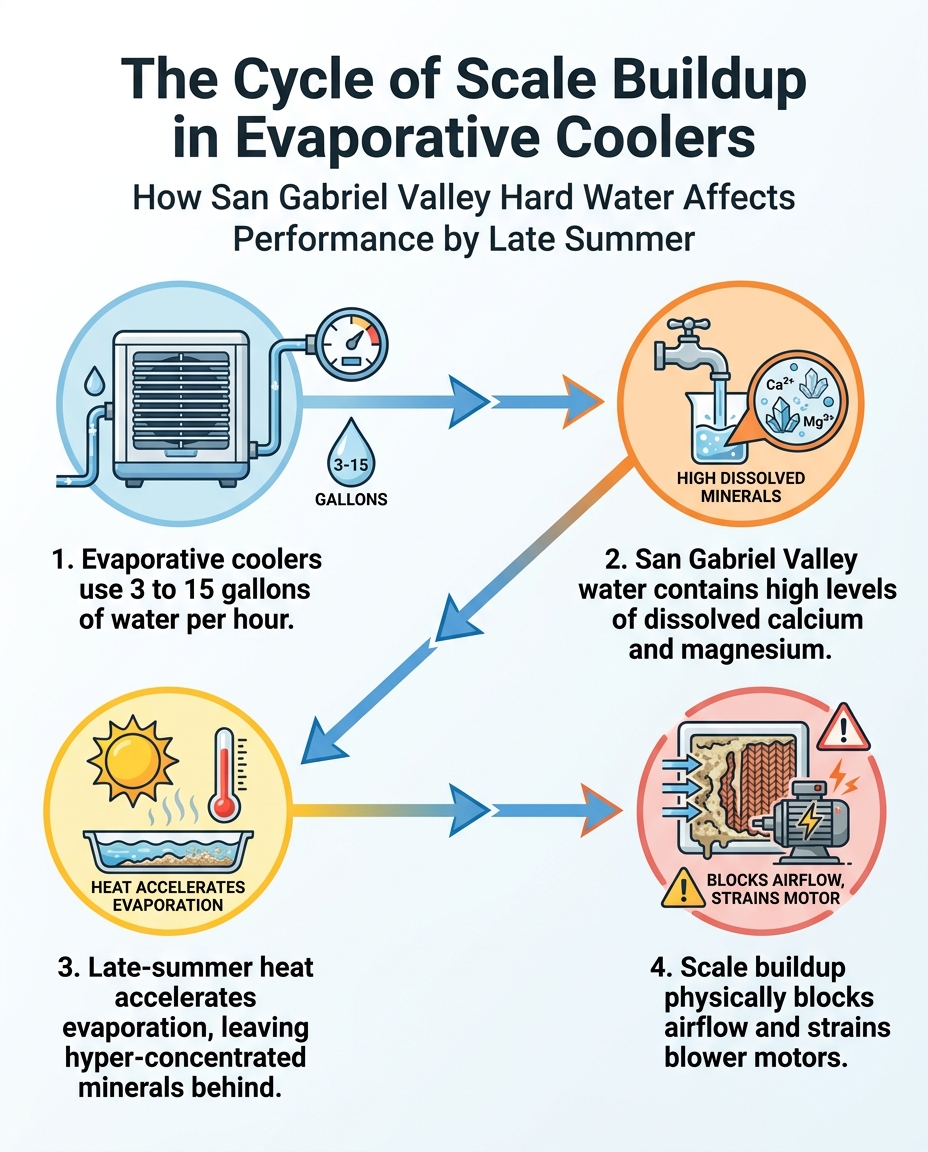
Evaporative cooling relies entirely on water to absorb heat from the air. However, when that water is packed with dissolved minerals, the system essentially acts as a massive, unintended water filter. As the water evaporates to cool your home, the minerals are left behind. By the time the late-summer August heat arrives and families are gearing up for the back-to-school transition, this slow accumulation turns into a severe obstruction. In our experience, homeowners are left facing a critical decision: continue fighting an endless battle against scale buildup with frequent pad replacements, or have our team help them explore more permanent cooling solutions.
Understanding the root cause of this calcification is the first step toward reclaiming your indoor comfort. While evaporative coolers can be highly effective in dry climates, their efficiency plummets the moment airflow is restricted. To bypass this constant maintenance cycle entirely, many local residents eventually transition to closed-loop traditional air conditioning systems that never rely on local water quality to keep the house comfortable.
Decoding Local Groundwater: Calcium, Magnesium, and Cooling
To understand why swamp coolers struggle so much in this region, you have to look underground. Our team often explains to customers that the unique geological makeup of the region naturally results in elevated calcium carbonate levels in the municipal water supply. As groundwater filters through the limestone and bedrock of the nearby mountains, it picks up high concentrations of dissolved calcium and magnesium. By the time this water flows out of the tap in the San Gabriel Valley and Baldwin Park, it is officially classified as hard to very hard water.
In a mechanical context, "hard water" means that the fluid carries a heavy load of microscopic solid particles in suspension. When you pipe this water into an evaporative cooler, the volume of minerals introduced to the system is staggering. A standard residential swamp cooler consumes between 3 and 15 gallons of water per hour during peak operation. Over a single hot day, the system might process well over 100 gallons of hard water. As the liquid evaporates to provide cooling, those dissolved solids do not evaporate with it. They precipitate out, clinging to the first surface they touch.
The Chemistry of Scale Buildup
The process of evaporation forces a phase change, turning liquid water into vapor. Because minerals like calcium and magnesium cannot turn into vapor at normal temperatures, they are left behind on the cooling pads. Initially, this microscopic layer is invisible. However, as the system runs day after day, the minerals bond together, creating a rigid, crystalline crust known as scale.
This scale physically blocks the porous openings in the cooling pads. Evaporative coolers require massive amounts of unrestricted airflow to function; the blower motor must pull hot outside air through the wet pads to cool it. When the pads become calcified, the air cannot pass through. Instead of a steady breeze of chilled air, you get restricted airflow that fails to lower the indoor temperature, forcing the system to run continuously without providing relief.
• Evaporative (Swamp) Cooler — Water Consumption: 3 to 15 gallons per hour — Impact of Local Hard Water: Severe; minerals accumulate directly on cooling pads — Airflow Restriction Risk: High; scale blocks porous pad materials rapidly
• Traditional Air Conditioning — Water Consumption: Zero (Closed refrigerant loop) — Impact of Local Hard Water: None; system is immune to local water chemistry — Airflow Restriction Risk: Low; relies only on standard air filter maintenance
The Evaporation Trap: Why Scaling Peaks in Late Summer
The severity of mineral scaling is directly tied to the rate of evaporation, which is why we typically see swamp cooler performance predictably crash at the worst possible time. The hot, dry late-summer climate in Southern California accelerates evaporation rates exponentially. When the ambient temperature spikes, the air can absorb moisture much faster. While this rapid evaporation theoretically provides better cooling, it also hyper-concentrates the calcium and magnesium on the pads at an alarming speed.
This creates a compounding, cumulative effect. Cooling pads that our team installed fresh and clean in May might function perfectly through June. However, by the time the late-summer August heat settles over the valley, those same pads have processed thousands of gallons of hard water. The mineral slurry in the water pan becomes highly concentrated, and the pads become heavily calcified. The system falls into an "evaporation trap": the hotter it gets, the faster water evaporates, the faster scale builds up, and the worse the system cools.
As airflow becomes increasingly restricted, the temperature inside your home begins to creep up, even though the cooler is running at full speed. This seasonal drop in efficiency is entirely predictable, making professional oversight critical. Having a technician assess the system mid-season can determine whether the calcified pads can survive the rest of the year or if an immediate intervention is required. For homeowners looking to stay ahead of these seasonal breakdowns, scheduling AC maintenance in Pasadena or the surrounding areas with our crew ensures your equipment is evaluated before the peak heat renders it useless.
Mechanical Toll: What Hard Water Does to Cooling Components
The damage caused by local water chemistry extends far beyond the disposable cooling pads. When scale builds up, the entire mechanical infrastructure of the evaporative cooler is forced to work under extreme stress. At Piggies Air Conditioning, we see the mechanical toll of this mineral buildup year-round throughout the San Gabriel Valley and Baldwin Park. For example, during a routine off-season visit, our team helped one local homeowner who reached out because their evaporative cooler coil needed a deep cleaning after a brutal summer of hard water exposure. We provided a detailed service quote and completed the cleaning timely to remove the extensive calcification, getting the system back to a satisfactory baseline before the next heat wave.
The most immediate victim of scale buildup is the blower motor. When the pads are crusted over with calcium, the static pressure inside the unit rises dramatically. The motor has to work significantly harder to pull the same volume of air through the restricted pads. This increased workload causes the motor to draw more electrical current and run at higher temperatures, which degrades the internal wire insulation and significantly shortens the lifespan of the component.
Beyond the Pads: Pump and Motor Strain
While the blower motor fights restricted airflow, the water distribution system is simultaneously being destroyed by the concentrated mineral slurry in the bottom of the unit.
• Water Pump Degradation: The small submersible pump responsible for pushing water up to the distribution tubes constantly ingests calcium flakes. Over time, these abrasive minerals chew up the plastic pump impellers, leading to premature mechanical failure.
• Distribution Tube Clogs: The narrow tubes that drip water onto the pads easily become clogged with scale, leading to dry spots on the pads. Air passing through a dry spot is not cooled, resulting in warm air entering the home.
• Corrosion and Rust: The concentrated mineral water sitting in the metal base pan acts as an electrolyte, accelerating rust and corrosion. If left unmanaged, the bottom of the cooler can rust completely through, causing extensive water leaks onto the roof.
The reality is that keeping a water-based cooling system operational in a hard water region requires intense, ongoing professional cleaning and maintenance. Ignoring the mineral buildup guarantees that multiple mechanical components will fail long before their expected lifespan.
Managing the Minerals: Professional Mitigation and Maintenance
Because you cannot change the municipal water supply, managing an evaporative cooler in this region requires aggressive mitigation strategies. The goal is to dilute the mineral concentration before it has a chance to bake onto the pads during the late-summer August heat. Our technicians often recommend the installation and proper calibration of a bleed-off valve as one of the most effective mechanical solutions.
Bleed-Off Valves: A bleed-off valve continuously drains a small amount of water from the system's pan while the pump is running. By constantly purging the mineral-heavy water and replacing it with fresh makeup water from the float valve, the overall concentration of calcium in the pan stays lower. While this increases the total water consumption of the unit, it is absolutely necessary to slow down the rate of scale formation.
Inline Water Filters and Treatments: Some systems utilize inline water filters on the supply line. However, standard sediment filters do not remove dissolved calcium or magnesium. Professional-grade scale treatments, such as polyphosphate cartridges, can be installed to sequester the minerals—essentially coating the calcium molecules so they are less likely to stick to the pads and internal components.
The Need for Professional Oversight: These mitigation strategies are not set-it-and-forget-it solutions. Bleed-off valves can easily become clogged with the very scale they are trying to prevent, and chemical treatment cartridges must be replaced regularly. This requires consistent, professional oversight to ensure the system is actually draining properly. Compared to the minimal upkeep of alternative cooling methods, the heavy, ongoing maintenance requirements of water-based coolers are a significant burden. Staying enrolled in preventative AC maintenance with a trusted team like ours is the only way to ensure these mitigation devices remain functional throughout the harshest months.
Breaking the Cycle: Moving Beyond Water-Dependent Cooling
While bleed-off valves, chemical treatments, and mid-season pad replacements can keep an evaporative cooler limping along, they are ultimately just treating the symptoms. No amount of mitigation can change the fundamental reality of the water chemistry in the San Gabriel Valley and Baldwin Park. Eventually, the constant battle against scale, rust, and restricted airflow becomes more expensive and exhausting than the cooling it provides.
This is why a growing number of homeowners are choosing to break the cycle entirely. Modern, traditional air conditioning systems and heat pumps are closed-loop, refrigerant-based systems. They do not consume water, they do not use wet pads, and they are completely immune to water hardness. The performance of a traditional AC unit will be exactly the same regardless of how much calcium is in the local groundwater.
When you compare the predictable, lower day-to-day maintenance of a refrigerant-based system against the constant battle with evaporative scale, the long-term value becomes clear. Traditional systems require simple air filter changes and annual tune-ups, freeing you from the chore of scraping calcium off your roof unit every few months. At Piggies Air Conditioning, our team has extensive expertise in guiding homeowners through the transition from high-maintenance swamp coolers to highly efficient, traditional AC systems designed specifically to handle the local climate. Upgrading is not just about getting colder air; it is a long-term investment in reliable, uninterrupted comfort. Keep in mind that generally applicable federal tax credits or utility incentive programs may apply to qualifying heat pump installations, making the upgrade more accessible. Be sure to verify current programs with your utility provider or a tax professional. If you are tired of the maintenance treadmill, exploring AC replacement in Covina and the surrounding communities with our team is the most definitive way to solve the hard water problem once and for all.
Common Questions About Local Water Chemistry and Cooling Efficiency
Navigating the challenges of local water quality can be confusing, especially as the late-summer August heat pushes your equipment to its limits. If you find yourself deciding whether to repair or replace your cooling system, our team has compiled these common questions about hard water and cooling efficiency to help clarify your next steps.
How do you prevent scale buildup in an evaporative cooler?
Our team recommends installing a properly calibrated bleed-off valve as the most effective way to prevent rapid scale buildup. This device continuously drains a portion of the mineral-heavy water from the pan, diluting the overall concentration. Additionally, professional-grade polyphosphate inline filters can help sequester dissolved minerals before they enter the system. Regular professional maintenance and mid-season pad inspections are essential to keep these prevention methods working.
Can I use hard water in a swamp cooler?
Yes, you can use hard water in a swamp cooler, but as we often warn our Baldwin Park clients, it requires significantly more maintenance than using soft water. Because the dissolved calcium and magnesium do not evaporate, they will rapidly accumulate on the cooling pads and mechanical components. Homeowners using hard water must rely on bleed-off systems and frequent pad replacements to maintain decent airflow and cooling performance.
How often should you change swamp cooler pads with hard water?
In areas with very hard water, we typically suggest changing your swamp cooler pads at least twice a cooling season. While standard pads might last an entire year in regions with soft water, the rapid calcification caused by local groundwater often renders pads completely blocked by late summer. Having a technician inspect the pads mid-season ensures you do not suffer a drop in cooling efficiency when you need it most.
Does hard water ruin a swamp cooler?
Over time, unmanaged hard water can severely damage an evaporative cooler. In our experience, the mineral scale forces the blower motor to work harder against restricted airflow, degrades the plastic impellers inside the water pump, and accelerates rust in the metal base pan. Without aggressive, professional maintenance, hard water will significantly shorten the lifespan of the entire unit.
How does hard water affect cooling efficiency?
Hard water directly lowers cooling efficiency by creating a physical barrier of mineral scale on the cooling pads. Evaporative cooling requires large volumes of hot air to pass freely through the wet pads. When scale blocks those porous openings, airflow drops dramatically, meaning the system runs longer, consumes more electricity, and fails to lower the indoor temperature effectively.
Is it better to replace a swamp cooler with traditional AC in Southern California?
For many of our customers, replacing a swamp cooler with traditional AC is the best long-term solution. Traditional air conditioners operate on a closed refrigerant loop and use zero water, making them completely immune to the region's hard water issues. This transition eliminates the constant battle with scale buildup, rust, and mid-season pad replacements, providing much more predictable and reliable cooling.
Take Control of Your Home's Climate Comfort
Dealing with the inevitable scale buildup on an evaporative cooler is a frustrating reality for anyone living in the San Gabriel Valley and Baldwin Park. The combination of hard local groundwater and relentless late-summer heat creates a perfect storm for restricted airflow, strained motors, and uncomfortable indoor temperatures. While professional maintenance and mitigation strategies can keep your water-based system running, they cannot change the fundamental chemistry of the water flowing into the unit.
You deserve the peace of mind that comes with a reliable, low-maintenance cooling system that works exactly as expected, no matter how hot it gets outside. By understanding the severe limitations your current system faces, you can make an informed decision about your home's future comfort. We encourage you to schedule a professional inspection and consultation with Piggies Air Conditioning to evaluate the health of your current cooler, discuss ongoing maintenance needs, and explore how upgrading to a modern, traditional AC system can permanently eliminate your hard water cooling headaches.
Other blogs


Customer Testimonials



CUSTOMER SERVICE!
I highly recommend this company for anyone needing AC repair or maintenance. I'll definitely be calling them again for any future needs!

I had the pleasure of experiencing outstanding service and professionalism from Ruben, and I am beyond impressed. From the moment I first contacted them, by phone and follow up communication via email for my quotes. The attention to detail and commitment to excellence were evident.
Ruben, was incredibly responsive, addressing all my inquiries promptly and with clear, thorough explanations. Their dedication to understanding and meeting my needs was remarkable.
Ruben, went above and beyond to ensure that everything was handled seamlessly, demonstrating not just professionalism, but also a sincere dedication to customer satisfaction.
I can't recommend Piggies air Conditioning/Ruben highly enough. If you're looking for someone who combines expertise with exceptional service, look no further. They are a true example of what outstanding professionalism should be.
The technician arrived on time, which I really appreciated given how crucial air conditioning is in this heat. Ruben was professional and friendly, explaining what he was doing throughout the process. The issue I had was diagnosed fairly quickly, and they provided me with a few options on how to fix it. The pricing was transparent, and I didn't feel like there were any hidden costs, which is always a plus when it comes to service calls like these. Highly recommend this company!
1st & foremost, huge shout out to Ruben thank u so so much for reaching out & making things happen SO FAST! I was so surprised since i had reached out to a couple different places who lagged on even answering calls, messages, etc.
Ruben was also very informative & taught me ALOT that i didnt know about.
Also cant leave the amazing Luis & Miles out of
this review.
They came, they saw, they conquered!
And they worked pretty swiftly too, felt very comfy around em, loved their personalities, great attitude, work ethic, professionalism, had some really good convos & they still got the job done lightning fast
SUPER HUGE SHOUT OUT & THANKS for everything guys! Definitely recommending u guys to everyone i know.
recommendations and feedback. The actual installation was painless and unremarkable, his AC experts got it done, got it cleaned and most importantly got it right. Rueben even went a step further to assure we had
protection from the coming rain, that is service unheard of these days. His price was competitive and a REAL value for the service we recieved. Using anyone else for your AC needs, would be a huge mistake. We thank them again and will recommend to everyone.
Echoing a lot of the other reviews here, Piggies Air Conditioning responds so quickly to requests (even though I actually accidentally sent in multiple requests on my side without responding, oops!)
They were able to come do a FREE energy audit and initial inspection on the same day and Ruben was amazing at explaining his thoughts on our house's situation and what he thought was worth the money and wasn't worth the money.
I truly felt like he was trying to help me find the best solution to our issues instead of just trying to upsell us on everything and anything.
I'm definitely recommending this business to anyone I know if they want a trustworthy and realistic service, value, and quality.