









Facing the September Wildfire Threat to Your Home's Air
September marks the urgent transition into peak autumn fire season, which means preparing your HVAC system for Southern California wildfire season is a task our team at Piggies Air Conditioning urges you to tackle right now. We have spent years helping Baldwin Park residents secure their home's indoor air quality before the first major blaze dominates the local news. Heavy, abrasive ash from nearby fires does not just smell bad—it actively infiltrates your home and clogs your outdoor condenser coils. As a homeowner, you face a critical decision: knowing exactly when it is safe to run your air conditioning during an active ash fall event, and knowing when to shut it down. Proactive defense is your best tool against smoke infiltration. For a comprehensive look at how all your heating and cooling components work together, explore our guide to HVAC systems.
The Hidden Danger: How Ash and Smoke Suffocate Your AC
While the acrid odor of smoke is an undeniable nuisance inside your home, the physical ash raining down outside presents a severe mechanical hazard for your outdoor cooling equipment. Most homeowners in Baldwin Park and surrounding Southern California areas are accustomed to regular seasonal dust, but wildfire fallout is a completely different threat.
Our technicians see the damage firsthand every fall: a phenomenon we call the "cement effect." When microscopic, highly abrasive chaparral ash settles onto the aluminum fins of your outdoor condenser unit, it interacts with the natural condensation produced by the system. This mixture of dry ash and moisture hardens into a thick, cement-like paste that stubbornly clings to the coils.
Once the coils are coated in this hardened layer, the system's ability to transfer heat is severely restricted. Your air conditioner is forced to overwork, running longer cycles to achieve the same cooling effect. This continuous strain leads to rapid overheating, spiked energy consumption, and, if left unchecked, catastrophic compressor failure.
Understanding the dual threat of our local micro-climate is essential. The dry Santa Ana winds drive the fires and spread the smoke, followed by heavy, abrasive chaparral ash settling directly onto your outdoor units. If you are already dealing with wind-blown debris, learning how Santa Ana winds affect your AC is a great first step, but fire season requires an even higher level of vigilance.
Standard Dust vs. Wildfire Ash
• Particle Size — Standard Seasonal Dust: Larger, coarse particles — Wildfire Chaparral Ash: Microscopic (PM2.5), highly invasive
• Texture — Standard Seasonal Dust: Loose and powdery — Wildfire Chaparral Ash: Abrasive and sticky
• Reaction to Moisture — Standard Seasonal Dust: Washes away easily with rain — Wildfire Chaparral Ash: Hardens into a cement-like paste
• Impact on AC Coils — Standard Seasonal Dust: Mild airflow reduction — Wildfire Chaparral Ash: Severe suffocation and overheating risk
Should You Run Your AC During an Active Wildfire?
The problem: You are trapped inside during a severe heatwave, but the sky outside is orange with smoke. The cause: Running your HVAC system normally might draw that toxic air directly into your living space. The solution: Adjusting your system settings to isolate your indoor air from the outdoor hazards.
When Baldwin Park customers call us in a panic during a fire, we always tell them the short answer is yes, you can safely run your air conditioning during a wildfire, but only if specific settings are adjusted to prevent drawing in outside smoke. Your air conditioning unit does not actually pull in fresh air to cool your house; it cools the existing indoor air and blows it back through your vents. However, certain system configurations and ventilation setups can inadvertently pull smoke indoors.
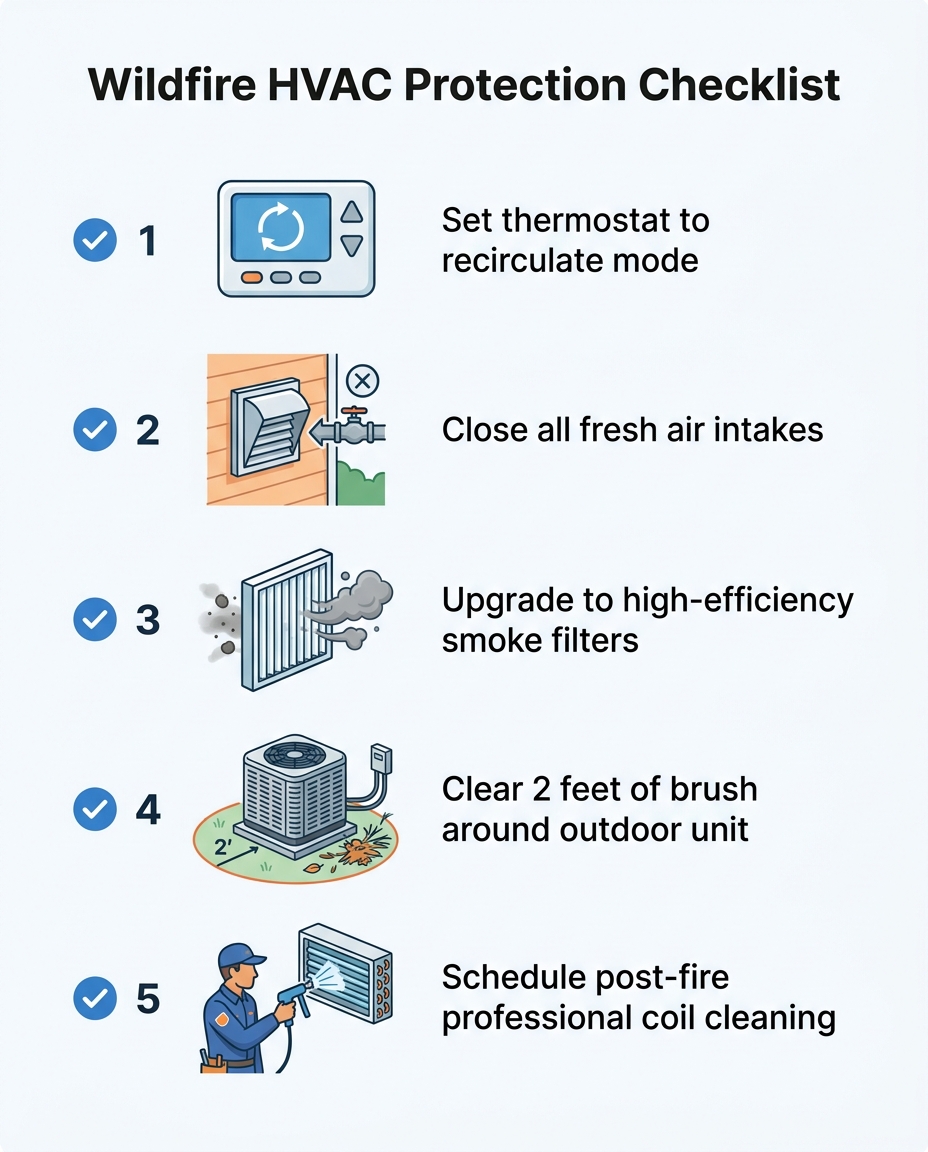
The critical adjustment: You must set your thermostat and fan settings to "recirculate" mode. This ensures that the system only moves the air already inside your house through the filter, rather than attempting to introduce fresh air from the smoky outdoors. If your HVAC system features a fresh air intake damper—often installed in newer, tightly sealed homes to improve ventilation—you need to locate it and temporarily close it until the air quality index improves.
Furthermore, you must avoid using whole-house fans or evaporative coolers (swamp coolers) during a fire. These specific systems operate by pulling massive amounts of outdoor air directly into the home and exhausting the indoor air out. Running a whole-house fan during an ash fall will instantly fill your home with toxic particulate matter and soot, undoing any indoor air quality protections you have in place.
Upgrading Your Indoor Defense: Filters for Smoke
Standard fiberglass filters—the inexpensive, transparent blue or green ones found at most hardware stores—are completely ineffective against the fine particulate matter generated by wildfires. These particles, known as PM2.5, are microscopic and will easily bypass a basic filter, circulating endlessly through your ductwork and into your lungs.
To properly defend your home, we highly recommend upgrading to high-efficiency pleated filters that carry MERV ratings appropriate for smoke filtration. The EPA recommends using a filter rated MERV 13 or higher to effectively capture microscopic ash and smoke particles. However, upgrading your filter requires a careful, step-by-step approach to avoid damaging your equipment.
1. Check your system's capacity: High-efficiency filters are dense. If your blower motor is older or undersized, a MERV 13 filter might restrict airflow too much, causing the system to freeze up or the motor to burn out. Consult your system's manual or a technician to verify the maximum MERV rating your specific unit can handle.
2. Select the right pleated filter: Look for filters explicitly labeled for smoke, smog, and fine particulate matter. The deep pleats provide more surface area to trap ash without instantly suffocating the airflow.
3. Monitor system performance: After installing a higher-rated filter, listen to your system. If it sounds like it is straining, or if the airflow from your vents feels noticeably weaker, you may need to step down to a MERV 11 filter and run an independent HEPA air purifier in your main living areas.
4. Stock up early: During an active fire event, you will need to change your filter much more frequently than the standard 90-day recommendation. Stock up on replacement filters before the season peaks, as hardware stores frequently sell out when the smoke rolls in.
Pre-Season Preparation Checklist for Autumn
Taking action before the sky turns gray is the most effective way to protect your property. This pre-season checklist provides actionable, safe steps you can complete over a weekend to fortify your home against autumn ash fallout.
• Clear a 2-foot perimeter: Go outside and inspect your condenser unit. Remove any dry brush, dead leaves, tall grass, and debris within a two-foot radius. Not only does this clear away potential kindling from stray embers, but it also ensures the unit has adequate airflow to operate efficiently.
• Inspect your weatherstripping: Walk around your home and check the seals around all windows and exterior doors. If you can feel a draft, smoke can get in. Replace worn weatherstripping to ensure a tight seal against smoke infiltration.
• Master your thermostat: Familiarize yourself with your system's thermostat settings right now. Locate the recirculation controls and ensure you know exactly how to turn off any fresh air intake features before an emergency strikes.
• Schedule your tune-up: The best defense is a clean, optimized system. Booking a routine HVAC maintenance plan visit ensures your system is operating at peak efficiency before it is stressed by high heat and poor air quality.
Post-Fire Recovery: When to Call a Professional
Once the fires are contained and the air quality returns to safe levels, the cleanup process begins. This is where many homeowners make critical mistakes that damage their equipment. It is vital to establish clear boundaries between safe DIY maintenance and mandatory professional intervention.
Opening the condenser cabinet to clean the internal coils is strictly a job for a licensed professional. The unit contains high-voltage electrical components and delicate aluminum fins that are easily crushed by heavy-handed brushing or improper water pressure. Furthermore, as discussed earlier, standard hose water is often not enough to remove ash that has baked onto the coils. Specialized, non-acidic chemical cleaners are required to safely dissolve the "cement" without corroding the metal.
Signs you need immediate professional help:
• The outdoor unit is running constantly but the house isn't cooling down.
• The vents are blowing warm or room-temperature air.
• The system is making unusual grinding, buzzing, or rattling noises after an ash fall.
• Your energy bills spike dramatically immediately following a fire event.
Sometimes, severe environmental stress reveals that a system is simply too compromised or outdated to keep up. Just last fall, our Piggies Air Conditioning crew responded to a Baldwin Park homeowner who experienced a complete cooling failure during a hot summer stretch shortly after moving into a new house. Because their budget was tight, we provided them with a cost-effective solution that included a higher-end unit and the installation of missing air vents to correct long-standing airflow issues. This kind of comprehensive airflow assessment proves that professional intervention goes far beyond just wiping down equipment.
Leveraging localized knowledge of the Baldwin Park area, our qualified technicians understand how regional micro-climates require specialized coil cleaning techniques that generic statewide advice misses. Scheduling a comprehensive AC tune-up in Baldwin Park after a fire is the safest way to restore lost efficiency and protect your compressor from premature failure.
Long-Term Protection for Your Cooling Equipment
Preparing for fire season is not just about surviving a few smoky weeks in September; it is about the broader longevity and reliability of your home's cooling system. Protecting your system from the abrasive damage of ash directly translates to extending the overall lifespan of the equipment.
Routine care prevents emergency breakdowns during the hottest, most hazardous days of the year. When your system is clean, well-lubricated, and breathing easily through high-quality filters, it doesn't have to work as hard to keep you comfortable. This reduced strain means fewer worn belts, fewer blown capacitors, and a much lower risk of a burned-out compressor.
Maintaining optimal indoor air quality is an ongoing process that requires both high-quality filtration inside and clean internal components outside. By staying proactive with your air conditioning service, you ensure that your home remains a safe, comfortable refuge no matter what the autumn winds blow in.
Frequently Asked Questions About HVAC Wildfire Protection
Should I turn off my AC during a wildfire?
No, you do not need to turn off your AC during a wildfire, provided you take the proper precautions. Running your air conditioner is actually beneficial because it helps filter the indoor air, as long as the system is set to "recirculate" mode. If you leave fresh air intakes open, however, you will pull smoke indoors, so verifying your settings is the most important step before turning the unit on.
Can wildfire smoke damage my air conditioner?
Yes, the physical ash carried by wildfire smoke can cause severe mechanical damage to your air conditioner. When abrasive ash settles on the moist outdoor condenser coils, it hardens into a thick paste that suffocates airflow. This forces the compressor to overwork, leading to overheating, massive efficiency losses, and potential system failure if not professionally cleaned.
What filter rating is best for wildfire smoke?
The EPA recommends using a filter with a MERV 13 rating or higher to effectively capture the microscopic PM2.5 particles found in wildfire smoke. However, you must check your specific HVAC system's manual before upgrading, as older or smaller blower motors may not be able to handle the restricted airflow of a highly rated pleated filter without freezing up.
How do you clean an air conditioner after a fire?
Cleaning an air conditioner after a fire requires specialized chemical treatments to dissolve hardened ash without damaging the delicate aluminum fins. Because this involves opening the high-voltage condenser cabinet and applying non-acidic foaming cleaners, it is strictly a job for a licensed HVAC professional. Hosing down the outside of the unit yourself is often ineffective and can push the ash deeper into the coils.
Why does my AC smell like smoke outside but not inside?
If your AC smells like smoke outside but the indoor air remains fresh, your system is doing its job correctly. Air conditioners do not pull outdoor air inside to cool your home; they cool the existing indoor air and blow it back out. The smell outside is simply the ambient smoke in your neighborhood, while your indoor filter is successfully trapping any particles that manage to sneak into your ductwork.
How often should I change my HVAC filter during an active fire event?
During a severe wildfire with heavy smoke and ash fall, you should check your HVAC filter every single week. Depending on the air quality index and how often your system is running, you may need to replace the filter every two to three weeks until the fires are fully contained. Once the smoke clears, you can return to your normal 30-to-90-day replacement schedule.
Secure Your Home's Air Quality This Fire Season
Actionable, safe advice and proper preparation are your best defenses against the hazards of autumn ash. You do not have to wait until the sky turns orange to take control of your indoor air quality. By upgrading your filters, adjusting your thermostat settings, and understanding the mechanical risks to your outdoor unit, you can keep your family breathing easy all season long. At Piggies Air Conditioning, we encourage you to explore professional tune-up options to ensure your system is fully prepared for the challenging months ahead. Reach out to our local professionals to secure your home's comfort and safety today.
Other blogs


Customer Testimonials



CUSTOMER SERVICE!
I highly recommend this company for anyone needing AC repair or maintenance. I'll definitely be calling them again for any future needs!

I had the pleasure of experiencing outstanding service and professionalism from Ruben, and I am beyond impressed. From the moment I first contacted them, by phone and follow up communication via email for my quotes. The attention to detail and commitment to excellence were evident.
Ruben, was incredibly responsive, addressing all my inquiries promptly and with clear, thorough explanations. Their dedication to understanding and meeting my needs was remarkable.
Ruben, went above and beyond to ensure that everything was handled seamlessly, demonstrating not just professionalism, but also a sincere dedication to customer satisfaction.
I can't recommend Piggies air Conditioning/Ruben highly enough. If you're looking for someone who combines expertise with exceptional service, look no further. They are a true example of what outstanding professionalism should be.
The technician arrived on time, which I really appreciated given how crucial air conditioning is in this heat. Ruben was professional and friendly, explaining what he was doing throughout the process. The issue I had was diagnosed fairly quickly, and they provided me with a few options on how to fix it. The pricing was transparent, and I didn't feel like there were any hidden costs, which is always a plus when it comes to service calls like these. Highly recommend this company!
1st & foremost, huge shout out to Ruben thank u so so much for reaching out & making things happen SO FAST! I was so surprised since i had reached out to a couple different places who lagged on even answering calls, messages, etc.
Ruben was also very informative & taught me ALOT that i didnt know about.
Also cant leave the amazing Luis & Miles out of
this review.
They came, they saw, they conquered!
And they worked pretty swiftly too, felt very comfy around em, loved their personalities, great attitude, work ethic, professionalism, had some really good convos & they still got the job done lightning fast
SUPER HUGE SHOUT OUT & THANKS for everything guys! Definitely recommending u guys to everyone i know.
recommendations and feedback. The actual installation was painless and unremarkable, his AC experts got it done, got it cleaned and most importantly got it right. Rueben even went a step further to assure we had
protection from the coming rain, that is service unheard of these days. His price was competitive and a REAL value for the service we recieved. Using anyone else for your AC needs, would be a huge mistake. We thank them again and will recommend to everyone.
Echoing a lot of the other reviews here, Piggies Air Conditioning responds so quickly to requests (even though I actually accidentally sent in multiple requests on my side without responding, oops!)
They were able to come do a FREE energy audit and initial inspection on the same day and Ruben was amazing at explaining his thoughts on our house's situation and what he thought was worth the money and wasn't worth the money.
I truly felt like he was trying to help me find the best solution to our issues instead of just trying to upsell us on everything and anything.
I'm definitely recommending this business to anyone I know if they want a trustworthy and realistic service, value, and quality.