









The Truth About Upgrading Your Comfort in Unpredictable Fall Weather
At Piggies Air Conditioning, when we help homeowners evaluate the pros and cons of variable-speed HVAC systems for Southern California climates, we often encounter a common misconception: that premium cooling technology is only necessary for battling the absolute hottest days of summer. Here is the thing we always tell our customers: the true test of an air conditioning system often happens when the weather is entirely unpredictable. During the September and October transition months, the weather can swing wildly from scorching afternoon highs to rapidly cooling evenings. This unique seasonal shift exposes the limitations of standard, older air conditioning units.
If you are currently evaluating different air conditioning systems for a pre-heating season replacement, you will quickly notice that the conversation centers around one major decision: sticking with traditional single-stage equipment or upgrading to variable-speed technology. Making the right choice requires weighing the initial investment against the long-term benefits of consistent indoor temperatures, better energy efficiency, and extended equipment lifespan.
The Fall Comfort Gap
In our years of serving Baldwin Park and the San Gabriel Valley, we have noticed most homes are equipped with systems designed to tackle extreme heat. However, when early fall arrives, your home might only need a small amount of cooling to stay comfortable. Standard units simply cannot adjust their output to match this lower demand. They blast cold air at full capacity, shut off abruptly, and leave the indoor air feeling clammy and stagnant. Upgrading your comfort means looking beyond raw cooling power and focusing on precision control.
Standard vs. Variable-Speed Technology: Understanding the Baseline
To make an informed decision about your home's comfort, you first need to understand the mechanical differences beneath the cabinet. The distinction between a standard unit and a variable-speed unit comes down to how the compressor and the blower motor operate when the thermostat calls for cooling or heating.
The Single-Stage Limitation
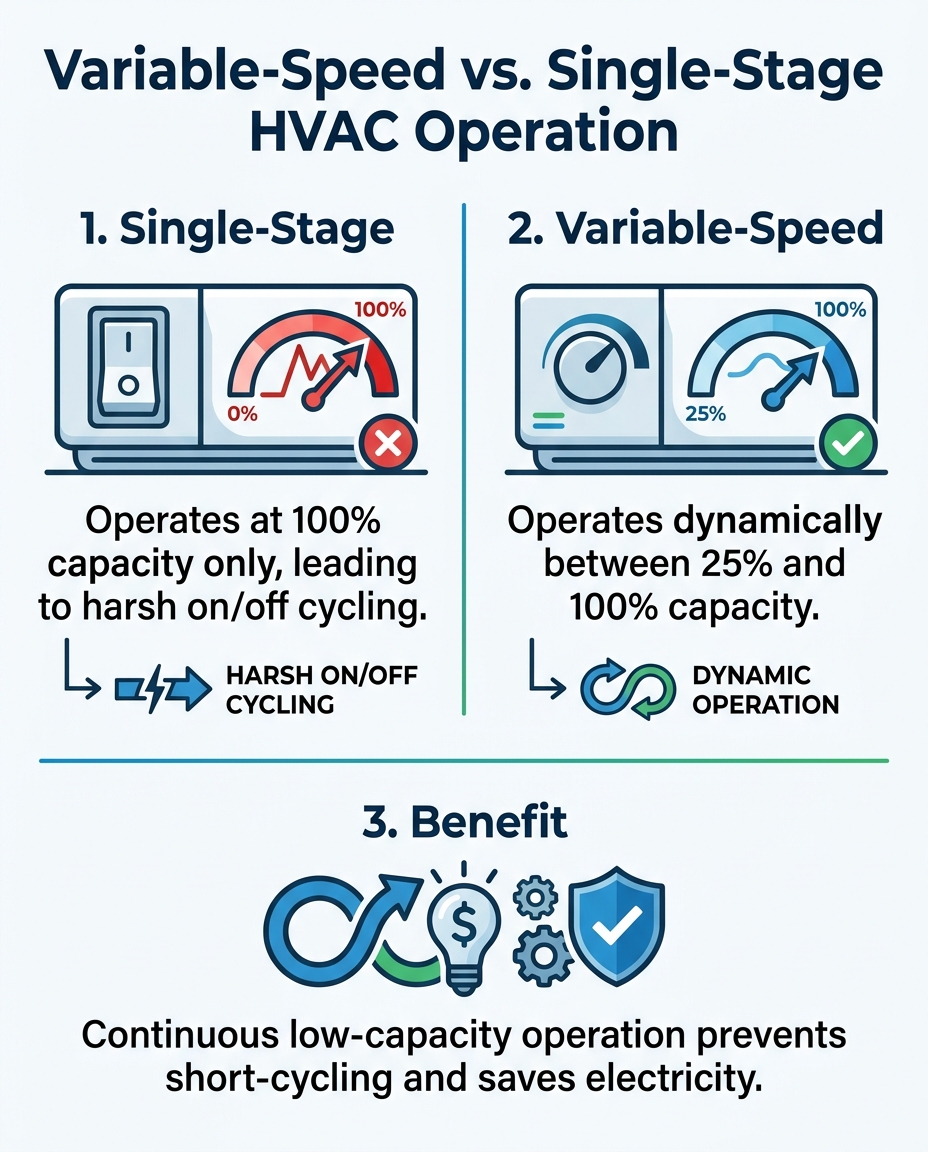
A traditional single-stage HVAC system operates on a very rigid cycle: it is either 100% ON or 100% OFF. When the indoor temperature rises above your thermostat setting, the system kicks on at full blast. Once the target temperature is reached, it shuts down completely. In the microclimates of Baldwin Park and the San Gabriel Valley, this all-or-nothing approach forces the system to start and stop constantly throughout a mild fall day, drawing massive amounts of electricity during each startup.
The Variable-Speed Advantage
Variable-speed compressors, paired with Electronically Commutated Motors (ECM), operate much like the accelerator pedal in a car. Instead of just stopping and going, they can run at capacities as low as 25% to 30%. They dynamically adjust their output to match the exact cooling or heating demand of your home at any given moment. If you are scheduling a professional AC replacement and installation, understanding this operational baseline is critical for evaluating long-term value.
• Compressor Output — Standard Single-Stage System: 100% capacity only — Variable-Speed System: Adjusts dynamically (usually 25% to 100%)
• Motor Technology — Standard Single-Stage System: Standard PSC motor — Variable-Speed System: High-efficiency ECM motor
• Temperature Swings — Standard Single-Stage System: Noticeable fluctuations (hot/cold spots) — Variable-Speed System: Precise, consistent temperatures within a half-degree
• Cycle Length — Standard Single-Stage System: Short, frequent on/off cycles — Variable-Speed System: Long, continuous low-capacity operation
The Pros: Why Variable-Speed Excels During the Fall Transition
The advantages of advanced HVAC technology become glaringly obvious during the September and October transition months. Southern California falls are famous for hot daytime peaks followed by rapidly cooling evenings. A standard system struggles to keep up with these rapid shifts without turning on and off constantly. Variable-speed technology adapts to these changes seamlessly.
Eliminating the Short-Cycle
Short-cycling occurs when an oversized or standard unit cools a space too quickly and shuts off, only to turn back on a few minutes later when the temperature creeps up. This constant stopping and starting is the hardest thing a system can do mechanically. Variable-speed units prevent this by running continuously at a very low speed. For example, when our installation team recently helped a local homeowner remove and replace an aging AC unit within a single day, upgrading to a system that could handle these exact temperature swings was a priority. We completed the swap efficiently, providing a setup that adapts instantly to shifting afternoon heat without the harsh on-and-off cycling.
Consistent Comfort and Humidity Control
• Consistent temperatures: Because variable-speed systems run almost continuously at low capacities, they eliminate the hot and cold spots that plague multi-level homes. The air is constantly circulating and mixing.
• Better humidity control: Air conditioners do not just cool the air; they dehumidify it. Longer run times allow the system to pull more moisture out of the indoor air, removing the sticky feeling that often accompanies early fall weather.
• Lower daily electricity consumption: It takes significantly more energy to start a compressor than it does to keep it running at a low speed. If you have ever wondered how much electricity an AC unit uses daily, you will find that continuous low-capacity operation uses less power than constant hard starts.
• Quieter operation: Running at 30% capacity means the blower motor and compressor are whisper-quiet. You will rarely hear the system kick on or notice the rush of air through the vents.
The Cons: Weighing the Initial Investment
While the operational benefits of variable-speed technology are undeniable, it is important to honestly evaluate the drawbacks. The primary disadvantage is not in how the system performs, but in what it takes to get it installed in your home. Upgrading to this tier of comfort requires a higher initial investment compared to swapping out an old unit for a basic single-stage model.
The Upfront Investment
Variable-speed compressors and ECM motors are sophisticated pieces of engineering. They rely on complex internal electronics, advanced inverter boards, and proprietary communicating thermostats to monitor your home's climate in real time. This advanced technology naturally commands a premium price tag upfront. For homeowners in Baldwin Park and the San Gabriel Valley, this higher initial cost must be weighed carefully against the expected lifespan of the equipment and the projected monthly energy savings.
Installation Complexity
Our technicians know firsthand that installing a variable-speed system is not a simple "box swap." These units require specialized training to install and calibrate correctly. The ductwork must be assessed to ensure it can handle continuous, low-velocity airflow, and the communicating thermostat must be perfectly synced with the outdoor unit and indoor air handler. Because of this complexity, you cannot cut corners on the installation process.
Fortunately, the upfront cost does not have to be a roadblock. Many homeowners choose to manage the initial investment by taking advantage of flexible HVAC financing options. Structured payment plans allow you to spread the cost of the premium equipment over time, making it easier to enjoy the immediate comfort and efficiency benefits without draining your savings.
Maximizing ROI with Energy Efficiency and Generic Incentives
When evaluating the long-term return on investment (ROI) for a variable-speed upgrade, energy efficiency is the deciding factor. The continuous, low-capacity operation of these systems translates directly into lower electricity usage, which is especially valuable in regions with high utility rates.
The Highway Mileage Analogy
Think of a standard single-stage air conditioner like a car driving in heavy stop-and-go city traffic. Every time it accelerates from a dead stop, it burns a massive amount of fuel. A variable-speed system, on the other hand, is like a car cruising steadily on the highway. Even though it is running continuously, maintaining a steady speed requires a fraction of the energy. The ECM motors used in these systems are incredibly efficient, drawing significantly less wattage than traditional motors during the September and October transition months.
Leveraging Generic Incentives
To further offset the premium initial cost, homeowners should explore available energy efficiency incentives. Because variable-speed systems achieve some of the highest SEER2 (Seasonal Energy Efficiency Ratio) ratings on the market, they frequently qualify for various generic federal tax credits and local utility rebates designed to promote green energy upgrades.
The smart move: Always verify current rebate programs with your utility provider or consult a tax professional before scheduling your installation. These generic incentives can meaningfully reduce the total cost of ownership, accelerating the timeline for when your monthly energy savings overtake the initial premium.
Variable-Speed Heat Pumps: A Year-Round Solution for Mild Winters
While we often discuss variable-speed technology in the context of air conditioning, its most powerful application for Southern California homeowners is actually within a heat pump system. Heat pumps provide both high-efficiency cooling during the summer and fall, and reliable heating throughout the winter.
Why Heat Pumps Make Sense Here
Instead of burning fuel to generate heat, a heat pump simply reverses the flow of refrigerant to pull ambient heat from the outside air and transfer it indoors. Because the winters in Baldwin Park and the San Gabriel Valley are relatively mild, a heat pump never has to work incredibly hard to keep your home warm. When you combine heat pump technology with a variable-speed compressor, you get a system that provides exact, gentle heating without the dry, blasting hot air associated with traditional gas furnaces.
Just recently, our team provided an estimate to a local homeowner preparing for the upcoming winter season. After receiving a competitive quote and having their questions thoroughly answered by our experts, they scheduled the replacement for the following week. Our installation crew handled the home with care, leaving the new system ready to tackle both late-fall heat waves and chilly winter mornings. Upgrading to variable-speed heat pumps simplifies your home's infrastructure by providing a single, highly efficient solution for year-round climate control.
Calculating the Right System for Your Specific Microclimate
Generic national advice often fails to account for the unique weather patterns of Southern California. What works for a home in the Midwest is not necessarily the right choice for managing the rapid temperature swings of our local microclimates. Determining if a variable-speed upgrade is truly worth the investment requires a personalized approach.
The Importance of a Professional Load Calculation
Before committing to any new HVAC system, a professional load calculation (often called a Manual J calculation) must be performed. This process evaluates your home's specific thermal characteristics rather than just guessing based on square footage.
Here is what a proper evaluation should include:
• Insulation levels: Checking the quality of insulation in your attic and walls to determine how well your home retains conditioned air.
• Window quality and orientation: Assessing how much solar heat gain your home experiences during the hottest parts of the day.
• Ductwork condition: Inspecting existing ducts for leaks, poor airflow, or sizing issues that could bottleneck a new high-efficiency system.
• Local weather patterns: Factoring in the specific diurnal temperature variations (the difference between daytime highs and nighttime lows) of your exact neighborhood.
As local experts based in Baldwin Park, our team at Piggies Air Conditioning understands the unique microclimates of Southern California and can accurately calculate if a variable-speed system's long-term energy savings will offset the initial premium cost for your specific home. Working with a local team ensures your new system is tailored to reality, not just a generic formula.
Frequently Asked Questions
Why do single-stage HVAC systems short cycle in mild weather?
Single-stage systems only operate at 100% capacity, meaning they blast maximum cold air regardless of the actual temperature outside. During mild weather, they cool the house too quickly, shut off, and then turn right back on when the temperature slightly rises. This rapid stopping and starting is called short-cycling and causes excessive wear on the components.
Are variable-speed HVAC systems worth it in Southern California?
For many homeowners, yes. The ability to run at low capacities makes variable-speed systems ideal for handling the dramatic temperature swings between our hot afternoons and cool evenings. They provide superior comfort, better humidity control, and lower daily energy consumption compared to standard models.
How do variable-speed compressors save electricity during the fall?
They save electricity by running continuously at a very low speed, often around 25% to 30% of their total capacity. It takes significantly less electricity to maintain a low running speed than it does to constantly start and stop a heavy compressor at full power.
What are the disadvantages of a variable speed HVAC?
The primary disadvantage is the higher initial purchase and installation cost. Because the technology relies on complex electronics, communicating thermostats, and specialized ECM motors, both the equipment and the professional installation require a larger upfront investment than basic single-stage units.
How long do variable speed compressors last?
When properly maintained, a variable-speed compressor can last 15 to 20 years. Because they avoid the harsh, constant starting and stopping of single-stage units, variable-speed compressors generally experience less mechanical stress and wear over their operational lifespan.
Can generic tax credits help offset the cost of a variable-speed upgrade?
Yes, many high-efficiency variable-speed systems and heat pumps meet the strict SEER2 energy guidelines required to qualify for generic federal tax credits and local utility rebates. Homeowners should always verify current, applicable incentive programs with their utility provider or a tax professional prior to installation.
Ready to Upgrade Your Home's Comfort This Fall?
Navigating the transition weather of early fall does not have to mean constantly adjusting your thermostat or settling for a clammy house. By weighing the pros and cons of variable-speed technology, you can make an informed choice that delivers consistent, quiet comfort for years to come. If you are ready to explore your options, scheduling a professional AC replacement and installation evaluation will give you the clear, regionally grounded answers you need to find the perfect fit for your home.
Other blogs


Customer Testimonials



CUSTOMER SERVICE!
I highly recommend this company for anyone needing AC repair or maintenance. I'll definitely be calling them again for any future needs!

I had the pleasure of experiencing outstanding service and professionalism from Ruben, and I am beyond impressed. From the moment I first contacted them, by phone and follow up communication via email for my quotes. The attention to detail and commitment to excellence were evident.
Ruben, was incredibly responsive, addressing all my inquiries promptly and with clear, thorough explanations. Their dedication to understanding and meeting my needs was remarkable.
Ruben, went above and beyond to ensure that everything was handled seamlessly, demonstrating not just professionalism, but also a sincere dedication to customer satisfaction.
I can't recommend Piggies air Conditioning/Ruben highly enough. If you're looking for someone who combines expertise with exceptional service, look no further. They are a true example of what outstanding professionalism should be.
The technician arrived on time, which I really appreciated given how crucial air conditioning is in this heat. Ruben was professional and friendly, explaining what he was doing throughout the process. The issue I had was diagnosed fairly quickly, and they provided me with a few options on how to fix it. The pricing was transparent, and I didn't feel like there were any hidden costs, which is always a plus when it comes to service calls like these. Highly recommend this company!
1st & foremost, huge shout out to Ruben thank u so so much for reaching out & making things happen SO FAST! I was so surprised since i had reached out to a couple different places who lagged on even answering calls, messages, etc.
Ruben was also very informative & taught me ALOT that i didnt know about.
Also cant leave the amazing Luis & Miles out of
this review.
They came, they saw, they conquered!
And they worked pretty swiftly too, felt very comfy around em, loved their personalities, great attitude, work ethic, professionalism, had some really good convos & they still got the job done lightning fast
SUPER HUGE SHOUT OUT & THANKS for everything guys! Definitely recommending u guys to everyone i know.
recommendations and feedback. The actual installation was painless and unremarkable, his AC experts got it done, got it cleaned and most importantly got it right. Rueben even went a step further to assure we had
protection from the coming rain, that is service unheard of these days. His price was competitive and a REAL value for the service we recieved. Using anyone else for your AC needs, would be a huge mistake. We thank them again and will recommend to everyone.
Echoing a lot of the other reviews here, Piggies Air Conditioning responds so quickly to requests (even though I actually accidentally sent in multiple requests on my side without responding, oops!)
They were able to come do a FREE energy audit and initial inspection on the same day and Ruben was amazing at explaining his thoughts on our house's situation and what he thought was worth the money and wasn't worth the money.
I truly felt like he was trying to help me find the best solution to our issues instead of just trying to upsell us on everything and anything.
I'm definitely recommending this business to anyone I know if they want a trustworthy and realistic service, value, and quality.