










Why Does Your Second Floor Feel Like an Oven While the Downstairs Freezes?
Are you constantly adjusting the thermostat just to make your bedroom bearable, while your family downstairs wears sweaters? If you are searching for the real reason your upstairs rooms are always hotter than downstairs, you are not alone. It is a common frustration, especially when the late-summer August heat hits its peak. Many homeowners try to fix this by simply cranking the AC lower, but that usually just leaves the living room freezing while the second floor remains sweltering.
The core problem usually comes down to thermal displacement combined with inadequate return air sizing, rather than a failing compressor. You face a clear decision point: keep overworking that downstairs thermostat and paying high energy bills, or address the actual structural airflow limitations trapping heat upstairs. Fixing the root cause often requires targeted solutions like a ductless mini-split system or comprehensive air conditioning services to properly balance the airflow throughout your home.
The Physics of Thermal Displacement in Multi-Level Homes
To understand why your second floor feels so uncomfortable, you have to look at the natural physics of how heat moves through a building. When you live in one of the many Baldwin Park multi-level homes, your house acts as a giant structural heat trap. While physics initiates the problem, your HVAC system's design dictates whether that heat gets trapped or successfully removed.
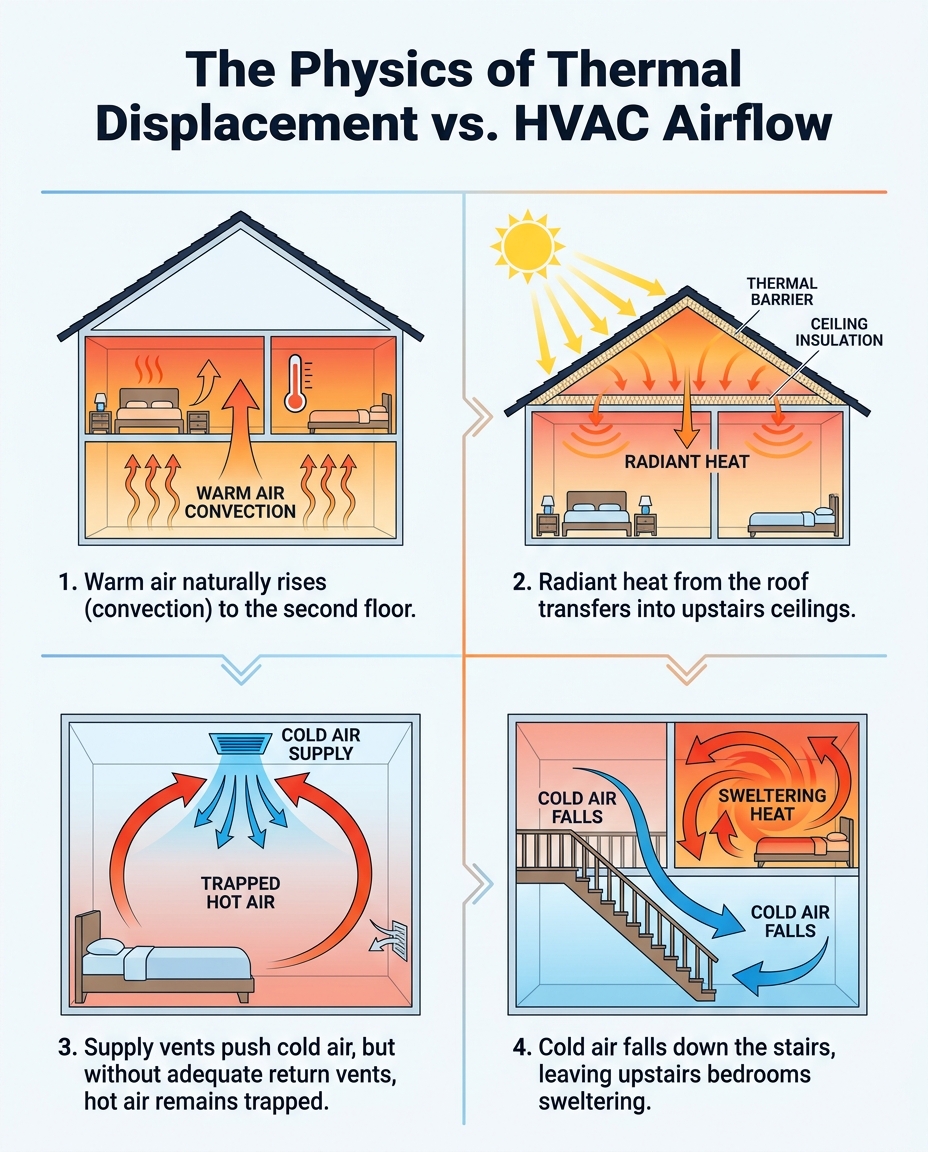
Here is exactly how the physics of thermal displacement works against your comfort:
1. The Natural Rise of Warm Air (Convection): Thermal displacement is the scientific term for a simple concept: warm air is less dense than cold air. Because it is lighter, warm air naturally rises to the highest point in your house, which is always your second-story ceiling.
2. Radiant Solar Heat Gain: Your roof absorbs massive amounts of radiant solar heat throughout the day. Highlighted by the intense Southern California late-summer heat radiating through the roof, this thermal energy transfers directly down into your attic and eventually into your upstairs bedrooms.
3. The Back-to-School Transition Period: During late summer, the sun's angle changes, often hitting second-story windows more directly. This intense solar heat gain compounds the natural convection already happening inside your home.
4. The Structural Heat Trap: Because heat naturally rises from the first floor and radiant heat presses down from the attic, your second floor becomes squeezed by high temperatures. Without a mechanical way to extract this specific pocket of hot air, the heat simply accumulates until the sun goes down.
While you cannot change the laws of physics, a properly designed cooling system is built to counteract them. When it fails to do so, the problem usually lies in the ductwork.
The Mechanical Failure: Undersized Return Air Vents
The real reason your upstairs stays hot is rarely a lack of cold air being pushed in. Instead, it is a failure to pull the hot air out. Your HVAC system relies on two distinct types of airflow to function: supply and return.
The Problem: Supply vents push conditioned, cold air into your rooms. Return vents act as vacuums, pulling stagnant, warm air back into the ductwork to be filtered, cooled, and redistributed. Many two-story homes were built with plenty of supply vents but severely undersized—or completely missing—return vents in the upstairs bedrooms.
The Cause: If the trapped hot air cannot be pulled out of a closed bedroom, the new cold air being pushed by the supply vents has nowhere to go. It is like trying to blow air into a glass bottle that is already full. The airflow simply stops. Furthermore, most multi-level homes rely on a single-zone thermostat located on the cooler first floor. Because cold air naturally falls, the downstairs reaches the target temperature quickly. The thermostat then shuts off the cooling cycle long before the upstairs is properly conditioned.
The Solution: Restoring the balance requires addressing the return air volume. For example, one local homeowner found their AC wasn't cooling properly on a hot Sunday. A technician stopped by, evaluated the system, and fixed the issues. Often, these hot-day emergencies reveal that the cooling equipment itself is working fine, but the airflow is heavily restricted by undersized returns during the extreme late-summer August heat.
Why Supply Vents Aren't Enough
You might wonder why a powerful blower motor cannot just force enough cold air upstairs to overcome the heat. The short answer is gravity and pressure.
• Cold air is heavy: Conditioned air is dense. As soon as it leaves an upstairs supply vent, it naturally wants to fall down the stairs and pool on the first floor.
• Lack of vacuum pressure: Without dedicated upstairs returns actively pulling the hot air out, the system cannot create the necessary vacuum to cycle the air effectively. The hot air simply sits near the ceiling, untouched by the cold air falling to the floor.

The Danger of Closing Downstairs Vents to Force Air Upstairs
When faced with a freezing first floor and a boiling second floor, the most common homeowner instinct is to walk around the downstairs and close all the supply registers. The logic seems sound: if you block the air from entering the living room, it will be forced to travel up to the bedrooms. Unfortunately, this is a harmful myth.
The Myth: Closing vents redirects cold air to the rooms that need it most, balancing the home's temperature for free.
The Reality: Closing vents dramatically increases the static pressure inside your ductwork, which can cause severe mechanical damage to your cooling system.
HVAC systems are meticulously balanced to push a specific volume of airflow. When you close registers, the blower motor still tries to push the same amount of air, but now it has fewer escape routes. This creates a bottleneck. High static pressure strains the blower motor, causing it to overheat and potentially fail prematurely. Worse, because less air is flowing over the indoor evaporator coil, the coil can literally freeze solid into a block of ice.
When a coil freezes, it blocks all airflow, which is a primary reason why your AC is running constantly without actually cooling your Baldwin Park multi-level home. Rebalancing airflow safely requires professional damper adjustments within the main duct trunk lines, not just shutting the plastic registers in your ceiling or floor.
Why Simply Upgrading to a Larger AC Unit Won't Fix the Problem
Another common misconception is that a hot upstairs simply means the air conditioner is too weak. Homeowners often assume that upgrading to a larger capacity unit will finally blast enough cold air to the second floor. In reality, capacity does not equal airflow distribution.
If you install an oversized AC unit on a duct system with undersized returns, you will actually make your comfort problems worse. An oversized unit will cool the downstairs incredibly fast. Because the thermostat is located downstairs, the system will short-cycle—meaning it shuts off prematurely after only running for five or ten minutes.
Short-cycling prevents the system from running long enough to push cooling to the second story. Even worse, an air conditioner needs to run for at least 15 to 20 minutes to effectively dehumidify the air. A short-cycling oversized unit leaves your home feeling cold and clammy downstairs, and hot and humid upstairs.
Proper professional standards dictate how a system should be sized. ACCA Manual J is the industry-standard load calculation used to determine exactly how much cooling a specific home needs, factoring in windows, insulation, and the late-summer August heat. ACCA Manual D is the standard for designing the ductwork to handle that exact volume of air.
Leveraging Piggies Air Conditioning's expertise in custom HVAC system design and airflow dynamics, we know that fixing the issue requires proper load calculation and return air sizing, not just a bigger AC unit. In one instance, a homeowner needed an air conditioner repair, and we successfully repaired the existing unit when another company had aggressively suggested a full replacement. A bigger unit cannot push air through a duct system that isn't designed to handle it.
Effective Solutions for Balancing Multi-Level Temperatures
If closing vents and buying a bigger AC unit aren't the answers, what actually works? Correcting the airflow imbalance in Baldwin Park multi-level homes requires targeted, professional solutions that address the root cause of thermal displacement.
Here is a breakdown of the most effective methods to balance your home's temperatures:
• Ductwork Modifications — How It Works: Expanding existing upstairs return vents or adding new dedicated returns to actively pull trapped hot air out of bedrooms. — Best Application: Homes with accessible attic space where adding larger return ducts is structurally feasible.
• HVAC Zoning Systems — How It Works: Installing motorized dampers inside the ductwork, controlled by multiple thermostats, allowing you to cool floors independently. — Best Application: Homes with adequate existing ductwork that just need precise, room-by-room temperature control.
• Ductless Mini-Splits — How It Works: Installing an independent, targeted cooling unit directly on the wall of a hot bedroom, bypassing the central ductwork entirely. — Best Application: Bonus rooms, master suites, or older homes where expanding central ductwork is impossible or cost-prohibitive.
Each of these solutions directly addresses the physics of heat rising by ensuring the upstairs space has the mechanical support it needs to either extract the hot air or introduce dedicated cooling directly at the source.
How Routine Maintenance Impacts Upstairs Airflow
Even if your home is perfectly designed with large upstairs returns and balanced ductwork, neglecting basic upkeep will eventually choke off the airflow to your second floor. The furthest points of your house—the upstairs bedrooms—are always the first to suffer when system efficiency drops.
Here is how neglecting maintenance restricts your system's ability to pull air from the upstairs:
• Clogged Air Filters: A dirty filter acts like a wall in your ductwork. It severely restricts the blower motor's ability to pull return air from the distant upstairs vents.
• Dirty Evaporator Coils: When dust bypasses a bad filter, it sticks to the wet indoor coil. This restricts airflow velocity and reduces the system's ability to absorb heat.
• Failing Blower Motors: A motor straining against high static pressure will eventually lose its ability to push cold air all the way up the stairs.
Professional cleanings restore your system's baseline static pressure and airflow velocity. For instance, another homeowner recently needed an evaporator coil cleaning; a quote was provided, and the cleaning service was completed timely and satisfactorily, immediately restoring proper airflow to the upper levels of the house.
To ensure your blower motor is operating at peak capacity during the hottest months, scheduling routine HVAC maintenance is non-negotiable. A clean system breathes easier, and when your system breathes easier, your upstairs bedrooms stay cooler during the intense late-summer August heat.
Frequently Asked Questions About Multi-Level Cooling
Why is my upstairs so hot even with the AC on?
Your upstairs stays hot because of thermal displacement combined with inadequate return air vents. Warm air naturally rises to the second floor, while the roof radiates heat downward into the bedrooms. If your Baldwin Park multi-level home lacks large enough return vents to pull that trapped hot air out, the new cold air from the AC has nowhere to go, leaving the upstairs sweltering while the downstairs freezes.
Does closing downstairs vents help cool the upstairs?
No, closing downstairs vents does not help cool the upstairs and can actually damage your HVAC system. Closing registers increases the static pressure inside your ductwork, which acts like a kink in a garden hose. This excess pressure strains the blower motor and can cause the indoor evaporator coil to freeze solid, ultimately stopping the cooling process entirely.
How do I balance the AC between two floors?
Balancing the AC requires professional adjustments to the airflow, not just tweaking the thermostat. The most effective methods include expanding the upstairs return air vents, installing a mechanical HVAC zoning system with motorized dampers, or adjusting the blower motor speed. A technician must measure the static pressure to ensure any adjustments do not harm the equipment.
How can I cool down my upstairs bedroom?
To cool down an upstairs bedroom effectively, you must address the trapped heat. Keeping interior doors open helps air circulate back to the main return vent. However, for a permanent fix, you may need a technician to install dedicated return vents in the bedroom, or you might consider adding a supplemental cooling system that targets that specific room.
Can a ductless mini-split solve upstairs heat?
Yes, a ductless mini-split is often the most effective solution for stubborn upstairs heat. Because mini-splits operate independently of your central ductwork, they completely bypass the issues of undersized returns and thermal displacement. They provide targeted, efficient cooling directly to the hottest rooms without overcooling the rest of the house.
Get Professional Help Balancing Your Home's Airflow
Living with a freezing living room and a boiling bedroom is not just a fact of life you have to accept. Upstairs heat is a structural airflow issue driven by the physics of thermal displacement and the mechanical limitations of your ductwork. When the late-summer August heat sets in, overworking your downstairs thermostat will only lead to higher energy bills and a strained system.
Correcting this imbalance requires professional diagnostics to accurately measure static pressure, evaluate return air volume, and determine the exact load requirements of your second floor. If you are tired of uneven temperatures, it is time to schedule a thorough inspection. We can provide a clear, physics-based explanation of your thermal displacement and return air issues, along with a clear understanding of the professional diagnostic steps and solutions required to correct the airflow imbalance permanently.
Other blogs


Customer Testimonials



CUSTOMER SERVICE!
I highly recommend this company for anyone needing AC repair or maintenance. I'll definitely be calling them again for any future needs!

I had the pleasure of experiencing outstanding service and professionalism from Ruben, and I am beyond impressed. From the moment I first contacted them, by phone and follow up communication via email for my quotes. The attention to detail and commitment to excellence were evident.
Ruben, was incredibly responsive, addressing all my inquiries promptly and with clear, thorough explanations. Their dedication to understanding and meeting my needs was remarkable.
Ruben, went above and beyond to ensure that everything was handled seamlessly, demonstrating not just professionalism, but also a sincere dedication to customer satisfaction.
I can't recommend Piggies air Conditioning/Ruben highly enough. If you're looking for someone who combines expertise with exceptional service, look no further. They are a true example of what outstanding professionalism should be.
The technician arrived on time, which I really appreciated given how crucial air conditioning is in this heat. Ruben was professional and friendly, explaining what he was doing throughout the process. The issue I had was diagnosed fairly quickly, and they provided me with a few options on how to fix it. The pricing was transparent, and I didn't feel like there were any hidden costs, which is always a plus when it comes to service calls like these. Highly recommend this company!
1st & foremost, huge shout out to Ruben thank u so so much for reaching out & making things happen SO FAST! I was so surprised since i had reached out to a couple different places who lagged on even answering calls, messages, etc.
Ruben was also very informative & taught me ALOT that i didnt know about.
Also cant leave the amazing Luis & Miles out of
this review.
They came, they saw, they conquered!
And they worked pretty swiftly too, felt very comfy around em, loved their personalities, great attitude, work ethic, professionalism, had some really good convos & they still got the job done lightning fast
SUPER HUGE SHOUT OUT & THANKS for everything guys! Definitely recommending u guys to everyone i know.
recommendations and feedback. The actual installation was painless and unremarkable, his AC experts got it done, got it cleaned and most importantly got it right. Rueben even went a step further to assure we had
protection from the coming rain, that is service unheard of these days. His price was competitive and a REAL value for the service we recieved. Using anyone else for your AC needs, would be a huge mistake. We thank them again and will recommend to everyone.
Echoing a lot of the other reviews here, Piggies Air Conditioning responds so quickly to requests (even though I actually accidentally sent in multiple requests on my side without responding, oops!)
They were able to come do a FREE energy audit and initial inspection on the same day and Ruben was amazing at explaining his thoughts on our house's situation and what he thought was worth the money and wasn't worth the money.
I truly felt like he was trying to help me find the best solution to our issues instead of just trying to upsell us on everything and anything.
I'm definitely recommending this business to anyone I know if they want a trustworthy and realistic service, value, and quality.