









Hearing Alarming AC Noises? When to Panic and When to Pause
At Piggies Air Conditioning, we regularly hear from Baldwin Park homeowners who are standing in their hallway, listening to an awful racket from their vents, and frantically searching for strange noises from your AC unit: squeals, grinds, and pops explained. You are not alone. It is incredibly stressful to hear your cooling system making loud, aggressive sounds, especially when you rely on it to keep your home comfortable. The immediate question racing through your mind is likely whether you should shut the system off right now to prevent a catastrophic failure, or if it can safely wait until our technicians arrive.
In our years of keeping local homes cool, we've found that different mechanical sounds carry completely different risk levels for your equipment. A sudden bang might be harmless, while a steady screech could indicate a component is on the verge of tearing itself apart. If you live in Baldwin Park CA, losing your cooling capacity during a late-summer heatwave is a serious problem, making it all the more important to understand exactly what your system is trying to tell you. Understanding these mechanical sounds is the very first step to resolving the issue safely and protecting your investment.
For comprehensive support with your cooling system, explore our air conditioning services to see how professional care keeps your home comfortable.
Immediate Triage: Mapping AC Sounds to Risk Levels
When your air conditioner starts making a new, loud noise, the safest initial step is always to turn the thermostat to the "OFF" position. Your outdoor compressor operates at incredibly high revolutions per minute (RPMs). Because of this speed, a failing internal part can cause severe, irreversible damage to the entire unit within a matter of minutes. By shutting the system down, you prevent a relatively minor component failure from destroying the entire machine.
However, once the system is safely off, you can start to categorize the sound you heard. Creating a clear distinction between noises that demand an immediate shutdown and those you can temporarily monitor will help you communicate effectively with our professional team. If you are dealing with a severe sound, you may need to look into emergency HVAC repair to protect your home's comfort.
Sounds That Require Immediate System Shutdown
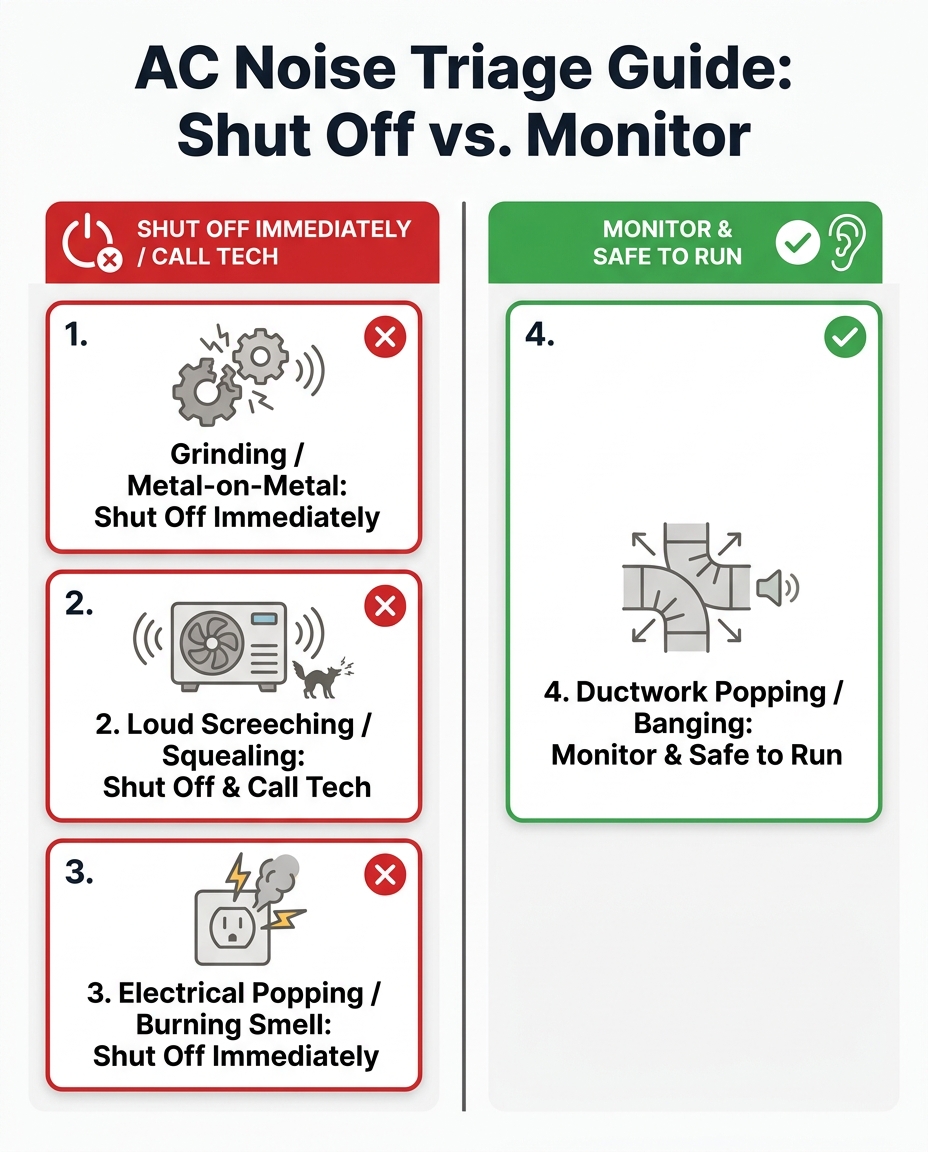
If you hear any of the following sounds, leave the system off and call for professional help immediately. These noises indicate active mechanical or electrical damage.
• Grinding or screeching: A harsh, metal-on-metal sound coming from the outdoor unit usually means motor bearings have failed.
• Loud electrical popping: Distinct from ductwork popping, this sound is often followed by a burning plastic or ozone smell, indicating a severe electrical short.
• Violent rattling: A heavy, chaotic rattling suggests internal hardware, like a fan blade or motor mount, has broken loose and is actively striking other components.
Sounds You Can Temporarily Monitor
While no unusual sound should be ignored forever, our technicians often reassure homeowners that some noises do not pose an immediate threat of catastrophic equipment failure.
• Brief popping on startup: A single pop or bang when the system first turns on is often just metal ductwork expanding as cold air hits it.
• Mild hissing near vents: A slight hissing sound might indicate a duct leak or a refrigerant issue. While it requires prompt professional attention, it usually won't cause the unit to explode in the next ten minutes.
Decoding AC Squeals: Fan Belts and Blower Motor Stress
A high-pitched squealing or screeching sound is one of the most common complaints homeowners have about their air conditioners. While it can be incredibly irritating, translating that sound to its likely mechanical source can help you understand what is going wrong inside the cabinet. In most cases our team sees, a loud squeal points directly to a worn-out fan belt or failing blower motor bearings.
Older air conditioning units often use a belt-driven blower motor. Just like the serpentine belt in your car engine, continuous operation degrades these rubber belts over time. As the rubber dries out, cracks, and stretches, the belt begins to slip on its metal pulleys. This high-speed slipping creates a piercing screech every time the indoor fan engages. If left unaddressed, the belt will eventually snap, leaving you with no airflow at all.
The Lifecycle of Blower Motor Bearings
In newer, direct-drive systems (which do not use belts), a continuous squeal usually indicates an issue with the blower motor's internal bearings. These bearings are packed with heavy lubrication to allow the motor shaft to spin smoothly at high speeds. Over years of operation, this lubrication breaks down, dries up, or leaks out. Once the bearings lose their protective coating, the metal parts begin to rub together, producing a high-pitched squeal that often transitions into a deeper grind as the wear worsens.
While a squealing belt or bearing might not require an emergency shutdown at two in the morning, it is a massive red flag. It indicates that a vital component is nearing total failure. Addressing the squeal early can prevent a sudden breakdown during the hottest part of the day. If you are noticing these warning signs, scheduling AC repair in Los Angeles County before the component fails completely is the smartest approach.
The Danger of Grinding Noises: Compressor and Bearing Failure
If a squeal is a warning, a grinding noise is a blaring alarm. Grinding is defined by a harsh, heavy, metal-on-metal sound that usually originates from the outdoor condenser unit. When you hear this sound, you are listening to physical destruction happening in real-time. This noise frequently points to completely failed motor bearings or, even worse, internal compressor failure.
The underlying problem: When motor bearings fail completely, the rotor inside the motor loses its precise alignment. It begins to scrape against the inner housing of the motor casing. This metal-on-metal friction creates the loud grinding noise. If the sound is coming from the sealed compressor itself, it means the internal pistons or scroll mechanisms are failing and breaking apart.
The compounding cause: Running a system with a grinding motor forces the equipment to work exponentially harder to overcome the friction. This excessive strain draws massive amounts of electrical current, which overheats the motor windings. Eventually, the motor will burn out entirely, drastically increasing the scope of the repair.
The practical solution: The rule for grinding noises is absolute: turn the thermostat to "OFF" immediately. Our team at Piggies Air Conditioning frequently sees this exact scenario during the late-summer rush. Just last August, as kids were heading back to school, a local family reached out to us when their air conditioner needed repair after it started making a harsh noise. Another company had already recommended a full system replacement, but a careful inspection by our skilled technicians revealed the unit could actually be repaired, avoiding a costly replacement. By shutting the system off early and getting a second opinion from our team, they saved the core machinery from total destruction. If you suspect your outdoor unit is failing, understanding what to do about a heat pump making a grinding or rattling noise can save your equipment.
Popping and Banging: Thermal Expansion vs. Electrical Issues
Popping and banging sounds are particularly tricky because they can represent either a completely harmless physical reaction or a highly dangerous electrical short. Differentiating between harmless ductwork popping and dangerous electrical popping is essential to ease your anxiety while maintaining safety in your home.
When your air conditioner kicks on, it immediately starts pushing very cold air through metal ductwork that has been sitting in a warm attic or ceiling space. As the cold air hits the warm metal, the ductwork rapidly contracts. This natural thermal expansion and contraction causes the metal to buckle slightly, resulting in a distinct popping or banging sound. While this ductwork popping can be annoying—especially at night—our technicians will tell you it is generally harmless to your HVAC system.
Comparing Popping Sounds
To help you determine what you are hearing, use this comparison of common popping noises:
• Sound Profile — Thermal Expansion (Ductwork): Hollow, metallic bang or single pop. — Electrical Issues (Relays/Capacitors): Sharp, rapid clicking, crackling, or snapping.
• Location — Thermal Expansion (Ductwork): Inside the house, radiating from vents or walls. — Electrical Issues (Relays/Capacitors): Outside, directly at the condenser unit cabinet.
• Timing — Thermal Expansion (Ductwork): Occurs just after the system turns on or off. — Electrical Issues (Relays/Capacitors): Occurs continuously, or the system fails to start.
• Action Required — Thermal Expansion (Ductwork): Monitor it; safe to run. Consider duct insulation. — Electrical Issues (Relays/Capacitors): Shut off immediately. Call a professional.
If a popping or rapid clicking sound is accompanied by a burning plastic odor, or if the system simply refuses to start after making the noise, you are dealing with an electrical issue. Failing relays, dying capacitors, or dangerous electrical shorts require a licensed professional to safely diagnose and repair.
How Late-Summer Heat Accelerates Mechanical Fatigue
You might wonder why these sudden, alarming noises frequently appear late in the cooling season rather than right when you turn the system on in the spring. In our experience working through Baldwin Park's intense back-to-school heatwaves, the answer lies in the cumulative mechanical fatigue caused by the August late-summer cooling season.
With Baldwin Park's intense, continuous summer heat, your air conditioner is forced to run longer, harder cooling cycles just to maintain a baseline temperature in your home. These extended cycles drastically reduce the downtime that internal motors need to cool off. By the time late summer arrives, your AC has endured months of peak-capacity operation.
The Cumulative Toll of August Heat
This cumulative mechanical fatigue is the primary driver for sudden snapped belts, worn bearings, and electrical relay failures. Parts that were slightly worn in May are completely exhausted by August. The continuous heat causes lubricants to thin out and rubber components to become brittle.
During a particularly hot late-summer weekend last year, one of our local customers called because their AC needed repair urgently after it began making a strange noise. Our technician arrived the same day, performed step-by-step troubleshooting, and solved the problem, getting the system working again despite the intense heat. This highlights why proactive listening during this critical late-season period is so important. Catching the sound of a slightly worn bearing in early August can prevent a complete motor burnout during a late-August heatwave.
Professional Diagnosis: Moving from Panic to Resolution
Understanding what the different noises mean helps prepare you for a technician's visit. It removes the mystery and allows you to communicate the symptoms clearly. At Piggies Air Conditioning, our team prioritizes transparent communication, ensuring homeowners understand exactly what these noises mean and explaining the simple fixes clearly, without resorting to high-pressure, fear-based tactics.
When our professionals arrive to diagnose an unusual noise, we do not simply guess at the problem. We follow a rigorous, step-by-step troubleshooting process targeted at the specific component causing the issue.
The Professional Diagnostic Process
1. Auditory and Visual Inspection: The technician will safely power on the system briefly to isolate the exact location and nature of the sound, looking for visible signs of wear like loose belts or vibrating panels.
2. Electrical Testing: Using specialized multimeters, they will test the capacitors, relays, and motor windings to ensure the components are receiving and using the correct voltage.
3. Mechanical Assessment: The technician will physically inspect the blower wheel, fan blades, and motor bearings for excessive play, friction, or damage.
4. Clear Explanation: Once the issue is isolated, our technician will walk you through the findings. For example, when one of our Baldwin Park customers needed their AC unit checked out recently, our technician arrived early the next day, and clearly explained the simple fix and recommendations for the future.
This transparent approach ensures you are fully informed about the health of your system and the necessary steps to restore it to quiet, efficient operation.
Frequently Asked Questions About Alarming AC Noises
Is it safe to run my AC if it's making a loud noise?
Generally, no. If the noise is loud, grinding, screeching, or accompanied by a burning smell, turn the system off immediately at the thermostat. Running a compromised system can cause minor component wear to escalate into catastrophic, irreversible damage. Only restart the system if a professional has cleared it, or if the noise is identified as harmless ductwork expansion.
Why is my air conditioner making a loud screeching sound?
Screeching is most commonly caused by a worn or slipping fan belt in older units, or failing bearings in the blower motor of newer direct-drive systems. As rubber belts age, they dry out and slip on their pulleys, creating a high-pitched squeal. If it is a bearing issue, the lack of lubrication is causing metal parts to rub together at high speeds.
What does a bad AC compressor sound like?
A failing compressor often produces a harsh grinding, clanking, or loud humming sound as internal components struggle or break. You might hear a heavy rattling if internal springs or mounts have snapped. Because the compressor is the heart of your cooling system, any loud, aggressive noise from the outdoor unit should be treated as an immediate emergency.
Why does my AC sound like it's grinding?
Grinding almost always indicates a metal-on-metal friction issue, typically due to worn-out motor bearings in either the indoor blower or the outdoor condenser fan. When the bearings fail, the motor's internal rotor scrapes against the casing. This creates a heavy grinding noise and requires immediate shutdown to prevent the motor from burning out completely.
Can popping ductwork cause damage to my HVAC system?
No, the thermal expansion that causes ductwork to pop is generally harmless, though it can be a nuisance. As cold air rushes through warm metal ducts, the metal contracts and buckles, creating a popping sound. While it does not damage the mechanical components of your AC, persistent popping might indicate a need for better duct insulation or flexible acoustic dampeners.
What should I do before calling a technician for a noisy AC?
First, turn the system off at the thermostat to prevent any further damage to the internal components. Next, take a moment to note exactly when the noise happens (on startup, continuously, or after shutdown) and what it sounds like (grinding, squealing, popping). Finally, check your air filter; a severely clogged filter can cause airflow restrictions that lead to strange whistling or humming noises.
Restore Your Peace of Mind and Your AC's Performance
Knowing exactly what squeals, grinds, and pops mean gives you control over a stressful situation. By translating these alarming sounds into their underlying mechanical issues, you can make informed decisions about your home's cooling system. The verdict is clear: always shut off systems that are grinding or screeching, safely monitor popping ductwork, and never ignore a persistent new sound.
Because the intense late-summer heat places massive strain on your equipment, addressing these noises early is the best way to prevent a minor repair from turning into a full system replacement. Do not wait for a squeal to turn into a complete breakdown. Talk to our expert team at Piggies Air Conditioning today to properly diagnose your specific situation, restore your peace of mind, and ensure your home stays cool and comfortable all season long.
Other blogs


Customer Testimonials



CUSTOMER SERVICE!
I highly recommend this company for anyone needing AC repair or maintenance. I'll definitely be calling them again for any future needs!

I had the pleasure of experiencing outstanding service and professionalism from Ruben, and I am beyond impressed. From the moment I first contacted them, by phone and follow up communication via email for my quotes. The attention to detail and commitment to excellence were evident.
Ruben, was incredibly responsive, addressing all my inquiries promptly and with clear, thorough explanations. Their dedication to understanding and meeting my needs was remarkable.
Ruben, went above and beyond to ensure that everything was handled seamlessly, demonstrating not just professionalism, but also a sincere dedication to customer satisfaction.
I can't recommend Piggies air Conditioning/Ruben highly enough. If you're looking for someone who combines expertise with exceptional service, look no further. They are a true example of what outstanding professionalism should be.
The technician arrived on time, which I really appreciated given how crucial air conditioning is in this heat. Ruben was professional and friendly, explaining what he was doing throughout the process. The issue I had was diagnosed fairly quickly, and they provided me with a few options on how to fix it. The pricing was transparent, and I didn't feel like there were any hidden costs, which is always a plus when it comes to service calls like these. Highly recommend this company!
1st & foremost, huge shout out to Ruben thank u so so much for reaching out & making things happen SO FAST! I was so surprised since i had reached out to a couple different places who lagged on even answering calls, messages, etc.
Ruben was also very informative & taught me ALOT that i didnt know about.
Also cant leave the amazing Luis & Miles out of
this review.
They came, they saw, they conquered!
And they worked pretty swiftly too, felt very comfy around em, loved their personalities, great attitude, work ethic, professionalism, had some really good convos & they still got the job done lightning fast
SUPER HUGE SHOUT OUT & THANKS for everything guys! Definitely recommending u guys to everyone i know.
recommendations and feedback. The actual installation was painless and unremarkable, his AC experts got it done, got it cleaned and most importantly got it right. Rueben even went a step further to assure we had
protection from the coming rain, that is service unheard of these days. His price was competitive and a REAL value for the service we recieved. Using anyone else for your AC needs, would be a huge mistake. We thank them again and will recommend to everyone.
Echoing a lot of the other reviews here, Piggies Air Conditioning responds so quickly to requests (even though I actually accidentally sent in multiple requests on my side without responding, oops!)
They were able to come do a FREE energy audit and initial inspection on the same day and Ruben was amazing at explaining his thoughts on our house's situation and what he thought was worth the money and wasn't worth the money.
I truly felt like he was trying to help me find the best solution to our issues instead of just trying to upsell us on everything and anything.
I'm definitely recommending this business to anyone I know if they want a trustworthy and realistic service, value, and quality.