









The Myth of the Magic AC Box: Why New Equipment Doesn't Always Guarantee Better Cooling
One of the most persistent myths in home comfort is that a brand-new, high-efficiency unit will automatically solve all your cooling problems, but understanding the realities of upgrading ductwork during an AC replacement: when it is actually necessary is the real key to achieving the comfort you expect. Many homeowners invest in top-tier air conditioning equipment only to find that their house still has hot spots, their new unit short-cycles, and their energy bills remain stubbornly high. The uncomfortable truth is that a new air conditioner is only as effective as the delivery system it relies on.
For expert guidance on your next project, explore our Air Conditioning solutions.
If your home's existing infrastructure is undersized, leaking, or poorly designed, attaching a powerful new cooling system to it is like putting a high-performance sports car engine onto a bicycle frame. In our years serving Baldwin Park, the team at Piggies Air Conditioning sees this scenario constantly. Southern California's intense heatwaves quickly expose these underperforming systems, making infrastructure integrity absolutely critical. When temperatures spike, a mismatched system simply cannot keep up with the environmental load.
This concrete problem becomes glaringly obvious to our technicians during peak late-summer August cooling demand, especially as families face the back-to-school transition. You might hear the new compressor kicking on constantly, yet the air barely trickles out of the vents in the farthest bedrooms. Deciding whether to keep or replace existing ducts should never be based on guesswork or a quick visual glance. It requires a diagnostic-based framework that our honest professionals use to evaluate your system's true health, ensuring your investment actually delivers the comfort you are paying for.
The Reality of System Integration
Modern air conditioners are highly sophisticated machines. They use variable-speed motors and precise refrigerant metering to extract heat from your home efficiently. However, they are highly sensitive to the airflow environment they operate within. If the ductwork cannot accommodate the volume of air the new blower motor is trying to move, the entire system suffers. The blower motor works harder, draws more electricity, and ultimately overheats, while the evaporator coil risks freezing over due to a lack of warm return air passing over it.
The Airflow Bottleneck: How Restrictive Ducts Choke High-Efficiency Systems
To understand why ductwork matters so much, you have to look at the technical relationship between new high-SEER (Seasonal Energy Efficiency Ratio) equipment and your existing duct capacity. High-efficiency systems require precise airflow volumes to achieve their rated performance. If you restrict that airflow, you instantly degrade the efficiency of the unit.
This creates a severe bottleneck effect. Connecting a powerful new unit to restrictive, undersized ducts causes significant static pressure imbalances. The system tries to push a massive volume of conditioned air through channels that are simply too small or too convoluted to handle it. As a result, the air backs up, pressure builds inside the duct system, and the blower motor is forced to strain against that resistance.
This equipment mismatch leads to severe energy loss and a complete failure to maintain comfortable indoor temperatures, especially when you need it most. If you are wondering Does a New AC Increase Home Value in Southern California?, we always tell our clients the answer depends heavily on whether the system actually works as designed. A high-end unit attached to failing ducts will not impress a home inspector or a potential buyer.
The Hidden Cost of Incompatibility
When an air conditioner strains against restrictive ductwork, the consequences extend beyond just poor airflow. The compressor, which is the heart of your cooling system, relies on a steady flow of cool refrigerant returning from the indoor coil. If airflow is severely restricted, the indoor coil gets too cold, sending liquid refrigerant back to the compressor—a condition known as "liquid slugging" that can destroy the compressor entirely.
During intense late-summer August cooling demand, this bottleneck forces the system to run nearly non-stop. The unit will short-cycle—turning on and off rapidly—because it cannot distribute the air evenly enough to satisfy the thermostat, leading to premature wear and tear on expensive components.
Eliminating Guesswork: Why Objective Diagnostics Are Non-Negotiable
Determining the health of your ductwork should never rely on a technician simply looking in your attic and declaring the ducts "old." Objective tools exist to measure duct capacity and justify whether a replacement is genuinely necessary. The most critical of these tools is the static pressure test.
What is a static pressure test? Conceptually, it is similar to taking the blood pressure of your HVAC system. It measures the resistance to airflow within the ductwork. By inserting specialized probes into the supply and return plenums, a technician can read the exact pressure the blower motor is working against.
Here is how the diagnostic process typically unfolds when our technicians evaluate a system:
1. Establishing Baseline Measurements: The technician measures the total external static pressure of the operating system to see if it falls within the manufacturer's acceptable range.
2. Isolating the Resistance: By taking readings at different points, the technician can identify exactly where the restriction is occurring—whether it is a highly restrictive filter, an undersized return drop, or crushed supply lines.
3. Evaluating Airflow Volume: Using a flow hood or anemometer, the technician measures the actual cubic feet per minute (CFM) of air reaching each room to ensure it matches the home's cooling load requirements.
4. Checking Temperature Splits: The technician measures the temperature of the air entering the return and leaving the supply to verify the system is transferring heat effectively without losing capacity to unconditioned attic space.
This test provides objective proof of duct health rather than relying on subjective visual checks. These readings identify hidden blockages, undersized returns, or severe design flaws that are invisible from the outside. Our team at Piggies Air Conditioning relies on objective static pressure test diagnostics rather than blindly upselling duct replacements. Honest diagnostics protect the homeowner.
For example, we recently visited a local homeowner who requested an AC inspection, expecting to be told they needed a completely new unit because the house wasn't cooling. Instead, our thorough evaluation identified a small, simple fix—a blocked return path—that restored the system's performance, avoiding an unnecessary replacement entirely. Reputable technicians use these exact diagnostics to explain upgrade details clearly, so you know exactly what you are paying for and why.
Hidden Leaks and Title 24: Visual and Measurable Signs of Duct Failure
While pressure testing reveals how hard the system is working, other secondary diagnostic criteria are just as important. Air leaks, visual degradation, and regulatory compliance all play a major role in the decision to keep or replace your ductwork.
According to ENERGY STAR data, typical residential duct systems lose 20 to 30 percent of the air moving through them due to leaks, holes, and poor connections. When your ducts run through an unconditioned attic that reaches 130 degrees in the summer, losing that much conditioned air is a massive waste of energy. Worse, the system can pull that superheated attic air into the return ducts, forcing your AC to cool 130-degree air instead of the 75-degree air inside your home.
Thorough visual and measurable inspections focus on several key indicators of failure:
• Disconnected joints: Sections of ductwork that have pulled apart over time, blowing cold air directly into the attic or crawlspace.
• Deteriorated insulation: Outer jackets that have flaked away, exposing the inner lining to extreme attic temperatures and causing condensation issues.
• Crushed or kinked runs: Flexible ductwork that has been stepped on, pinched by framing, or bent too sharply, severely restricting airflow.
• Biological growth: Signs of moisture buildup inside the ducts, which often indicates poor airflow and inadequate insulation.
• Failed pressure readings: Severe visual degradation almost always correlates with failed static pressure test diagnostics, confirming the system is compromised.
In California, these issues are not just matters of comfort—they are matters of compliance. California Title 24 energy efficiency standards often require mandatory duct leakage testing when replacing HVAC equipment. If your existing ductwork leaks more than the allowable percentage, you are legally required to seal or replace it to pass inspection. If you are planning an AC Replacement in Covina or the surrounding areas, our installation crews ensure passing this leakage test is a critical step in the process.
Protecting Your Investment: Honest Assessments Over Blind Upselling
Upgrading your HVAC system is a significant investment, and protecting that investment requires transparent, data-driven assessments. The HVAC industry unfortunately has its share of generic "replace it if it looks old" advice. However, age alone is not a diagnostic metric. A 15-year-old rigid metal duct system that was properly sealed and sized may perform flawlessly, while a 5-year-old flexible duct system installed poorly might choke a new air conditioner.
As honest contractors, we use data to prove a replacement is necessary, rather than pushing unneeded upgrades. Our technicians show you the static pressure readings. We show you the leakage percentages. We explain the Title 24 requirements clearly. This transparency in diagnostics builds confidence in the final installation plan.
Our team uses static pressure test diagnostics to protect homeowners from blind upselling, ensuring transparent service. A thorough inspection by one of our experts might reveal that you don't need a total replacement. Sometimes, sealing the accessible joints with mastic and enlarging the main return plenum is enough to bring the static pressure into a healthy range.
During a recent period of hot weather, a homeowner's AC unit completely shut down and stopped running. Because our technician took the time to come out, properly diagnose the root cause with objective measurements, and identify the specific airflow restriction, we were able to repair the AC unit quickly. The system was back up and running like new without the homeowner being pressured into buying ductwork they didn't need. Data-backed recommendations ensure you only pay for what your home actually requires.
The Keep vs. Replace Decision Framework
To make the best decision for your home, you need clear thresholds for when existing ducts can stay and when they must go. Establishing these thresholds removes the emotion and guesswork from the process.
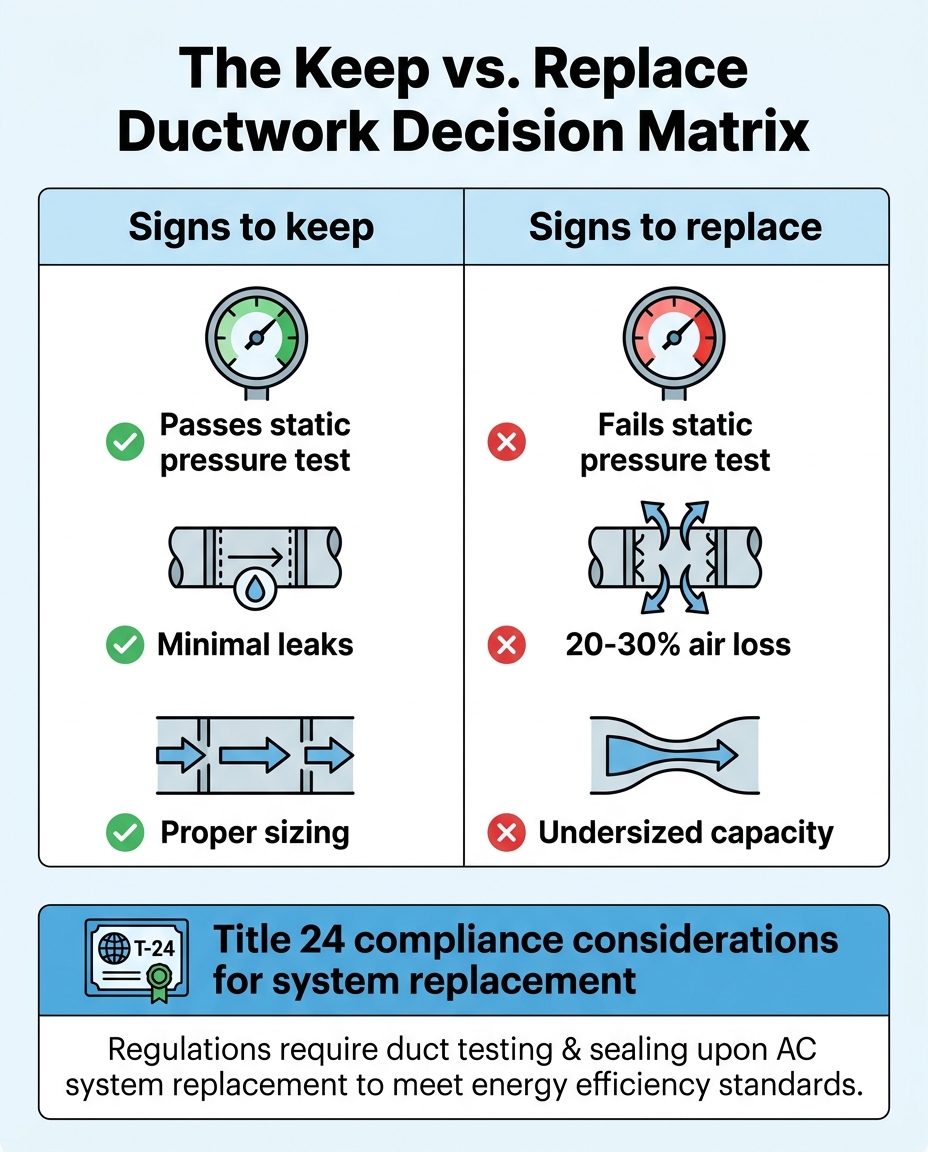
You can confidently keep your existing ducts if they pass pressure tests, show minimal leakage, and are properly sized for the airflow requirements of the new unit. Conversely, replacement becomes mandatory if the system fails pressure tests, suffers from 20-30% air loss, exhibits severe visual damage, or is fundamentally undersized for modern high-efficiency equipment.
Here is a clear side-by-side breakdown of how these factors impact long-term system efficiency:
• Static Pressure Test — Keep the Ductwork: Readings fall within manufacturer limits (e.g., below 0.5 inches of water column). — Replace the Ductwork: Readings exceed maximum limits, indicating severe airflow restriction. — Impact on New AC Unit: High pressure burns out blower motors and causes coil freezing.
• Air Leakage — Keep the Ductwork: Minimal leakage; easily passes Title 24 testing requirements. — Replace the Ductwork: 20-30% air loss; fails Title 24 testing and cannot be easily sealed. — Impact on New AC Unit: Leaky ducts waste energy and pull hot attic air into the system.
• Visual Condition — Keep the Ductwork: Insulation is intact, joints are secure, and runs are straight. — Replace the Ductwork: Crushed sections, disconnected joints, and degraded insulation jackets. — Impact on New AC Unit: Damaged ducts restrict flow and reduce the cooling capacity delivered to rooms.
• System Sizing — Keep the Ductwork: Ducts are properly sized to handle the CFM of the new blower. — Replace the Ductwork: Ducts are undersized (common when upgrading from older, smaller units). — Impact on New AC Unit: Undersized ducts cause short-cycling during late-summer August cooling demand.
Alternative Solutions for Difficult Spaces
Sometimes, traditional duct replacement is structurally impossible or cost-prohibitive due to vaulted ceilings or inaccessible crawlspaces. In these scenarios, you still have options. Upgrading to Ductless Mini Split Options allows you to bypass the ductwork entirely, delivering highly efficient, zoned cooling directly to the rooms that need it most without tearing open your drywall.
Frequently Asked Questions About AC and Ductwork Integration
What happens if you put a new AC on old ductwork?
If the old ductwork is properly sized and sealed, the new AC will function normally and deliver efficient cooling. However, if the old ductwork is restrictive or leaky, the new AC will likely short-cycle, lose efficiency, and struggle to cool the home. The advanced blower motors in modern units will strain against the high static pressure, leading to increased wear and tear and higher energy consumption.
Do I need to replace my ductwork when I get a new AC?
Not always; replacement is only necessary if objective testing reveals the existing ducts cannot handle the airflow requirements of the new system. Visual degradation, crushed runs, and severe air leaks are also primary indicators for replacement. If a static pressure test confirms your current ducts are healthy and properly sized, you can safely connect a new air conditioner without upgrading the distribution network.
How do contractors test if ductwork needs replacing?
Professionals rely on static pressure test diagnostics to measure airflow resistance precisely, ensuring the ductwork can handle the new blower motor. They also perform thorough visual inspections for leaks, disconnected joints, and deteriorated insulation. Additionally, contractors often reference Title 24 standards, performing specialized leakage tests to ensure the system complies with state energy efficiency regulations.
How long does HVAC ductwork typically last?
In our experience working in Southern California homes, ductwork generally lasts between 10 and 15 years before seals, joints, and insulation begin to degrade significantly. The lifespan depends heavily on the original installation quality, the materials used, and environmental conditions like extreme attic heat or high humidity. Regular maintenance and professional sealing can help extend the functional life of the duct system.
Can undersized ductwork damage a high-efficiency air conditioner?
Yes, undersized ducts force the blower motor to work harder against high static pressure, which can severely damage the system. This constant strain can lead to premature component failure, frequent breakdowns, and increased energy consumption. Furthermore, restricted airflow can cause the indoor evaporator coil to freeze, which may eventually destroy the outdoor compressor.
Make an Informed, Data-Driven Decision for Your Next AC Upgrade
Upgrading ductwork during an AC replacement should always be based on objective diagnostics, not guesswork or assumptions. By relying on measurable data like static pressure readings and thorough visual inspections, you can ensure your new cooling system operates exactly as the manufacturer intended. The ultimate goal is achieving peak comfort and efficiency when it matters most, especially during peak late-summer August cooling demand.
Don't let a restrictive duct system choke the life out of your new air conditioner. Protect your home and your investment by scheduling a professional evaluation with our team, who uses data-backed testing to guide our recommendations. Explore our AC Installation and Replacement Services today to ensure your next upgrade is built on a solid foundation.
Other blogs


Customer Testimonials



CUSTOMER SERVICE!
I highly recommend this company for anyone needing AC repair or maintenance. I'll definitely be calling them again for any future needs!

I had the pleasure of experiencing outstanding service and professionalism from Ruben, and I am beyond impressed. From the moment I first contacted them, by phone and follow up communication via email for my quotes. The attention to detail and commitment to excellence were evident.
Ruben, was incredibly responsive, addressing all my inquiries promptly and with clear, thorough explanations. Their dedication to understanding and meeting my needs was remarkable.
Ruben, went above and beyond to ensure that everything was handled seamlessly, demonstrating not just professionalism, but also a sincere dedication to customer satisfaction.
I can't recommend Piggies air Conditioning/Ruben highly enough. If you're looking for someone who combines expertise with exceptional service, look no further. They are a true example of what outstanding professionalism should be.
The technician arrived on time, which I really appreciated given how crucial air conditioning is in this heat. Ruben was professional and friendly, explaining what he was doing throughout the process. The issue I had was diagnosed fairly quickly, and they provided me with a few options on how to fix it. The pricing was transparent, and I didn't feel like there were any hidden costs, which is always a plus when it comes to service calls like these. Highly recommend this company!
1st & foremost, huge shout out to Ruben thank u so so much for reaching out & making things happen SO FAST! I was so surprised since i had reached out to a couple different places who lagged on even answering calls, messages, etc.
Ruben was also very informative & taught me ALOT that i didnt know about.
Also cant leave the amazing Luis & Miles out of
this review.
They came, they saw, they conquered!
And they worked pretty swiftly too, felt very comfy around em, loved their personalities, great attitude, work ethic, professionalism, had some really good convos & they still got the job done lightning fast
SUPER HUGE SHOUT OUT & THANKS for everything guys! Definitely recommending u guys to everyone i know.
recommendations and feedback. The actual installation was painless and unremarkable, his AC experts got it done, got it cleaned and most importantly got it right. Rueben even went a step further to assure we had
protection from the coming rain, that is service unheard of these days. His price was competitive and a REAL value for the service we recieved. Using anyone else for your AC needs, would be a huge mistake. We thank them again and will recommend to everyone.
Echoing a lot of the other reviews here, Piggies Air Conditioning responds so quickly to requests (even though I actually accidentally sent in multiple requests on my side without responding, oops!)
They were able to come do a FREE energy audit and initial inspection on the same day and Ruben was amazing at explaining his thoughts on our house's situation and what he thought was worth the money and wasn't worth the money.
I truly felt like he was trying to help me find the best solution to our issues instead of just trying to upsell us on everything and anything.
I'm definitely recommending this business to anyone I know if they want a trustworthy and realistic service, value, and quality.