










The Energy-Saving Myth That Costs You More
Closing off a guest room or home office to save money is a common strategy, but it is exactly why we strongly advise against closing vents in unused rooms. Here at Piggies Air Conditioning, our team frequently hears from Baldwin Park homeowners who naturally assume that shutting off airflow to an empty space will redirect that cold air to the master bedroom or living room, ultimately saving energy. The logic seems sound on the surface, especially when you are trying to manage utility bills during August and late summer heatwaves. However, our experience in the field shows that this assumption is based on a misunderstanding of how modern cooling technology operates.
The confusion often stems from comparing an HVAC system to a plumbing system. If you pinch a water hose, the pressure increases and the water shoots out faster from the end. While this logic makes sense for a water hose, forced-air cooling operates on entirely different physical principles. A blower motor is a fan, not a pump. It is designed to move a specific volume of air across a wide area, not to force air through restricted pipes.
Attempting to save energy this way actually forces the system to work harder, leading to the exact opposite result. Instead of lowering your monthly bills, you are inadvertently putting massive strain on your air conditioning equipment. The decision point for homeowners is recognizing that reopening those vents is the first step to protecting your expensive equipment from premature failure. When you understand the physics behind forced air, it becomes clear that keeping every vent open is the most efficient way to cool your home.
How Your Forced-Air System Actually Works
To understand why closing vents is harmful, it helps to look at how your system breathes. Modern cooling units are carefully calibrated to push a specific volume of air, which technicians measure in Cubic Feet per Minute (CFM). Before your system was even installed, the manufacturer determined exactly how much CFM the blower motor needs to move to keep the internal components at the right temperature.
The ductwork running through your attic or crawlspace is sized specifically to handle this predetermined volume of air. Every supply vent blowing cold air into a room and every return grille pulling warm air back into the system is part of a calculated mathematical equation. When all vents are open, the system breathes easily, maintaining the intended equilibrium between supply and return air. The air flows freely, the motor runs efficiently, and the indoor temperature drops steadily.
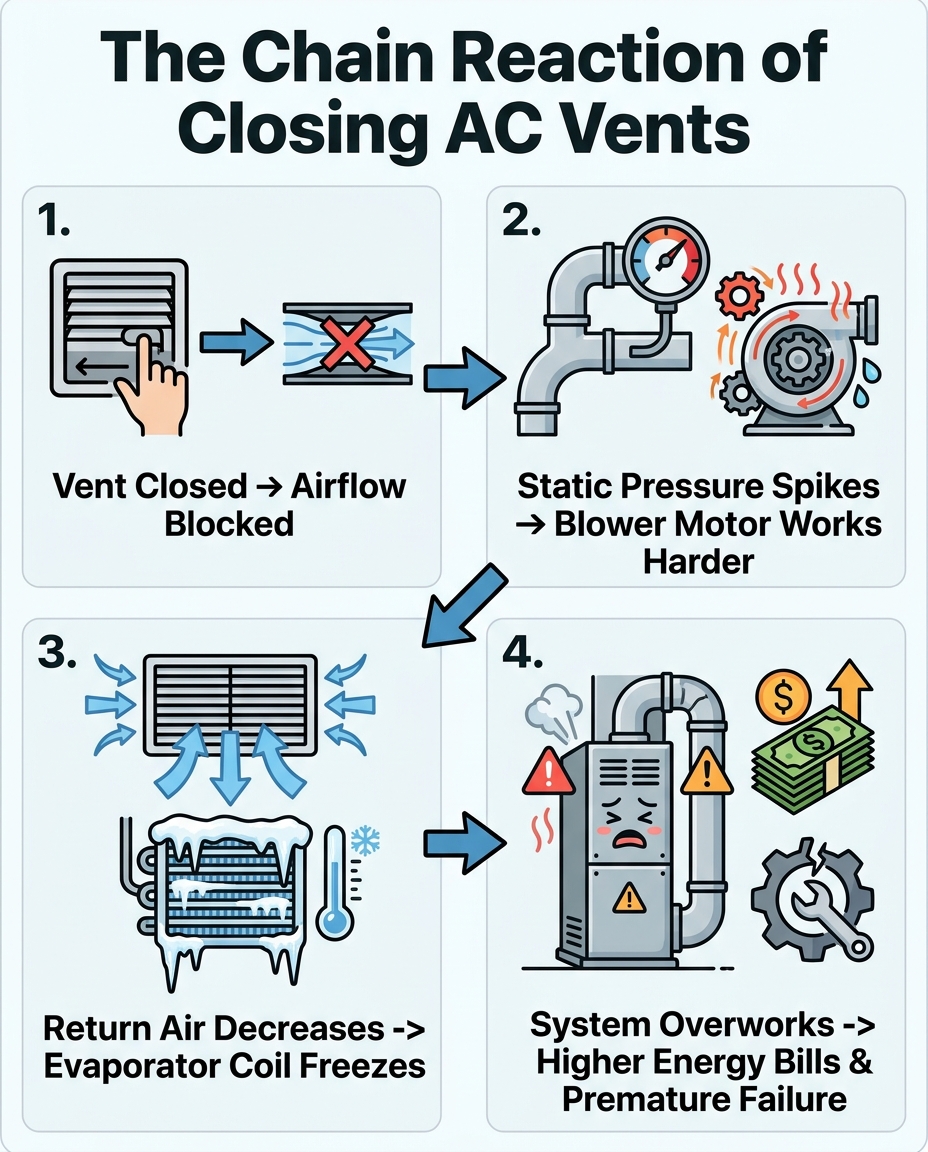
Closing a vent does not tell the system to produce less air; it simply blocks the exit path for the air that is already being pushed. The blower motor continues trying to move the exact same CFM, but now it has fewer pathways to distribute that air. This creates an immediate bottleneck, leading to elevated static pressure inside the ductwork.
The 'Single Lung' Analogy
Think of the central cooling unit as a single lung rather than a collection of independent room units. When you breathe in, your lungs require a clear airway to take in oxygen and expel carbon dioxide. Pinching off one airway doesn't reduce the lung's effort; it increases the resistance against it. Your body has to work much harder to get the same amount of air.
Your forced-air system operates the same way. This resistance disrupts the delicate balance required for efficient heat exchange. The system cannot independently shut down cooling to just one room; it relies on the entire network of ducts and vents to function as one cohesive respiratory system.
The Invisible Threat: What Happens When Static Pressure Spikes
The Problem: Static pressure is the resistance to airflow within the ductwork. Every forced-air system is designed to operate within a very specific maximum static pressure rating. When you close a vent, it acts as a physical blockage, causing an immediate spike in this resistance. The air has nowhere to go, so it pushes back against the incoming airflow.
The Cause: The blower motor must then work significantly harder to push the same volume of air through fewer openings. It is like trying to breathe out through a tiny straw instead of your open mouth. The motor has to fight against the built-up pressure just to keep the air moving. Just this past late summer, our Piggies Air Conditioning technicians responded to a Baldwin Park home where the family had closed vents in their empty guest rooms. The overworked system completely shut down during a massive heatwave. Our team diagnosed the underlying strain, opened the vents, and repaired the unit so it was back up and running like new.
The Solution: The only way to resolve elevated static pressure caused by blocked vents is to reopen them. By removing the physical barrier, the pressure drops back to normal levels, allowing the motor to operate without fighting against itself. This simple action often prevents the system from overheating and tripping the circuit breaker.
Blower Motor Strain and Overheating
The type of motor in your system determines exactly how it reacts to this strain, but neither outcome is good. Variable-speed motors are designed to adjust their output to maintain airflow. When they sense resistance, they will ramp up their RPMs to overcome the blockage, consuming significantly more electricity in the process. Standard motors, on the other hand, will simply struggle against the pressure, overheating and potentially causing the system to shut down entirely.
The long-term result is a drastically shortened lifespan for one of the system's most expensive components. Explaining the science behind static pressure and CFM reveals that this advice is rooted in protecting your equipment from measurable physical strain, not just arbitrary rules.
Why Restricted Airflow Leads to Frozen Evaporator Coils
The blower motor is not the only component that suffers when vents are closed. The evaporator coil—the indoor part of your system responsible for actually cooling the air—is highly sensitive to changes in airflow. Here is the step-by-step process of how closing vents leads to a frozen system:
1. The Heat Exchange Process: The evaporator coil relies on a constant flow of warm return air from your home to absorb heat and prevent the chemical refrigerant inside from getting too cold.
2. Airflow Reduction: When supply vents are closed, less air is pushed into the rooms, which means less air circulates back to the return grilles.
3. Temperature Drop: Without enough warm air passing over the coil to absorb the cooling energy, the temperature of the metal drops rapidly below freezing.
4. Ice Formation: Condensation naturally forming on the coil turns to ice, eventually encasing the entire component and blocking all remaining airflow.
In our years of servicing AC units throughout Baldwin Park, we've seen firsthand how Southern California's intense late-summer heat causes longer cooling cycles. A restricted airflow situation will freeze an evaporator coil much faster here than in milder climates. Because the system runs continuously for hours to combat the heat, the coil never gets a chance to rest and warm up.
The Defrosting Dilemma
Once a coil freezes, the system must be completely shut down to thaw, leaving the home without cooling during the hottest part of the day. Running a system with a frozen coil is incredibly risky; it can cause liquid refrigerant to flow backward into the compressor, causing catastrophic failure.
Thawing and cleaning the coil requires professional intervention to ensure the system is safe to operate again. During a recent end-of-season cooling service call, a homeowner asked our technicians to clean a frozen evaporator coil. We provided a detailed explanation of how restricted airflow from closed vents impacts the coil, offered a reasonable assessment, and completed the cleaning in a timely manner. Keeping vents open prevents the rapid dirt buildup and freezing that makes these deep cleanings necessary.

The Impact on Ductwork and Year-Round Performance
Increased pressure doesn't just strain the motor and freeze the coil; it seeks the path of least resistance through the ductwork. Your ducts are made of sheet metal, fiberglass, or flexible plastic, held together by tape and mastic sealant. They are not designed to hold back high-pressure air.
When elevated static pressure builds up, it forces conditioned air out through tiny leaks, seams, and joints in unconditioned spaces like attics or crawlspaces. You end up paying to cool the attic instead of the living space. This physical rule applies year-round, meaning closing vents during cooler months causes identical strain on your heating system, potentially overheating the furnace heat exchanger.
Accelerated Duct Leakage
Most homeowners do not realize how much air they are already losing. The average home already loses up to 20-30% of its conditioned air to normal duct leaks. Spiking the internal pressure by closing vents exacerbates these leaks drastically.
• All Vents Open — Static Pressure Level: Normal / Balanced — Impact on Ductwork: Minimal air loss; air flows smoothly to intended rooms.
• 1-2 Vents Closed — Static Pressure Level: Elevated — Impact on Ductwork: Air is forced through existing minor leaks in the attic.
• Multiple Vents Closed — Static Pressure Level: Dangerously High — Impact on Ductwork: Pressure can physically blow apart poorly sealed seams over time.
Over time, the increased pressure can actually compromise the structural integrity of the ductwork, requiring expensive repairs to reseal the system.
Better Ways to Manage Late-Summer Cooling Costs
If closing vents is off the table, you might be wondering how to actually manage high utility bills during August and late summer. As families transition back to school routines, our technicians recommend focusing on reducing the heat load on the home. Here are effective, safe alternatives we share with our Baldwin Park customers to keep homes comfortable and efficient:
• Block solar heat gain: Utilize thermal curtains or blackout shades during the hottest parts of the day, particularly on south and west-facing windows.
• Use smart technology: Upgrade to a smart thermostat to implement strategic temperature setbacks when the house is empty, rather than trying to micromanage individual rooms.
• Keep doors open: Ensure interior doors remain open as much as possible to allow return air to flow freely back to the central grilles.
• Schedule professional balancing: Ensure the system is professionally checked so that airflow is balanced at the plenum (the main trunk of the ductwork) using built-in dampers, rather than at the room vents.
• Maintain the system: Invest in routine HVAC maintenance to keep coils clean, filters fresh, and motors running efficiently without unnecessary strain.
Protect Your Equipment by Keeping Vents Open
The science is clear: forced-air systems require unimpeded airflow to function efficiently and safely. By leaving all vents open, you maintain proper equilibrium, prevent motor strain, and avoid frozen coils. Attempting to outsmart the system by blocking vents only leads to elevated static pressure and premature breakdowns.
If certain rooms are consistently too cold or too hot, the solution is professional duct balancing, not closing vents. Reach out to our local experts at Piggies Air Conditioning to evaluate your system's performance and explore genuine energy-saving strategies. Understanding exactly why we strongly advise against closing vents in unused rooms gives you the confidence to operate your system the way it was designed, keeping your home comfortable and your equipment safe.
Frequently Asked Questions
Does closing vents save money on my energy bill?
No, closing vents does not save money and often increases your energy costs. Your system still produces the same amount of air, but the blower motor has to work harder against the restricted airflow. This extra strain consumes more electricity and can lead to expensive repairs.
Will closing vents damage my AC compressor or blower motor?
Yes, it can cause significant damage over time. The increased static pressure forces the blower motor to overwork, which can lead to overheating and eventual burnout. Additionally, if the restricted airflow causes the system to freeze, liquid refrigerant can flow back to the compressor, causing catastrophic failure.
What is HVAC static pressure and why does it matter?
Static pressure is the measurement of resistance to airflow within your ductwork. It matters because forced-air systems are designed to operate within a specific pressure range. When pressure spikes due to closed vents or dirty filters, the system cannot move air efficiently, leading to poor cooling and equipment strain.
Why does closing vents cause frozen evaporator coils?
Closing vents reduces the amount of warm return air flowing back over the indoor evaporator coil. Without enough warm air to absorb the cooling energy, the coil's temperature drops below freezing. Condensation on the coil then turns to ice, eventually blocking all airflow and requiring a complete system shutdown to thaw.
How many vents can I safely close in my house?
The short answer is zero. HVAC professionals strongly recommend keeping 100% of your supply and return vents fully open at all times. If you need to redirect air to balance temperatures, it must be done by a professional using dampers near the main unit, not by closing the grilles in individual rooms.
Other blogs


Customer Testimonials



CUSTOMER SERVICE!
I highly recommend this company for anyone needing AC repair or maintenance. I'll definitely be calling them again for any future needs!

I had the pleasure of experiencing outstanding service and professionalism from Ruben, and I am beyond impressed. From the moment I first contacted them, by phone and follow up communication via email for my quotes. The attention to detail and commitment to excellence were evident.
Ruben, was incredibly responsive, addressing all my inquiries promptly and with clear, thorough explanations. Their dedication to understanding and meeting my needs was remarkable.
Ruben, went above and beyond to ensure that everything was handled seamlessly, demonstrating not just professionalism, but also a sincere dedication to customer satisfaction.
I can't recommend Piggies air Conditioning/Ruben highly enough. If you're looking for someone who combines expertise with exceptional service, look no further. They are a true example of what outstanding professionalism should be.
The technician arrived on time, which I really appreciated given how crucial air conditioning is in this heat. Ruben was professional and friendly, explaining what he was doing throughout the process. The issue I had was diagnosed fairly quickly, and they provided me with a few options on how to fix it. The pricing was transparent, and I didn't feel like there were any hidden costs, which is always a plus when it comes to service calls like these. Highly recommend this company!
1st & foremost, huge shout out to Ruben thank u so so much for reaching out & making things happen SO FAST! I was so surprised since i had reached out to a couple different places who lagged on even answering calls, messages, etc.
Ruben was also very informative & taught me ALOT that i didnt know about.
Also cant leave the amazing Luis & Miles out of
this review.
They came, they saw, they conquered!
And they worked pretty swiftly too, felt very comfy around em, loved their personalities, great attitude, work ethic, professionalism, had some really good convos & they still got the job done lightning fast
SUPER HUGE SHOUT OUT & THANKS for everything guys! Definitely recommending u guys to everyone i know.
recommendations and feedback. The actual installation was painless and unremarkable, his AC experts got it done, got it cleaned and most importantly got it right. Rueben even went a step further to assure we had
protection from the coming rain, that is service unheard of these days. His price was competitive and a REAL value for the service we recieved. Using anyone else for your AC needs, would be a huge mistake. We thank them again and will recommend to everyone.
Echoing a lot of the other reviews here, Piggies Air Conditioning responds so quickly to requests (even though I actually accidentally sent in multiple requests on my side without responding, oops!)
They were able to come do a FREE energy audit and initial inspection on the same day and Ruben was amazing at explaining his thoughts on our house's situation and what he thought was worth the money and wasn't worth the money.
I truly felt like he was trying to help me find the best solution to our issues instead of just trying to upsell us on everything and anything.
I'm definitely recommending this business to anyone I know if they want a trustworthy and realistic service, value, and quality.