









The Frustration of a Sweltering Upstairs Bedroom
Your downstairs thermostat reads a perfectly chilled 72 degrees, but the moment you walk up the stairs to go to sleep, you hit a physical wall of stagnant, heavy heat. Here at Piggies Air Conditioning, addressing airflow imbalances in two-story Covina homes is a priority we tackle daily, especially when the bedrooms become too uncomfortable to use during those late-summer August nights. You might hear your air conditioner running constantly on the ground floor, blowing ice-cold air into the living room, yet the second story feels completely disconnected from the cooling system.
If you are tired of battling uneven temperatures and restless nights as the back-to-school season approaches, our professional Air Conditioning Services can help you uncover the root cause and implement a permanent solution.
Many homeowners mistakenly assume that a hot upstairs means their air conditioning unit is broken or failing. However, our team frequently finds that this is a widespread structural and architectural issue rather than a mechanical breakdown. The ductwork, the location of the thermostat, and the physics of the house itself all play a massive role in how air is distributed. During intense August heat waves, these underlying structural flaws become impossible to ignore. Resolving the issue requires a professional evaluation by our experienced technicians to determine whether the home needs targeted zoning, ductwork adjustments, or supplemental cooling.
Understanding the Stack Effect in Southern California Architecture
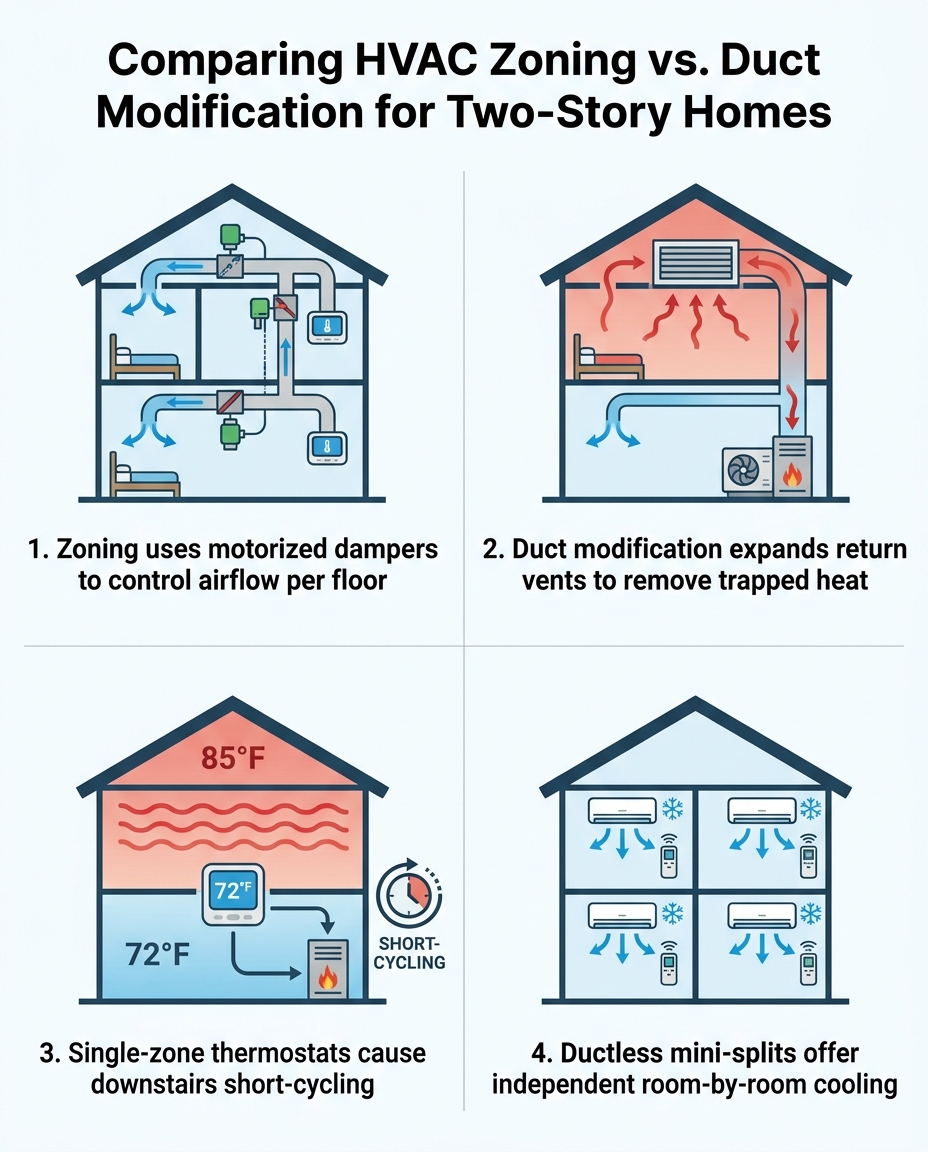
To understand why the second floor of your home refuses to cool down, our experts always point to the basic physics of air movement. This phenomenon is commonly known as the "stack effect." Hot air is naturally less dense than cold air, causing it to rise to the highest point in the house. Meanwhile, the dense, heavy, conditioned air produced by your HVAC system naturally wants to settle on the ground floor. In the Covina two-story tract homes we service, this creates a natural separation of temperatures that a standard cooling system struggles to overcome.
The intense, dry end-of-season heat in the San Gabriel Valley creates a severe thermal load on the upper levels of the home, magnifying this natural stack effect. The sun beats down on the roof all day, heating the attic space to extreme temperatures. That radiant heat transfers directly downward through the ceiling insulation and into the upstairs bedrooms. At the exact same time, the cold air from your vents is cascading down the staircase to the first floor.
The Limitation of Single-Zone Thermostats
The core of the problem often lies with how the system is controlled. Standard single-zone thermostats exacerbate the stack effect because of their placement. Usually installed on the ground floor in a central hallway or living room, the thermostat only measures the temperature of the air immediately surrounding it.
• Premature shut-off: The thermostat registers that the downstairs has reached the target temperature and shuts the entire system down.
• Ignored upper floors: The system stops cooling long before the upstairs rooms have a chance to reach a comfortable temperature.
• Constant cycling: If you push the thermostat lower to try and cool the upstairs, you end up freezing the downstairs and forcing the system to work overtime.
If you find yourself constantly adjusting the dial just to get a breeze upstairs, it might explain Why Your AC Runs Constantly without delivering the comfort you expect.
Why Upgrading to a Larger AC Unit Isn't the Answer
A common misconception we hear from homeowners is that a bigger, more powerful air conditioner will forcefully push more cold air up to the second floor. In reality, oversizing your HVAC equipment is one of the worst things you can do for home comfort. An oversized system cools the downstairs space far too rapidly. Because the thermostat is satisfied so quickly, the system shuts off before it can push adequate air to the furthest reaches of the ductwork—namely, the upstairs bedrooms.
This rapid on-and-off cycle, known as short-cycling, prevents the air conditioner from running long enough to remove humidity from the air, leaving the home feeling cold but clammy. Structural airflow bottlenecks cannot be brute-forced by larger equipment. If the ductwork is too small to carry the air upstairs, a bigger blower motor will only create excess static pressure, noise, and wear and tear on the machinery.
At Piggies Air Conditioning, we know that deep local expertise means diagnosing these structural airflow problems and recommending tailored modifications, rather than just pushing unnecessary full AC replacements. During a recent late-summer heat wave, one local homeowner's air conditioner was struggling to keep up. While they were previously told they needed a full system replacement with a larger unit, our technicians evaluated the situation and were able to repair and optimize the existing air conditioner. This proved that an honest assessment of airflow and system health is always better than an unnecessary equipment upsell. Finding the true root cause is the only way to achieve lasting comfort.
Before you commit to a major equipment change, ensure you are getting an accurate diagnostic. If you are considering AC Installation in Covina, it is critical to let our team address the ductwork and airflow design first, so your new system performs efficiently.
HVAC Zoning: Precision Climate Control for Every Floor
One of the most effective ways our team combats the stack effect in Covina two-story tract homes is through professional HVAC zoning. A zoning system transforms a single-thermostat setup into a customized climate control network, allowing you to control the temperature of the upstairs and downstairs independently. Instead of cooling the entire house every time the system turns on, zoning directs conditioned air exactly where it is needed.
This is achieved by installing a secondary thermostat on the upper floor and integrating a central control panel. The system reads the temperature demands from both floors and operates the HVAC equipment accordingly. The Department of Energy notes that proper zoning significantly improves home comfort and energy distribution, preventing the massive temperature swings that plague multi-level homes during August heat waves.
How Motorized Dampers Reroute Airflow
The physical mechanism that makes zoning possible is a series of motorized dampers installed directly inside the ductwork. You can think of these dampers as traffic cops for your conditioned air.
• Directing the flow: When the downstairs is cool but the upstairs is hot, the dampers closing off the downstairs vents force all the cold air up to the second floor.
• Independent operation: Once the upstairs reaches the target temperature, the dampers adjust again to maintain balance across the whole house.
• Static pressure management: Because closing off sections of ductwork changes the air pressure inside the system, professional installation by our licensed technicians is mandatory. We install bypass dampers to ensure static pressure remains balanced, protecting the blower motor from burning out.
Duct Modification: Removing Structural Airflow Bottlenecks
Sometimes the issue isn't just how the system is controlled, but the physical pathways the air must travel. In our experience working throughout Baldwin Park and Covina, altering or expanding the existing ductwork can resolve severe airflow restrictions that prevent cold air from reaching the second story. Many homes were built with duct systems that met minimum code requirements at the time but are woefully inadequate for combating modern summer heat loads.
Common ductwork flaws include crushed flexible ducts in the attic, disconnected joints leaking cold air into the insulation, or supply branches that are simply too small to carry enough volume to the furthest bedrooms. Balancing supply registers and sealing leaks ensures the proper volume of air reaches the rooms that need it most. By removing these physical bottlenecks, the existing air conditioner can finally do its job effectively.
When our crew performs routine AC Maintenance in Covina, we often uncover these hidden ductwork issues, allowing us to recommend targeted modifications rather than full system replacements.
The Importance of Adequate Return Air
The most overlooked aspect of home cooling we encounter is the return air system. Cooling a space requires removing the heat first. Air conditioning is a cyclical process; the system must pull hot air out of the room, carry it back to the equipment to be cooled, and then push it back out.
If your upstairs bedrooms have supply vents blowing cold air but no return vents pulling the hot air out, the room becomes pressurized. The cold air has nowhere to go, and the trapped hot air cannot escape. Expanding return air pathways or adding a dedicated return vent upstairs can drastically improve circulation, allowing the stagnant heat in Covina two-story tract homes to be properly filtered and cooled.
Ductless Mini-Splits: A Targeted Approach for Stubborn Rooms
In some architectural layouts, modifying the central ductwork or installing a full zoning system is either physically impossible or cost-prohibitive. For these situations, we frequently recommend ductless technology as a highly effective alternative. Ductless systems bypass centralized ductwork entirely, providing independent, targeted cooling to a specific room or zone.
This is an ideal solution for a master bedroom that always runs hot. A ductless unit consists of a small outdoor compressor connected to a sleek indoor air handler mounted high on the bedroom wall. Because it operates completely independently of the main central air system, you can set the bedroom to a crisp 68 degrees for sleeping without affecting the temperature in the rest of the house.
Modern mini-split units are incredibly energy-efficient, utilizing variable-speed inverter compressors that adjust their output to precisely match the room's cooling demand. They also operate whisper-quiet, making them perfect for sleeping areas. If you are struggling with a single stubborn room during the late-summer heat, exploring Ductless Mini-Split Systems can provide immediate relief without requiring a whole-home retrofit. Additionally, generic federal tax credits and local utility rebates may apply to qualifying high-efficiency heat pump installations, making this an even more attractive option. We always advise our customers to verify current programs with their utility provider or tax professional.
Zoning vs. Duct Modification: Making the Right Choice for Your Home
Deciding how to fix your hot upstairs requires assessing the current health of the home's ductwork, evaluating the layout, and determining the severity of the temperature discrepancy. Zoning only works if the existing ducts are adequately sized and sealed. If the ducts are undersized or heavily damaged, installing dampers will only create pressure problems.
Because these are non-DIY solutions that require a licensed professional to calculate load requirements and static pressure, our team at Piggies Air Conditioning always walks homeowners through the primary differences between the two approaches.
• Primary Mechanism — HVAC Zoning System: Motorized dampers and multiple thermostats direct air based on demand. — Duct Modification: Physical expansion of ductwork, adding returns, or sealing leaks.
• Best Used When... — HVAC Zoning System: Ductwork is in good condition, but the single thermostat causes imbalance. — Duct Modification: Ducts are undersized, crushed, or lacking proper return air ventilation.
• Temperature Control — HVAC Zoning System: Allows independent temperature settings for the upstairs and downstairs. — Duct Modification: Balances the whole house to a single, consistent temperature.
• Installation Impact — HVAC Zoning System: Requires retrofitting dampers into accessible ductwork and wiring controls. — Duct Modification: Requires attic access to physically replace, expand, or seal duct runs.
Restore Whole-Home Comfort Before the Next Heat Wave
A sweltering upstairs is a frustrating but entirely solvable problem with the right professional approach from Piggies Air Conditioning. You do not have to accept sleeping in a hot room while the rest of your house feels like a refrigerator. Whether the answer lies in installing a precision zoning system, modifying your ductwork to improve return airflow, or adding a ductless unit for targeted relief, a permanent fix is within reach.
Do not wait until the peak of the August late-summer heat waves to address your home's structural airflow issues. Schedule an evaluation with our team to determine the most effective airflow solution for your specific home layout. For expert diagnostics and AC Repair in Covina, reach out to us to secure a comfortable, balanced climate for every floor of your home.
Frequently Asked Questions
Why is my upstairs so much hotter than downstairs in the summer?
Our technicians find that hot air naturally rises while dense, cold air settles on the ground floor, a phenomenon known as the stack effect. Additionally, the second floor absorbs massive amounts of radiant heat from the roof and attic. When a single thermostat is located downstairs, it shuts the cooling system off before the upper level has a chance to cool down.
Does HVAC zoning work for two-story homes?
Yes, HVAC zoning is one of the most effective solutions for two-story homes. By installing motorized dampers in the ductwork and a second thermostat upstairs, our team can direct cold air exactly where it is needed. This allows you to control the temperature of each floor independently, ensuring balanced comfort throughout the house.
What is the best way to cool the second floor of a house?
The best method depends on your home's specific architecture and ductwork health. Professional zoning systems and adding dedicated return air vents are highly effective for central systems. If the central ductwork cannot be modified, installing a ductless mini-split in the master bedroom provides excellent, targeted cooling.
Can you add a zone to an existing HVAC system?
In many cases, a zone control system can be retrofitted to an existing HVAC setup. A licensed technician must first evaluate the ductwork to ensure it can handle the changes in static pressure. If the ducts are adequately sized and in good condition, dampers and a control board can be installed without replacing the main AC unit.
Will a bigger AC cool my upstairs better?
No, installing a larger air conditioner will usually make the problem worse. An oversized unit cools the downstairs too quickly and shuts off before the cold air can reach the second floor. This leads to short-cycling, which increases wear and tear on the equipment and fails to remove humidity from the air.
How can I improve the return airflow on my second floor?
Improving return airflow requires removing the trapped hot air so cold air has room to enter. A professional can expand existing return air pathways, add a dedicated return vent to the upstairs hallway, or install jumper ducts above the bedrooms. These modifications must be calculated carefully to maintain the proper pressure balance in the system.
Other blogs


Customer Testimonials



CUSTOMER SERVICE!
I highly recommend this company for anyone needing AC repair or maintenance. I'll definitely be calling them again for any future needs!

I had the pleasure of experiencing outstanding service and professionalism from Ruben, and I am beyond impressed. From the moment I first contacted them, by phone and follow up communication via email for my quotes. The attention to detail and commitment to excellence were evident.
Ruben, was incredibly responsive, addressing all my inquiries promptly and with clear, thorough explanations. Their dedication to understanding and meeting my needs was remarkable.
Ruben, went above and beyond to ensure that everything was handled seamlessly, demonstrating not just professionalism, but also a sincere dedication to customer satisfaction.
I can't recommend Piggies air Conditioning/Ruben highly enough. If you're looking for someone who combines expertise with exceptional service, look no further. They are a true example of what outstanding professionalism should be.
The technician arrived on time, which I really appreciated given how crucial air conditioning is in this heat. Ruben was professional and friendly, explaining what he was doing throughout the process. The issue I had was diagnosed fairly quickly, and they provided me with a few options on how to fix it. The pricing was transparent, and I didn't feel like there were any hidden costs, which is always a plus when it comes to service calls like these. Highly recommend this company!
1st & foremost, huge shout out to Ruben thank u so so much for reaching out & making things happen SO FAST! I was so surprised since i had reached out to a couple different places who lagged on even answering calls, messages, etc.
Ruben was also very informative & taught me ALOT that i didnt know about.
Also cant leave the amazing Luis & Miles out of
this review.
They came, they saw, they conquered!
And they worked pretty swiftly too, felt very comfy around em, loved their personalities, great attitude, work ethic, professionalism, had some really good convos & they still got the job done lightning fast
SUPER HUGE SHOUT OUT & THANKS for everything guys! Definitely recommending u guys to everyone i know.
recommendations and feedback. The actual installation was painless and unremarkable, his AC experts got it done, got it cleaned and most importantly got it right. Rueben even went a step further to assure we had
protection from the coming rain, that is service unheard of these days. His price was competitive and a REAL value for the service we recieved. Using anyone else for your AC needs, would be a huge mistake. We thank them again and will recommend to everyone.
Echoing a lot of the other reviews here, Piggies Air Conditioning responds so quickly to requests (even though I actually accidentally sent in multiple requests on my side without responding, oops!)
They were able to come do a FREE energy audit and initial inspection on the same day and Ruben was amazing at explaining his thoughts on our house's situation and what he thought was worth the money and wasn't worth the money.
I truly felt like he was trying to help me find the best solution to our issues instead of just trying to upsell us on everything and anything.
I'm definitely recommending this business to anyone I know if they want a trustworthy and realistic service, value, and quality.