









The Myth of Maximum Tonnage: Will a Bigger Air Conditioner Actually Cool My House Faster?
When our technicians at Piggies Air Conditioning respond to service calls across Baldwin Park, we frequently hear the same question: "Will a bigger air conditioner actually cool my house faster?" It is a common misconception among homeowners that upgrading to a massive cooling unit will instantly solve all their comfort problems. When you are sweating through a warm afternoon, it is easy to assume that throwing more raw power at the problem is the best solution. However, in our years of working on local residential cooling systems, we can confidently say that bigger is definitely not always better.
The short answer is no, a bigger air conditioner will not cool your house better. While an oversized unit will drop the indoor temperature very quickly, it will shut off long before it has a chance to remove the humidity from the air. This rapid cooling cycle leaves your home feeling cold but clammy, creating an uncomfortable, cave-like atmosphere. The air might register as 70 degrees on the thermostat, but your skin will still feel sticky and damp.
Proper sizing is the absolute foundation of indoor comfort. As you start reviewing replacement quotes during the early fall transition, understanding why maximum tonnage works against you is critical. Our team always recommends finding a system that matches your home's exact needs, not one that overpowers it. Finding the right balance is a core part of our comprehensive HVAC services, ensuring your equipment manages both temperature and moisture effectively.
The Sprinter vs. Marathon Runner: How Air Conditioners Actually Work
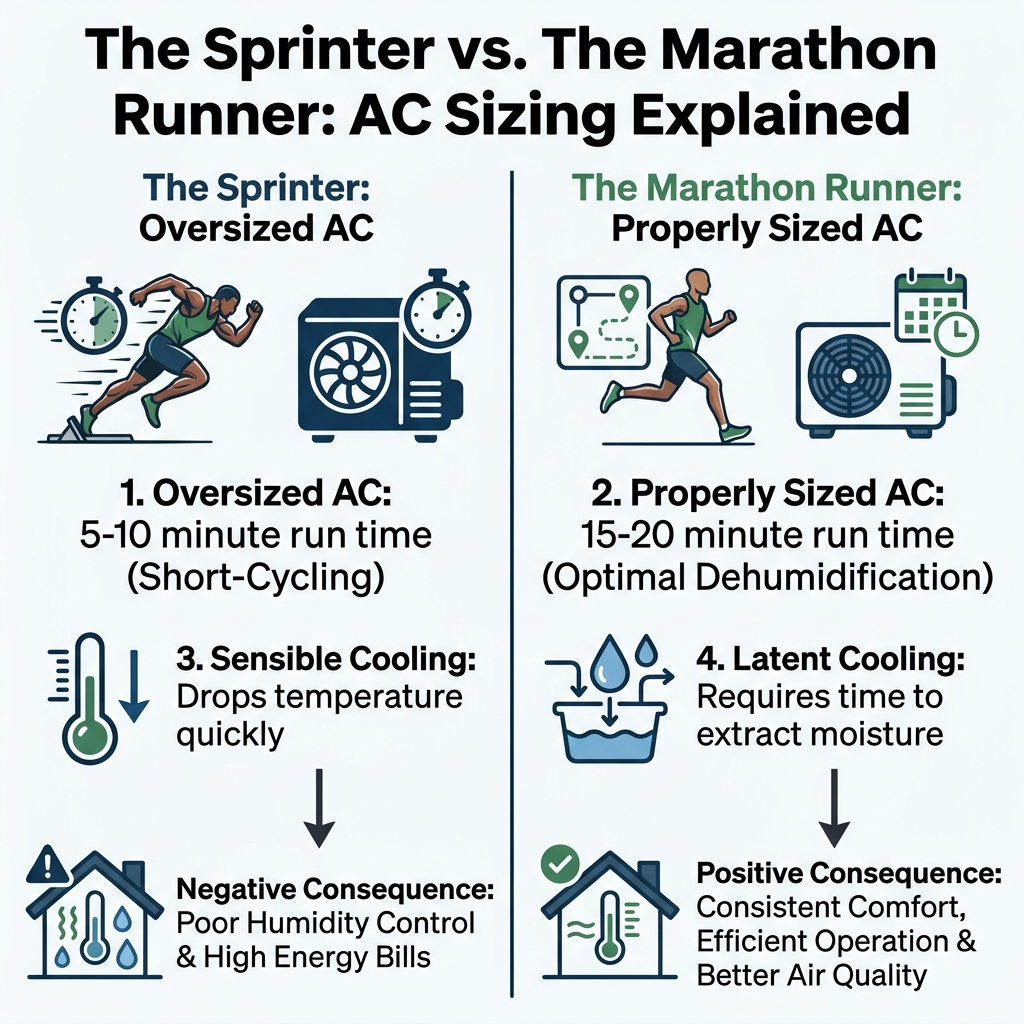
To help our customers understand why an oversized unit fails to keep them comfortable, we like to look at how air conditioners are designed to operate. You can think of an oversized AC as a sprinter. It fires up, runs at maximum capacity for a very short burst, and stops abruptly. It crosses the temperature finish line quickly, but it fails to complete the full job of conditioning the air.
A properly sized air conditioner, on the other hand, acts like a marathon runner. It is designed to run steadily and consistently for 15 to 20 minutes at a time. This steady, longer run cycle is absolutely necessary because the indoor air needs time to pass over the cold evaporator coil multiple times. As the air circulates repeatedly, the coil extracts the moisture, draining it away from your living space.
When you invest in proper air conditioning installation and sizing with our experienced crew, you are paying for a system that paces itself. The goal is not to blast the house with freezing air and shut down; the goal is to maintain a steady, comfortable climate by addressing both the heat and the humidity simultaneously.
Sensible vs. Latent Cooling Explained
Air conditioners perform two distinct types of cooling every time they turn on. Understanding the difference between these two functions reveals exactly why short run times are so problematic for your indoor air quality.
• Sensible Cooling — What It Does: Lowers the actual temperature of the air, which is what you feel on your skin immediately and what registers on your thermostat. — Time Required: Happens very quickly, especially with oversized units.
• Latent Cooling — What It Does: Extracts moisture and humidity from the indoor environment, removing the sticky, heavy feeling from the air. — Time Required: Requires sustained, continuous airflow over the indoor coils for 15 to 20 minutes.
If your system shuts down after just five minutes because the sensible cooling is finished, the latent cooling process never gets a chance to happen. You are left with cold air that is still holding all of its original moisture.
The Short-Cycling Dilemma: Why Oversized Units Leave You Cold and Clammy
When an oversized air conditioner blasts your home with cold air and shuts off within 5 to 10 minutes, it is experiencing a phenomenon known as short-cycling. In our years of diagnosing premature equipment failures, we have found that short-cycling is one of the most detrimental things that can happen to an HVAC system, both for your personal comfort and for the mechanical health of the equipment.
Because the unit satisfies the thermostat setting so rapidly, the system spends most of its day turning on and off in brief bursts. As we established, this prevents the system from properly dehumidifying the air. The resulting environment is characterized by poor indoor air quality. Your floors might feel slick, your windows might show condensation, and the air simply feels heavy. If you find yourself constantly adjusting the thermostat down to 68 degrees just to feel comfortable, high humidity is likely the culprit.
Beyond the comfort issues, short-cycling is incredibly hard on the machinery. The most stressful part of an air conditioner's operation is the startup phase, which draws a massive amount of electricity and puts heavy torque on the compressor. When a system turns on and off constantly, it accelerates wear and tear on these critical components. If you are wondering what it means if your AC is running constantly or cycling rapidly, our repair technicians frequently pinpoint improper sizing as the root cause.
One local homeowner recently reached out to us to have a new heat pump system installed around their busy schedule. By taking the time to provide an accurate estimate and properly size the equipment before scheduling the installation the following week, we ensured their new system would run efficiently with careful, steady cycles rather than the rapid, damaging short-cycling that plagues oversized units.
The Early Fall Transition: When Sizing Mistakes Become Obvious
The negative effects of an oversized air conditioner become painfully obvious during specific times of the year. During the absolute peak of summer, when temperatures are soaring, even an oversized unit might be forced to run long enough to remove some humidity simply because the extreme heat load demands it. The system has to work hard to fight the outdoor temperatures, which accidentally helps it dehumidify your home.
However, the early fall transition completely changes the equation. Here in Baldwin Park, our team notices that the shift from hot, dry summer days to fluctuating fall temperatures creates unique indoor air quality challenges. During this season, you might experience warm afternoons followed by significantly cooler evenings. Because the outdoor temperature is milder, your home's raw cooling demand drops significantly.
The Problem: When the weather is mild, an oversized unit reaches your desired thermostat set point almost instantly. There is very little sensible heat to remove from the house.
The Cause: Because the thermostat is satisfied in just a few minutes, the system shuts down long before it can extract any moisture. The latent cooling process is completely bypassed.
The Solution: A properly sized system will run at a lower capacity for a longer duration, gently removing the humidity without overcooling the house. Proper humidity control becomes just as important as temperature control during these early fall temperature swings, ensuring your home feels crisp and comfortable rather than damp and chilly.
Beyond Square Footage: The Importance of Manual J Load Calculations
For decades, many contractors used a simple "rule of thumb" based entirely on the square footage of a house to determine the size of an air conditioner. This outdated method is little more than amateur guesswork and is a pattern we see often when replacing older, oversized, short-cycling systems. Relying on square footage alone ignores the unique thermal dynamics of your specific living space.
The industry standard for determining the exact cooling capacity your home needs is called a Manual J load calculation. This is a precise mathematical process that evaluates exactly how much heat your home gains during the day. At Piggies Air Conditioning, our installation crews rely on precise Manual J calculations to ensure maximum comfort and efficiency. We actively avoid the practice of upselling larger, unnecessary units, focusing instead on what your home actually requires.
A proper Manual J calculation takes numerous specific factors into account, including:
1. Window Placement and Quality: South-facing windows let in significantly more heat than north-facing ones. The type of glass and framing also impacts heat transfer.
2. Insulation Levels: A well-insulated home retains cold air much better, requiring a smaller air conditioner than a drafty home of the exact same size.
3. Ceiling Height and Volume: Square footage only measures the floor. High vaulted ceilings mean there is significantly more air volume to cool and dehumidify.
4. Local Climate: The specific temperature and humidity trends of the Baldwin Park area dictate how much latent versus sensible cooling power is required.
5. Ductwork Condition: Leaky or poorly designed ductwork can lose a massive amount of cooling before the air even reaches your vents.
Accurate sizing is your best defense against contractors who try to pressure you into buying larger, more expensive equipment under the guise of "better performance." We recently worked with a homeowner moving into a new house who needed an AC installation on a tight budget. Instead of upselling unnecessary tonnage, we focused on proper airflow and sizing. We were able to offer a higher-end, correctly sized unit at no extra cost and even installed additional air vents for free to ensure perfect air distribution. Getting professional AC installation in Covina and the surrounding areas means prioritizing these exact calculations over simple guesswork.
The Hidden Costs of an Oversized Air Conditioner
Over our years of servicing HVAC systems across the region, we have seen first-hand how installing an air conditioner that is too large for your home does not just ruin your indoor comfort; it also hits your wallet in several hidden ways. The financial and mechanical consequences of an oversized unit can plague you for the entire lifespan of the system.
• Higher energy consumption: Air conditioners require a massive surge of electricity every time they start up. Because oversized units turn on and off constantly, they draw this high startup power far more often than a properly sized unit, driving up your monthly utility bills.
• Premature compressor failure: The compressor is the heart of your AC system, and it takes a beating during the startup phase. Frequent short-cycling puts immense mechanical stress on the compressor, drastically increasing the likelihood of early failure and expensive repairs.
• Mold and mildew growth: When your system fails to manage indoor humidity, the excess moisture has to go somewhere. It often settles into your drywall, carpets, and ductwork, creating the perfect breeding ground for mold and mildew, which can lead to costly remediation and health concerns.
• Higher upfront costs: Larger air conditioners simply cost more to purchase and install. If you buy a 5-ton unit when your home only needed a 3.5-ton unit, you have paid a premium for equipment that is actually going to perform worse and degrade faster.
Frequently Asked Questions About AC Sizing and Comfort
What happens if my AC is too big for my house?
As we often tell homeowners, if your AC is too big for your house, it will cool the air very quickly but shut off before it can remove humidity. This process, known as short-cycling, leaves your home feeling cold and clammy. Additionally, the constant starting and stopping puts severe wear and tear on the system's components, particularly the compressor, leading to a shorter equipment lifespan and higher utility bills.
Can an oversized AC cause humidity problems?
Yes, an oversized AC is one of the leading causes of indoor humidity problems during the cooling season. Because the unit is so powerful, it reaches the target temperature on your thermostat in just a few minutes. Since it doesn't run long enough to pull moisture out of the air, that humidity stays trapped inside your home, making the air feel sticky and uncomfortable.
How do I know if my AC is oversized?
The most common sign of an oversized AC is short-cycling, where the unit runs in brief bursts of 5 to 10 minutes before shutting off. You might also notice that your home feels damp or clammy, even when the temperature is cool. If certain rooms are freezing while others remain warm, or if your energy bills seem unusually high due to constant system startups, your unit may be too large for your square footage and insulation levels.
How long should an AC run to dehumidify?
A properly sized air conditioner should run continuously for about 15 to 20 minutes per cycle during warm weather. This duration is necessary because the indoor air needs time to circulate repeatedly over the cold evaporator coils. It is during these longer, steady cycles that the system effectively extracts moisture from the air and drains it outside.
Can I just run my oversized AC on a lower setting to fix the humidity?
Turning the thermostat down to a lower setting will not solve the humidity problem caused by an oversized AC. While it forces the unit to run slightly longer, it will simply make your home uncomfortably freezing while still failing to run a proper, steady dehumidification cycle. You will end up wasting a significant amount of energy and creating an indoor environment that feels like a damp refrigerator.
Will upgrading to a variable-speed compressor help with humidity control?
Yes, we frequently recommend upgrading to a variable-speed compressor for humidity control because it can run at lower capacities for much longer periods. Instead of blasting on at 100% power and shutting off, a variable-speed unit can run at 30% or 40% capacity continuously. This steady airflow constantly removes moisture from the air without overcooling the space, making it a highly effective solution for homes that struggle with clamminess.
Stop Guessing on System Size: Get Expert Help Today
When it comes to your home's HVAC system, our team at Piggies Air Conditioning knows that bigger is simply not better. An oversized unit might drop the temperature fast, but it will leave you shivering in a damp, clammy house while driving up your energy bills and wearing out its own compressor. True indoor comfort requires a delicate balance of temperature control and moisture removal.
Before you accept a replacement quote this fall, demand a proper load calculation. Do not settle for guesswork based on square footage alone. Talk to an expert who will evaluate your specific home layout, insulation, and comfort needs. Also, keep in mind that correctly sized, high-efficiency upgrades may qualify for generally applicable utility incentive programs or federal tax credits, making it easier to invest in the right equipment. By prioritizing correct sizing over maximum tonnage, you can ensure your next system delivers the perfect, consistent climate you deserve.
Other blogs


Customer Testimonials



CUSTOMER SERVICE!
I highly recommend this company for anyone needing AC repair or maintenance. I'll definitely be calling them again for any future needs!

I had the pleasure of experiencing outstanding service and professionalism from Ruben, and I am beyond impressed. From the moment I first contacted them, by phone and follow up communication via email for my quotes. The attention to detail and commitment to excellence were evident.
Ruben, was incredibly responsive, addressing all my inquiries promptly and with clear, thorough explanations. Their dedication to understanding and meeting my needs was remarkable.
Ruben, went above and beyond to ensure that everything was handled seamlessly, demonstrating not just professionalism, but also a sincere dedication to customer satisfaction.
I can't recommend Piggies air Conditioning/Ruben highly enough. If you're looking for someone who combines expertise with exceptional service, look no further. They are a true example of what outstanding professionalism should be.
The technician arrived on time, which I really appreciated given how crucial air conditioning is in this heat. Ruben was professional and friendly, explaining what he was doing throughout the process. The issue I had was diagnosed fairly quickly, and they provided me with a few options on how to fix it. The pricing was transparent, and I didn't feel like there were any hidden costs, which is always a plus when it comes to service calls like these. Highly recommend this company!
1st & foremost, huge shout out to Ruben thank u so so much for reaching out & making things happen SO FAST! I was so surprised since i had reached out to a couple different places who lagged on even answering calls, messages, etc.
Ruben was also very informative & taught me ALOT that i didnt know about.
Also cant leave the amazing Luis & Miles out of
this review.
They came, they saw, they conquered!
And they worked pretty swiftly too, felt very comfy around em, loved their personalities, great attitude, work ethic, professionalism, had some really good convos & they still got the job done lightning fast
SUPER HUGE SHOUT OUT & THANKS for everything guys! Definitely recommending u guys to everyone i know.
recommendations and feedback. The actual installation was painless and unremarkable, his AC experts got it done, got it cleaned and most importantly got it right. Rueben even went a step further to assure we had
protection from the coming rain, that is service unheard of these days. His price was competitive and a REAL value for the service we recieved. Using anyone else for your AC needs, would be a huge mistake. We thank them again and will recommend to everyone.
Echoing a lot of the other reviews here, Piggies Air Conditioning responds so quickly to requests (even though I actually accidentally sent in multiple requests on my side without responding, oops!)
They were able to come do a FREE energy audit and initial inspection on the same day and Ruben was amazing at explaining his thoughts on our house's situation and what he thought was worth the money and wasn't worth the money.
I truly felt like he was trying to help me find the best solution to our issues instead of just trying to upsell us on everything and anything.
I'm definitely recommending this business to anyone I know if they want a trustworthy and realistic service, value, and quality.