









The Illusion of a Catastrophic Cooling Failure
A completely silent outdoor unit usually triggers immediate panic, but the assumption that a quiet condenser means a dead compressor is one of the most expensive myths in home maintenance. At Piggies Air Conditioning, our team frequently encounters homeowners ready to replace their entire system over a simple communication error. Here is the reality: learning exactly how we diagnose thermostat wiring issues that mimic major AC failures can save you from replacing a system that only needs a minor repair. When the September early fall transition arrives and your house starts feeling uncomfortably warm, walking outside to find an unresponsive air conditioner often feels like a worst-case scenario. However, in our years serving Baldwin Park, we have proven time and again that a lack of noise does not automatically equal a fatal mechanical breakdown.
The critical decision point for any homeowner facing a sudden system failure is whether to accept a catastrophic diagnosis right away or to verify the low-voltage electrical communication first. Our professional electrical diagnostics frequently reveal that minor faults—like a severed wire or a blown fuse—are simply masquerading as major mechanical breakdowns. If you are trying to understand the overall health of your air conditioning system or you are deciding whether to repair or replace your AC, getting a second opinion from our experts on the communication pathway is the smartest step you can take before authorizing a full replacement.
Many homeowners do not realize that their cooling equipment relies on two entirely separate electrical systems to function. The high-voltage side does the heavy lifting, while the low-voltage side acts as the brain. When the brain cannot send the right signals, the heavy lifting stops entirely. Understanding this separation is the key to recognizing a false alarm.
How 24-Volt Communication Controls Your Cooling
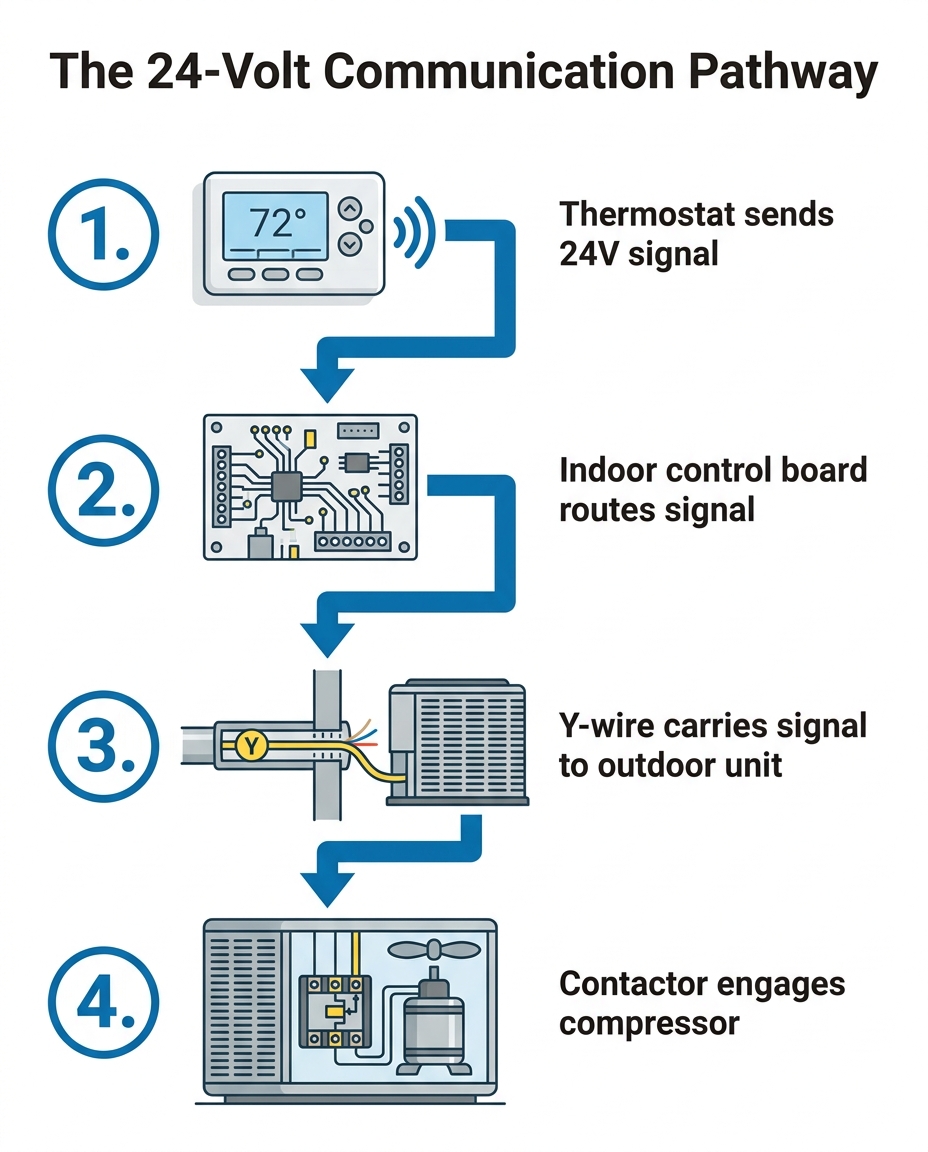
To understand why a simple wire can shut down a massive piece of cooling equipment, you have to look at the baseline mechanics of your home's control circuit. Standard residential HVAC systems rely on a 24-volt control circuit to operate. Our technicians often explain to customers that this low-voltage system is what allows your indoor thermostat to talk to the heavy-duty machinery located outside your Baldwin Park home.
The communication pathway follows a very specific route. When your home gets too warm, the thermostat sends a 24-volt signal down a designated wire (usually the yellow "Y-wire") to the indoor control board. From there, the signal travels outside to a component called the contactor. The contactor is essentially a heavy-duty switch. When the 24-volt signal reaches the contactor's magnetic coil, it pulls the switch closed, allowing high-voltage electricity to finally reach the compressor and the outdoor fan.
If this communication pathway is broken anywhere along the line, the outdoor unit will never receive the command to turn on. The compressor itself could be in perfect, factory-new condition, but without that 24-volt tap on the shoulder, it will sit completely silent. This mechanical reality perfectly explains the symptoms of an unresponsive system. If you have ever dealt with a thermostat not responding to AC settings, you have experienced a breakdown in this exact communication chain.
• Control Circuit — Voltage Level: 24 Volts (Low) — Primary Function: Sending commands and signals — Symptom of Failure: System unresponsive, blank screen, or indoor fan only
• Power Circuit — Voltage Level: 120V / 240V (High) — Primary Function: Running motors and compressors — Symptom of Failure: Tripped breakers, buzzing noises, or hot compressor
Common Low-Voltage Culprits Behind a Silent Compressor
When an outdoor unit refuses to run, a knowledgeable technician from our team will look for specific electrical faults that mimic a dead compressor. These low-voltage culprits are incredibly common, yet we see them frequently misdiagnosed by rushed contractors. Breaking down the problem, the root cause, and the proper solution reveals just how delicate the 24-volt system can be.
The Blown 3-Amp Control Board Fuse
The Problem: The entire HVAC system goes completely dark. The thermostat screen might go blank, the indoor fan will not run, and the outdoor compressor remains silent.
The Cause: Inside your furnace or air handler, there is a small, automotive-style 3-amp fuse mounted on the control board. This fuse exists to protect the low-voltage transformer from power surges or short circuits. If a wire anywhere in the house rubs against a sharp piece of metal and shorts out, this tiny fuse blows instantly, disabling the entire system to prevent a fire hazard.
The Solution: Our technician traces the length of the low-voltage wiring to find the exact location of the short circuit, repairs the exposed copper, and then replaces the 3-amp fuse.
The Severed Y-Wire
The Problem: The indoor blower fan turns on and circulates air, but the air is warm. The outdoor compressor and condenser fan do not turn on at all.
The Cause: The thermostat wiring bundle contains several different colored wires. The Y-wire is specifically responsible for carrying the cooling command to the outdoor unit. If this single wire is broken, corroded, or disconnected, the indoor fan will still receive its signal (via the G-wire), but the outdoor unit will remain in the dark.
The Solution: We perform a continuity test on the Y-wire to locate the break, splicing in new thermostat wire to restore the specific cooling communication.
The Shorted Thermostat Base
The Problem: The system behaves erratically, short-cycles, or fails to bridge the connection to turn the cooling on, closely mimicking a fatal breakdown of the outdoor equipment.
The Cause: The thermostat base (the plastic plate mounted to your wall) contains small metal pins and terminal blocks where the wires connect. Over time, these internal connections can short out or degrade. The thermostat faceplate might show that it is calling for cooling, but the base is failing to physically bridge the R-wire (power) to the Y-wire (cooling).
The Solution: Our team verifies the voltage drop across the thermostat base using a multimeter. If the base is failing, replacing the thermostat resolves the issue without touching the outdoor unit.
Thermal Expansion at Terminal Blocks
The Problem: The air conditioner works perfectly in the morning but fails to turn on during the hottest part of the afternoon.
The Cause: Baldwin Park homes transitioning from intense summer heatwaves to early fall can experience significant temperature swings. This causes the metal terminal blocks on the outdoor unit to undergo thermal expansion and contraction. Over several seasons, we consistently see this constant swelling and shrinking physically loosen the screws holding the low-voltage wires in place, leading to a weak or intermittent connection.
The Solution: A thorough seasonal tune-up from our team that includes manually tightening all low-voltage and high-voltage electrical connections inside the condenser cabinet.
The Hidden Threat of Pest Damage to HVAC Wiring
In our experience performing pre-heating-season tune-ups across Baldwin Park, one of the most surprising causes of a sudden system failure is entirely biological. The September early fall transition drives pests to seek shelter indoors or near warm equipment, frequently resulting in chewed low-voltage wiring. Rodents, squirrels, and even household pets are notorious for causing extensive damage to communication pathways.
Low-voltage wires are particularly vulnerable because they are often routed through dark, undisturbed areas like attics, crawlspaces, and along the exterior walls near the condenser. Many modern wire casings are manufactured with soy-based materials, which pests actively seek out as a food source. A single chewed wire severs the 24-volt communication line instantly. Because the wire bundle carries all the signals for heating, cooling, and fan operation, a hungry rodent can disable your entire climate control system in a matter of minutes.
When investigating a sudden failure, our technicians look for specific visual evidence of physical damage around the equipment:
• Frayed or missing outer casing: The brown or white outer jacket of the thermostat wire will look shredded rather than cleanly cut.
• Exposed copper wiring: Bare metal visible along the wire run, which often leads to the short circuits that blow the indoor 3-amp fuse.
• Nesting materials: Leaves, twigs, or insulation gathered inside the outdoor condenser cabinet near the electrical panel.
• Droppings: Rodent droppings along the wire path in the attic or inside the equipment housing.
It is highly important to recognize that this physical damage is a common, localized issue rather than a systemic equipment failure. Replacing a chewed section of thermostat wire is a straightforward repair that restores full functionality, proving once again that a silent unit does not mean the machinery itself is broken.
Professional Multimeter Diagnostics: Tracing the Fault
Accurate troubleshooting requires patience, proper tools, and a structured approach. One customer recently contacted Piggies Air Conditioning because they needed a thorough cleaning of their evaporator coil. A technician assessed the unit, provided a clear estimate, and completed the cleaning effectively in a timely manner. We apply that exact same commitment to diagnostic integrity and honest communication when meticulously tracing low-voltage wiring faults before ever recommending a compressor replacement.
When you call us for AC repair in Diamond Bar or the surrounding Baldwin Park area, our licensed professionals use a specialized multimeter to isolate the exact location of a short or break. Here is how our technicians trace a communication fault safely and accurately:
1. Verifying Transformer Output: Our technician starts at the indoor air handler, testing the low-voltage transformer to ensure it is actually stepping the 120V household power down to the required 24 volts. If the transformer is dead, no signals can be sent.
2. Checking the Control Board Fuse: We inspect the 3-amp fuse on the circuit board. If it is blown, we know immediately that a short circuit exists somewhere in the wire path.
3. Testing the Thermostat Base: Using the multimeter, our team tests for 24 volts between the R (power) and C (common) terminals at the wall. We then force a cooling call to verify that the thermostat is successfully sending voltage down the Y-wire.
4. Checking Continuity to the Condenser: If the signal leaves the thermostat but the outdoor unit remains off, our technician tests the wire bundle outside. By checking for continuity, we can determine if the wire has been severed or chewed somewhere inside the walls or attic.
5. Testing the Outdoor Contactor: Finally, we verify that 24 volts are reaching the magnetic coil on the outdoor contactor. If the voltage is present but the contactor does not pull in, the contactor itself has failed. If the voltage is missing, the wiring is the culprit.
These diagnostic steps must be performed by a licensed professional due to the extreme proximity to high-voltage components. The 24-volt terminals on a control board often sit mere inches away from 120-volt or 240-volt main power lines. A slip of a testing probe can cause severe injury or permanently destroy the control board. Contrasting this thorough, step-by-step approach with a rushed diagnosis highlights why testing is so critical—a quick glance might prematurely condemn a perfectly good compressor.
Protecting Your System's Electrical Integrity
Preventing communication failures is much easier than dealing with a sudden shutdown during the September early fall transition. Proactive electrical checks keep your system running reliably and prevent the panic-inducing moments when the air conditioning refuses to turn on. In fact, during a recent Baldwin Park service call, our team's routine AC unit inspection revealed that only a simple fix was needed. Our technician identified a small electrical fault and repaired the unit efficiently without upselling a new system. That is the power of proactive maintenance.
Protecting your wiring starts with the physical environment around your equipment. Highlighting the importance of sealing entry points around the outdoor condenser is a great first step to deter pests. We recommend using materials like thumb gum or outdoor-rated silicone to seal the hole where the refrigerant lines and low-voltage wires enter the house, preventing rodents from using that pathway as a front door. Furthermore, securing and insulating exposed low-voltage wire runs inside conduit protects them from both weather degradation and physical damage from weed whackers or pets.
The most effective way to protect your electrical integrity is by enrolling in a routine HVAC maintenance plan. During these seasonal tune-ups, our technicians do much more than just change filters. We actively tighten terminal blocks, test the 24-volt circuit for proper voltage drop, inspect the contactor for pitting, and look for early signs of wire chafing. Catching a loose connection or a slightly frayed wire in the fall ensures your system will communicate flawlessly when you need it most.
Frequently Asked Questions About Thermostat Wiring and AC Failures
Can bad thermostat wiring cause the AC compressor not to turn on?
Yes, if the 24-volt signal cannot reach the outdoor unit's contactor due to bad wiring, the compressor will not engage. The thermostat wire acts as the communication bridge between your indoor controls and the outdoor equipment. If that bridge is broken, chewed, or corroded, the heavy machinery outside will never receive the command to start the cooling cycle, even if the compressor is in perfect mechanical condition.
How do technicians tell if it is the thermostat or the AC unit?
Our technicians use a multimeter to check for voltage at the thermostat base and the control board to isolate where the signal drops. By testing the electrical current at each connection point, we can see exactly where the communication stops. If voltage leaves the thermostat but never arrives at the outdoor unit, the wiring is the issue; if voltage arrives at the outdoor unit but nothing happens, the mechanical components are failing.
What happens if a thermostat wire shorts out?
A shorted thermostat wire typically blows the 3-amp low-voltage fuse on the indoor control board, shutting down the entire system to protect the transformer. When the bare copper of a positive wire touches a ground or common wire, it creates a surge of electrical current. The small fuse acts as a sacrificial safeguard, breaking the circuit instantly to prevent the more expensive transformer from overheating or catching fire.
Why is my AC fan running but the compressor is silent?
We often find this indicates the indoor blower is receiving its signal, but the separate Y-wire signal to the outdoor compressor is broken or the outdoor contactor has failed. Your thermostat sends independent commands for the indoor fan (G-wire) and the outdoor cooling (Y-wire). If only the cooling wire is compromised by a pest or a loose connection, the fan will continue to circulate unconditioned, room-temperature air through your vents.
Can a homeowner test low-voltage HVAC wiring safely?
Because low-voltage wiring is integrated directly into control boards that handle high voltage, testing requires a licensed HVAC professional to ensure safety and prevent equipment damage. The terminal blocks for the 24-volt system are often located immediately adjacent to 120-volt or 240-volt power lines. Attempting to probe these areas without proper training and insulated tools carries a significant risk of electrical shock or accidentally shorting out the entire control board.
Ensuring Accurate Diagnostics for Your Peace of Mind
A silent compressor is not always a death sentence for your cooling system. As our team at Piggies Air Conditioning has seen, the delicate 24-volt communication pathway is susceptible to everything from thermal expansion to hungry pests during the September early fall transition. When that pathway breaks, the resulting symptoms mimic a catastrophic mechanical failure perfectly, leading to unnecessary panic and the fear of a massive replacement bill.
The value of a clear, professional breakdown of low-voltage wiring issues cannot be overstated. A technician who takes the time to trace the electrical fault with a multimeter is protecting your investment and ensuring you only pay for the repairs you actually need. We strongly encourage homeowners to prioritize a thorough diagnostic evaluation before making major replacement decisions. If you are deciding whether to repair or replace your AC, always demand that the low-voltage communication is verified first—it might just be a simple false alarm.
Other blogs


Customer Testimonials



CUSTOMER SERVICE!
I highly recommend this company for anyone needing AC repair or maintenance. I'll definitely be calling them again for any future needs!

I had the pleasure of experiencing outstanding service and professionalism from Ruben, and I am beyond impressed. From the moment I first contacted them, by phone and follow up communication via email for my quotes. The attention to detail and commitment to excellence were evident.
Ruben, was incredibly responsive, addressing all my inquiries promptly and with clear, thorough explanations. Their dedication to understanding and meeting my needs was remarkable.
Ruben, went above and beyond to ensure that everything was handled seamlessly, demonstrating not just professionalism, but also a sincere dedication to customer satisfaction.
I can't recommend Piggies air Conditioning/Ruben highly enough. If you're looking for someone who combines expertise with exceptional service, look no further. They are a true example of what outstanding professionalism should be.
The technician arrived on time, which I really appreciated given how crucial air conditioning is in this heat. Ruben was professional and friendly, explaining what he was doing throughout the process. The issue I had was diagnosed fairly quickly, and they provided me with a few options on how to fix it. The pricing was transparent, and I didn't feel like there were any hidden costs, which is always a plus when it comes to service calls like these. Highly recommend this company!
1st & foremost, huge shout out to Ruben thank u so so much for reaching out & making things happen SO FAST! I was so surprised since i had reached out to a couple different places who lagged on even answering calls, messages, etc.
Ruben was also very informative & taught me ALOT that i didnt know about.
Also cant leave the amazing Luis & Miles out of
this review.
They came, they saw, they conquered!
And they worked pretty swiftly too, felt very comfy around em, loved their personalities, great attitude, work ethic, professionalism, had some really good convos & they still got the job done lightning fast
SUPER HUGE SHOUT OUT & THANKS for everything guys! Definitely recommending u guys to everyone i know.
recommendations and feedback. The actual installation was painless and unremarkable, his AC experts got it done, got it cleaned and most importantly got it right. Rueben even went a step further to assure we had
protection from the coming rain, that is service unheard of these days. His price was competitive and a REAL value for the service we recieved. Using anyone else for your AC needs, would be a huge mistake. We thank them again and will recommend to everyone.
Echoing a lot of the other reviews here, Piggies Air Conditioning responds so quickly to requests (even though I actually accidentally sent in multiple requests on my side without responding, oops!)
They were able to come do a FREE energy audit and initial inspection on the same day and Ruben was amazing at explaining his thoughts on our house's situation and what he thought was worth the money and wasn't worth the money.
I truly felt like he was trying to help me find the best solution to our issues instead of just trying to upsell us on everything and anything.
I'm definitely recommending this business to anyone I know if they want a trustworthy and realistic service, value, and quality.