









Is Your AC Low on Refrigerant? Here's How to Tell Fast
Knowing how to check if your AC refrigerant is low can save you from a hot, uncomfortable home — and a much bigger repair bill down the road. If your air conditioner is running but your San Gabriel Valley home just won't cool down, low refrigerant could be the reason.
Here are the most common signs to look for right now:
- Warm or lukewarm air blowing from your vents even when the AC is running
- Ice buildup on the copper refrigerant lines or evaporator coil
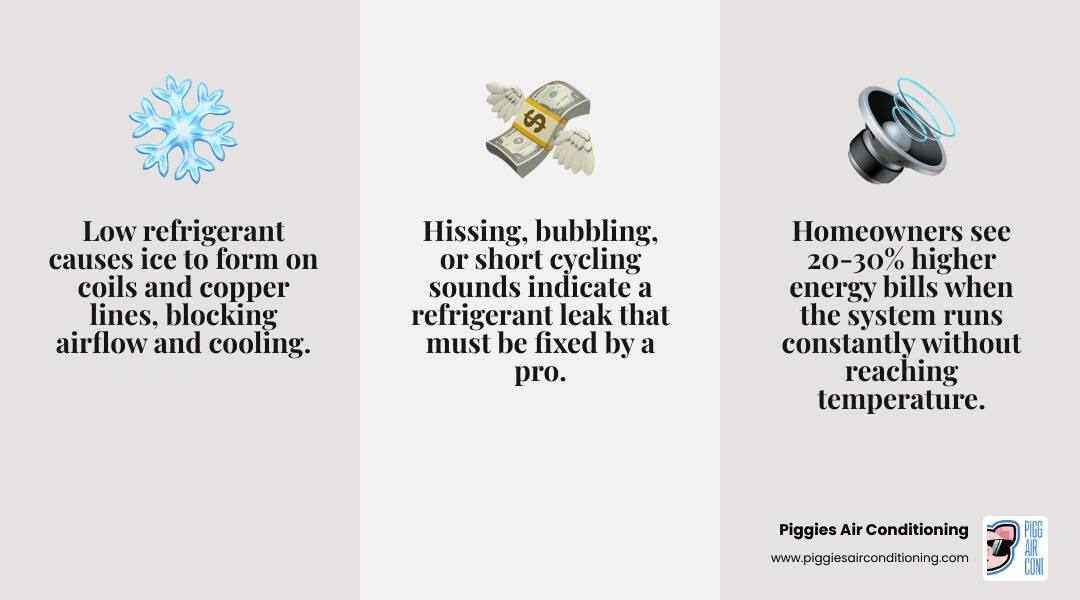
- Hissing or bubbling sounds near your indoor or outdoor unit
- Higher energy bills without a clear explanation
- AC running constantly but never reaching your set temperature
- Short cycling — the system turns on and off more frequently than normal
One important thing to understand: refrigerant does not get used up like fuel. A properly sealed AC system should never need a top-off. If your refrigerant is low, it means there is a leak somewhere in the system that needs to be found and fixed — not just refilled.
Only a certified HVAC technician can legally handle refrigerant and accurately measure system charge. But as a homeowner, you can absolutely spot the warning signs early — and that's exactly what this guide will walk you through.
Explore more about how to check if ac refrigerant is low:
- ac making clicking noise when starting up
- circuit breaker keeps tripping when ac turns on
- why is my ac blowing warm air
5 Common Signs Your Air Conditioner is Low on Freon

When the summer sun beats down on the San Gabriel Valley, your air conditioner is your home’s ultimate sanctuary. But when your system starts running low on refrigerant—often historically referred to by the brand name Freon—it won't be able to keep up with the heat. Because refrigerant is the vital medium that absorbs indoor heat and transfers it outside, a drop in its volume directly cripples your system’s cooling capacity.
Here are the five most common warning signs that your home's air conditioner is struggling with a low refrigerant charge:
1. Lukewarm Air Blowing From the Vents
If you place your hand in front of your supply registers and the air feels closer to room temperature than a refreshing, icy blast, your system is likely low on refrigerant. Without enough chemical refrigerant to absorb the heat from your indoor air, the air blowing back into your living spaces remains warm and humid.
2. Ice Buildup on the Refrigerant Lines and Evaporator Coil
It seems counterintuitive that a system struggling to cool your home would actually freeze over, but this is one of the most classic signs of low refrigerant. When refrigerant levels drop, the pressure inside the evaporator coil plunges. This drop in pressure causes the temperature of the coil to fall below freezing. As the natural moisture in your home’s air passes over this super-cold coil, it instantly freezes, forming a thick layer of ice. This ice can quickly travel down the copper lines all the way to your outdoor condenser unit.
3. Skyrocketing Energy Bills
Have you noticed your monthly electric bills climbing higher than a hiker on Mount Wilson? When your system is low on refrigerant, it has to work twice as hard to achieve your desired indoor temperature. Because it can’t transfer heat efficiently, it will run almost continuously, consuming massive amounts of electricity and driving up your utility costs.
4. Hissing or Bubbling Noises
Refrigerant operates under high pressure within a closed loop of copper tubing. If a leak develops, the escaping gas will often make a distinct hissing sound. If the leak is located in a section of the line where the refrigerant is in a liquid state, you might hear a bubbling or gurgling sound instead. If you hear these noises coming from your indoor air handler or your outdoor condenser, you have an active leak.
5. Short Cycling
Short cycling occurs when your air conditioner turns on and off rapidly in short bursts without completing a full cooling cycle. Low refrigerant levels directly disrupt the pressure balance in your system, triggering safety switches (like the low-pressure control) that shut the compressor down prematurely to prevent total system failure. If you are experiencing these issues, reviewing our guide on AC Troubleshooting Before Calling A Pro can help you rule out simple issues like dirty filters before pointing to a leak. For residents in historic or newer homes alike, Solving AC Cycling Problems Pasadena Homes provides local context on how cycling issues impact indoor humidity and system health.
How to Check If AC Refrigerant Is Low Safely at Home
As a homeowner, you should never attempt to attach pressure gauges or handle refrigerant yourself. Not only is it dangerous, but it is also a violation of federal environmental laws to handle or vent refrigerant without proper certification. However, you can safely perform a few non-invasive diagnostic checks at home using basic observation and a simple thermometer.
The most reliable way to estimate your refrigerant level without specialized tools is the Delta-T (Temperature Difference) Test. This test measures the temperature drop across your indoor evaporator coil.
How to Perform the Delta-T Test:
- Ensure your air filter is completely clean (a clogged filter restricts airflow and will ruin your readings).
- Turn your AC on and let it run continuously for at least 15 to 20 minutes to stabilize system pressures.
- Take a digital thermometer and measure the temperature of the air entering your return vent (where the filter is located).
- Measure the temperature of the air blowing out of one of your supply vents closest to the indoor unit.
- Subtract the supply air temperature from the return air temperature.
A properly charged, efficient air conditioner should have a temperature difference (Delta-T) of 8°C to 14°C (approximately 15°F to 20°F). If your temperature difference is below 7°C (12°F), it strongly suggests your system is low on refrigerant. (Conversely, a difference higher than 15°C usually points to an airflow restriction, such as a severely clogged filter or a failing blower motor).
| AC Operating Metric | Normal System Operation | Low Refrigerant System |
|---|---|---|
| Supply Air Temp | Icy cold (typically 12°C to 16°C / 54°F to 60°F) | Lukewarm or room temperature |
| Delta-T (Difference) | 8°C to 14°C (15°F to 20°F) | Below 7°C (12°F) |
| Suction Line (Thick Copper) | Cold to the touch, sweating with condensation | Warm or room temperature, bone dry |
| Evaporator Coil | Damp with normal condensation draining away | Covered in frost or thick ice |
| Outdoor Air Exhaust | Warm or hot air blowing out of the top | Cool or room-temperature air blowing out |
If your system fails these basic checks, you might find your AC System Not Working Covina homes require. Furthermore, when that frozen evaporator coil eventually shuts down and begins to thaw, it can overflow your drain pan, leading to severe Water Leakage Issues From Your AC Unit that can damage your ceilings or drywall.
Why Simply Topping Off Refrigerant is Not a Proper Fix
One of the most common misconceptions in home maintenance is that air conditioning systems naturally "consume" refrigerant over time, much like a car burns gasoline or needs an oil change.
This is entirely false. An air conditioner is a permanently sealed system. The refrigerant cycles continuously between liquid and gas states without ever being depleted or worn out. If your system is low on refrigerant, there is an active leak.
Simply "topping off" or refilling a leaking system without finding and repairing the source of the leak is an improper and irresponsible practice for several reasons:
- It Wastes Money: Because the system is leaking, any new refrigerant added will inevitably escape back into the atmosphere, requiring another expensive service call in the near future.
- It Can Destroy Your Compressor: Operating a system with low refrigerant starves the compressor of the oil it needs for lubrication, leading to overheating and total mechanical failure. The compressor is the "heart" of your AC and is incredibly expensive to replace.
- Environmental Damage: Standard refrigerants are powerful greenhouse gases. Intentionally recharging a known leaking system and allowing those gases to escape into the air violates EPA regulations and harms the planet.
- Formicary Corrosion: Many leaks develop deep within the copper evaporator coils due to formicary corrosion—a chemical reaction between household volatile organic compounds (VOCs) and the copper tubing that creates thousands of microscopic pinhole leaks.
Before the scorching summer months arrive, keeping an eye out for these issues is critical. Reviewing the Top 5 Signs Your AC Needs Repair Before Summer Hits can save you from a complete system breakdown. As your equipment ages, its overall efficiency can degrade, but a sudden drop in cooling capacity is almost always a mechanical or refrigerant issue. Read more on how this works in our analysis of Does AC Efficiency Drop As It Ages.
Comparing Home and Automotive Systems
While both residential HVAC units and automotive air conditioners rely on the exact same thermodynamic principles of compression, condensation, expansion, and evaporation, checking and maintaining them involves entirely different procedures, tools, and expectations.
In a home system, the entire assembly is constructed of rigid, brazed copper lines designed to remain perfectly stationary for decades. Because there are no moving rubber hoses or flexible joints, a residential system should remain 100% leak-free for its entire lifespan.
In contrast, a car’s AC system is subjected to constant engine vibration, extreme temperature swings under the hood, and physical movement from driving on bumpy roads. Car AC systems rely heavily on flexible rubber hoses, threaded fittings with rubber O-rings, and a rotating shaft seal on the compressor. Over time, these rubber components can naturally dry out, harden, and allow tiny amounts of refrigerant to seep out—even without a major physical puncture.
If you suspect your home system is struggling, understanding the Signs Your Heat Pump Needs Repair is highly relevant, as heat pumps use the exact same closed-loop refrigeration cycle to heat and cool your living spaces.
Home AC vs. Car AC: How to Check If AC Refrigerant Is Low
The process of diagnosing and charging these systems differs significantly:
- Automotive DIY Kits: You have likely seen DIY refrigerant recharge cans at your local auto parts store in West Covina or Arcadia. These kits typically connect only to the low-pressure service port and use a basic single-gauge setup. While popular, they are highly imprecise and can easily lead to overcharging, which can permanently damage the car's compressor clutch or cause system lockup.
- Refrigerant Types: Modern cars built after the mid-1990s primarily used R-134a, which is currently being phased out in newer vehicles (built after 2017) in favor of R-1234yf, an eco-friendly option with an incredibly low global warming potential. Home systems, on the other hand, transitioned from R-22 (Freon) to R-410A (Puron) in the 2000s, and are now transitioning to highly efficient, low-GWP alternatives like R-32 and R-454B.
- Residential Professionalism: Home AC systems operate at much higher pressures and require precise calculations of "superheat" and "subcooling" to ensure the charge is correct down to the ounce. There are no safe or legal "DIY cans" for residential systems; only EPA-certified professionals with commercial manifold gauges may legally purchase and handle residential refrigerants.
Professional Diagnostic and Repair Methods
When our certified technicians arrive at your home to investigate a suspected refrigerant issue, we don't just guess. We use a suite of advanced diagnostic tools to pinpoint the exact state of your system.
To determine if your system is operating at peak performance, we measure two critical thermodynamic calculations:
- Superheat: This is the temperature rise of the refrigerant gas after it has completely vaporized in the evaporator coil. Measuring superheat ensures that liquid refrigerant is not accidentally flowing back into the compressor, which would cause catastrophic "liquid slugging" and destroy the motor.
- Subcooling: This is the temperature drop of the liquid refrigerant after it condenses in your outdoor unit. Subcooling tells us exactly how much liquid refrigerant is backing up in the condenser, which is the most accurate indicator of charge level in systems utilizing a Thermostatic Expansion Valve (TXV).
Once we confirm the charge is low, we utilize specialized leak detection equipment to find the breach. This includes electronic leak detectors (which sniff out halogenated gas molecules in the air), applying specialized bubble solutions to joints, or performing a high-pressure nitrogen test to find microscopic cracks. All of our technicians hold federal EPA Section 608 certification, ensuring that every repair is performed in strict compliance with environmental safety standards.
If you are experiencing cooling issues in Arcadia, our team at AC Repair Arcadia CA is ready to help. We back our craftsmanship with industry-leading warranties, which you can read about in our AC Repair Guarantee Baldwin Park Guide.
How to Check If AC Refrigerant Is Low Using Professional Tools
The step-by-step professional process to accurately diagnose and restore a system includes:
- Attaching a Manifold Gauge Set: We connect high-precision digital gauges to both the liquid (high-pressure) and suction (low-pressure) service valves.
- Measuring Line Temperatures: We clamp digital temperature probes directly onto the copper lines to calculate real-time superheat and subcooling.
- Evacuating the System: If a leak is found and repaired, we use a commercial vacuum pump to pull a deep vacuum (down to 500 microns or lower) to remove all air and non-condensable moisture from the lines.
- Weighing the Charge: We use a highly precise digital scale to charge the system with the exact weight of refrigerant specified by the manufacturer's factory nameplate.
Frequently Asked Questions About Low AC Refrigerant
Can I run my AC if the refrigerant is low?
No, you should not run your air conditioner if you suspect the refrigerant is low. Operating a system with an insufficient charge causes the compressor to overheat, as it relies on the cool returning refrigerant gas to keep its internal motor cool. Running it continuously under these conditions will lead to permanent compressor burnout, resulting in a complete system shutdown and an incredibly expensive replacement.
Does AC refrigerant evaporate or run out over time?
No. Refrigerant operates in a completely closed, pressurized loop. It does not evaporate, break down, or get consumed during the cooling process. Barring a physical puncture, friction wear, or chemical corrosion causing a leak, the original refrigerant charge should last for the entire lifetime of your air conditioning system.
How do I know if my AC needs a repair or a full replacement?
This decision usually comes down to three main factors: the age of your system, the type of refrigerant it uses, and the overall cost of the repair.
If your air conditioner was built before 2010, it likely runs on R-22 refrigerant. Because R-22 has been completely phased out due to its ozone-depleting properties, locating reclaimed R-22 is exceptionally difficult and highly expensive. Investing in a major leak repair on an outdated R-22 system is rarely cost-effective. In these cases, upgrading to a modern, energy-efficient system is almost always the smarter long-term investment. To help you evaluate your current equipment, review our guide on the Signs That You Need A New AC System.
Conclusion
Understanding how to check if your AC refrigerant is low is the first step toward protecting your home's comfort and your wallet. While you can easily spot the early warning signs—like lukewarm air, frozen copper pipes, and sudden spikes in your energy bills—the actual diagnostic testing, leak repair, and recharging must always be left to certified professionals.
At Piggies Air Conditioning, we have spent years keeping families cool across the San Gabriel Valley and West Covina. As a trusted, owner-operated Daikin Comfort Pro dealer, we take pride in offering transparent, honest service with same-day availability. We even offer an incredible 12-year full replacement and labor warranty on qualifying Daikin Comfort Pro units, giving you ultimate peace of mind.
The best way to prevent refrigerant leaks and unexpected breakdowns is through regular, preventative maintenance. Our comprehensive seasonal tune-ups ensure your system remains perfectly sealed, clean, and efficient year-round.
If you're in Pasadena, don't wait for the peak of summer to check your system—schedule your AC Maintenance Pasadena CA today. You can also prepare your home for the warm months ahead by following our handy Spring AC Maintenance Checklist For Homeowners.
Ready to restore your home's cool comfort? Contact us today to explore our full range of professional heating and cooling solutions on our Piggies Air Conditioning Services page. Let us do the heavy lifting so you can sit back, relax, and enjoy a perfectly chilled home!
Other blogs


Customer Testimonials



CUSTOMER SERVICE!
I highly recommend this company for anyone needing AC repair or maintenance. I'll definitely be calling them again for any future needs!

I had the pleasure of experiencing outstanding service and professionalism from Ruben, and I am beyond impressed. From the moment I first contacted them, by phone and follow up communication via email for my quotes. The attention to detail and commitment to excellence were evident.
Ruben, was incredibly responsive, addressing all my inquiries promptly and with clear, thorough explanations. Their dedication to understanding and meeting my needs was remarkable.
Ruben, went above and beyond to ensure that everything was handled seamlessly, demonstrating not just professionalism, but also a sincere dedication to customer satisfaction.
I can't recommend Piggies air Conditioning/Ruben highly enough. If you're looking for someone who combines expertise with exceptional service, look no further. They are a true example of what outstanding professionalism should be.
The technician arrived on time, which I really appreciated given how crucial air conditioning is in this heat. Ruben was professional and friendly, explaining what he was doing throughout the process. The issue I had was diagnosed fairly quickly, and they provided me with a few options on how to fix it. The pricing was transparent, and I didn't feel like there were any hidden costs, which is always a plus when it comes to service calls like these. Highly recommend this company!
1st & foremost, huge shout out to Ruben thank u so so much for reaching out & making things happen SO FAST! I was so surprised since i had reached out to a couple different places who lagged on even answering calls, messages, etc.
Ruben was also very informative & taught me ALOT that i didnt know about.
Also cant leave the amazing Luis & Miles out of
this review.
They came, they saw, they conquered!
And they worked pretty swiftly too, felt very comfy around em, loved their personalities, great attitude, work ethic, professionalism, had some really good convos & they still got the job done lightning fast
SUPER HUGE SHOUT OUT & THANKS for everything guys! Definitely recommending u guys to everyone i know.
recommendations and feedback. The actual installation was painless and unremarkable, his AC experts got it done, got it cleaned and most importantly got it right. Rueben even went a step further to assure we had
protection from the coming rain, that is service unheard of these days. His price was competitive and a REAL value for the service we recieved. Using anyone else for your AC needs, would be a huge mistake. We thank them again and will recommend to everyone.
Echoing a lot of the other reviews here, Piggies Air Conditioning responds so quickly to requests (even though I actually accidentally sent in multiple requests on my side without responding, oops!)
They were able to come do a FREE energy audit and initial inspection on the same day and Ruben was amazing at explaining his thoughts on our house's situation and what he thought was worth the money and wasn't worth the money.
I truly felt like he was trying to help me find the best solution to our issues instead of just trying to upsell us on everything and anything.
I'm definitely recommending this business to anyone I know if they want a trustworthy and realistic service, value, and quality.