









Is Your AC Losing the Battle Against the Late-Summer Heat?
The August late-summer heat is bearing down as families navigate the back-to-school transition, and if you are currently researching the signs your air conditioner has a Freon leak (and why we can't just top it off), you are likely feeling the frustration of a house that simply refuses to cool down. It is incredibly stressful when your cooling system runs for hours on end, yet the indoor temperature barely drops. When this happens, our team at Piggies Air Conditioning frequently hears from homeowners who immediately suspect that the system is just "low on Freon" and hope for a quick, inexpensive recharge to get through the rest of the season.
Here is the thing we always tell our customers: while a quick top-off sounds incredibly appealing, it is neither a legal nor a mechanical solution to your cooling problems. Your air conditioning system is a sealed environment, meaning it never naturally consumes or burns up refrigerant. If the levels are low, there is a physical hole in the system that is allowing the gas to escape into the atmosphere. Adding more refrigerant without addressing the underlying damage is a temporary band-aid that leaves your expensive equipment vulnerable. Proper diagnostics are always required to locate the breach, protect the machinery, and restore your home's comfort safely. If you need a permanent fix rather than a fleeting patch, scheduling comprehensive air conditioning services is the best way to protect your investment.
Physical Symptoms of a Refrigerant Leak in Your System
Before calling one of our technicians out into the August late-summer heat, you can often identify a suspected leak by observing how your system is behaving. Because refrigerant is the lifeblood of the cooling process, a drop in pressure creates very specific, observable symptoms throughout the equipment. Knowing what to look for can help you communicate the issue clearly when you schedule a service call with us.
If you suspect your system is compromised, keep an eye out for these common physical indicators our team typically sees in the field:
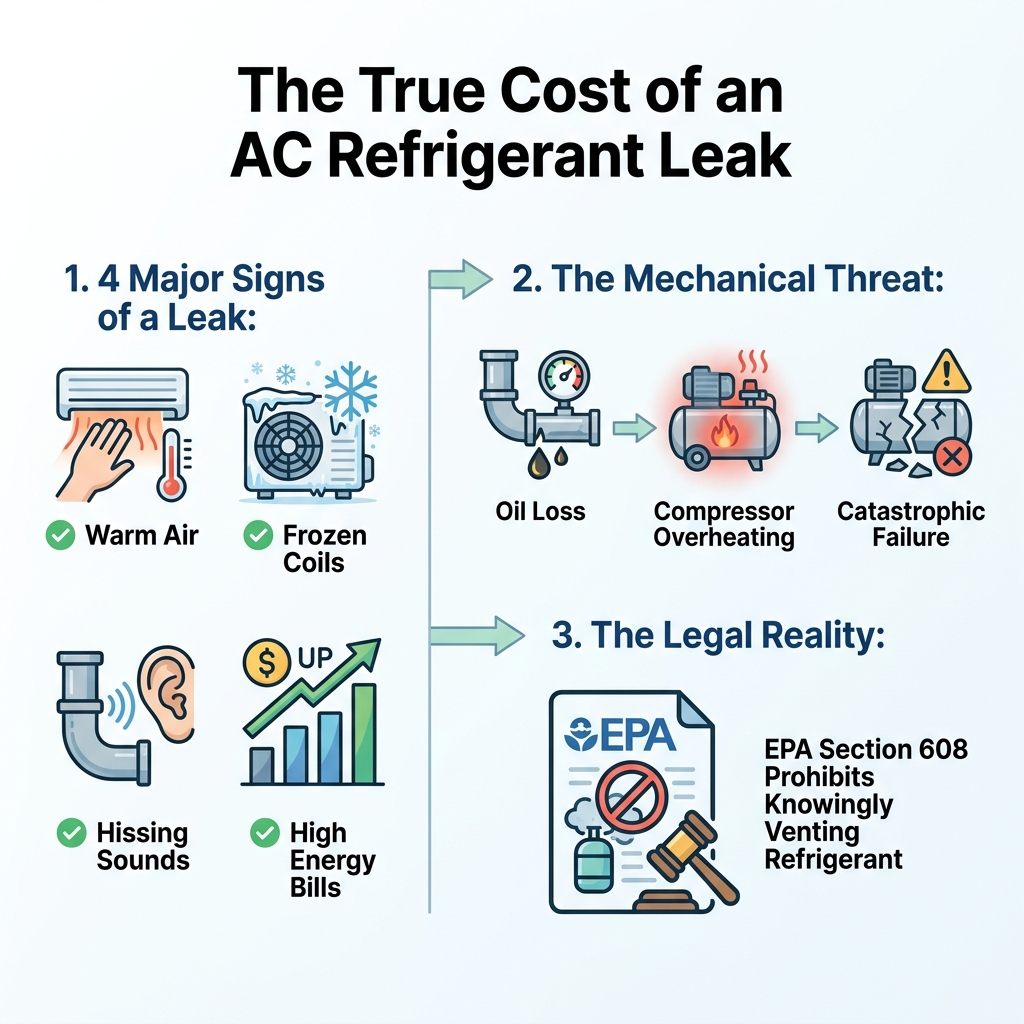
• Warm air from the vents: In our experience, this is usually the first and most obvious symptom. Without enough refrigerant to absorb heat from your indoor air, the blower motor will simply circulate unconditioned, room-temperature air back into your living spaces.
• Ice buildup on the evaporator coils: It sounds counterintuitive, but a lack of refrigerant actually causes the indoor coils to drop below freezing. Condensation from the air then freezes directly onto the metal, creating a block of ice that chokes off airflow entirely.
• Hissing or bubbling noises: If the physical hole in the copper line is large enough, you might actually hear the pressurized refrigerant escaping. A hissing sound indicates gas leaking out, while a bubbling sound usually points to a leak in a section of the line where the refrigerant is in a liquid state.
• Unusually high energy bills: Because the system cannot satisfy the thermostat's temperature setting, it will run continuously. This non-stop operation forces the equipment to consume massive amounts of electricity, causing a severe spike in your monthly utility costs.
Comparing Normal Operation to Leak Symptoms
To help you better understand what is happening, here is a quick breakdown of how a healthy system behaves compared to the leaking systems we frequently encounter:
• Vent Temperature — Normal Operation: Crisp, cold air flowing steadily — Suspected Refrigerant Leak: Lukewarm or room-temperature air
• Indoor Coil Status — Normal Operation: Cool and wet with condensation — Suspected Refrigerant Leak: Covered in frost or solid ice
• Operating Cycle — Normal Operation: Turns on and off periodically — Suspected Refrigerant Leak: Runs constantly without stopping
• System Sounds — Normal Operation: Smooth fan and compressor hum — Suspected Refrigerant Leak: Hissing or bubbling near copper lines
If you are experiencing any of these issues, learning how to check if your AC refrigerant is low is a helpful next step before a professional arrives.
The Closed-Loop Concept: Why ACs Never 'Consume' Freon
One of the most persistent myths our technicians encounter on service calls is that air conditioners naturally use up their Freon over time, much like a car consumes gasoline or an engine burns through oil. In reality, your cooling system operates on a strict closed-loop cycle. Understanding this concept is the key to understanding why top-offs are fundamentally flawed.
How the Refrigeration Cycle Actually Works
Your air conditioner cools your Baldwin Park home by continuously circulating a specific volume of refrigerant between the indoor and outdoor units. Inside, the refrigerant evaporates into a gas, absorbing heat and humidity from your living spaces. It then travels outside to the compressor and condenser coil, where it is pressurized and condensed back into a liquid, releasing that trapped heat into the outdoor air. The refrigerant then travels back inside to repeat the process.
Because this cycle takes place entirely within sealed copper tubing, the refrigerant is never "spent" or "burned." The exact same chemical compound is used over and over again for the entire lifespan of the equipment. Therefore, we have an absolute rule in professional HVAC: if a system is low on refrigerant, there is a leak that must be found.
The Punctured Tire Analogy:
Think of your air conditioning system like a bicycle tire. A healthy tire holds its air pressure indefinitely. If you find yourself needing to pump air into the tire every few days, you know there is a nail in the rubber or a faulty valve stem. Adding more air might let you ride the bike for another afternoon, but it does not fix the hole. Adding refrigerant to a leaking AC unit operates on the exact same logic—you are just paying to pump expensive gas into a system that will immediately let it leak back out.
EPA Regulations and the Legal Reality of Refrigerant Top-Offs
Beyond the mechanical inefficiency of adding gas to a leaking system, there are strict federal laws governing how HVAC professionals handle these chemicals. When our technicians refuse to blindly top off your system, they are not just being difficult; they are actively following federal law to protect both the environment and their professional licensing.
Understanding Section 608 of the Clean Air Act
Refrigerants, particularly older formulas like R-22 (commonly known as Freon) and even newer blends like R-410A, are potent greenhouse gases. When released into the atmosphere, they contribute significantly to ozone depletion and environmental damage. To combat this, the Environmental Protection Agency (EPA) established Section 608 of the Clean Air Act.
Under EPA regulations, it is illegal for anyone to knowingly vent refrigerants into the atmosphere. When our HVAC technicians hook up their gauges and confirm that your system is low on charge, they have verified that a leak exists. If they were to simply add more refrigerant knowing that it will eventually escape through that same leak, they would be knowingly contributing to environmental venting. Federal law requires licensed technicians to locate significant leaks, recover the remaining chemicals safely, and perform a permanent repair.
The Reality of Older Systems:
For homeowners in Baldwin Park with older systems that still utilize R-22, the rules are even stricter. R-22 has been entirely phased out of production worldwide due to its severe environmental impact. Because no new R-22 is being manufactured, the remaining supply is heavily restricted. Attempting to top off an R-22 system is not only environmentally irresponsible, but the scarcity of the gas makes it an incredibly poor financial decision compared to having our team find the leak or upgrade the equipment.
How Low Refrigerant Levels Destroy Compressors in High Heat
While the environmental and legal reasons against top-offs are clear, the mechanical consequences are even more severe. Running an undercharged system during the intense August late-summer heat does more than just make your house uncomfortable—it actively destroys the most expensive component in your entire system: the compressor.
The Hidden Danger: Lubrication Loss
The compressor, located in the outdoor unit, acts as the heart of your air conditioner. It pumps the refrigerant through the lines to keep the cooling cycle moving. Just like the engine in your car, the compressor contains specialized oil that keeps its internal moving parts lubricated and prevents friction.
Here is the critical mechanical connection: that lubricating oil travels through the system suspended within the liquid refrigerant. When your system develops a leak and the refrigerant levels drop, the oil does not flow back to the compressor efficiently. The compressor is forced to run dry, creating immense internal friction. To make matters worse, Baldwin Park's intense August heat forces the system to run non-stop to try and reach the thermostat setting.
The Path to Catastrophic Failure:
An overworking compressor running without proper lubrication will overheat rapidly. The internal windings will burn out, and the mechanical components will grind to a halt. Once a compressor fails, the repair is so extensive that it often makes more sense to replace the entire outdoor unit.
Our team recently helped a local homeowner who experienced this firsthand when their AC unit went down and stopped running entirely during a brutal stretch of hot weather. Our technicians came out, diagnosed the underlying issue—a lack of proper refrigerant flow causing severe overheating—and repaired the unit, getting the system back up and running like new before permanent compressor death occurred. By catching the issue early and scheduling professional AC repair, you can save the heart of your system from catastrophic failure.
The Ethical Diagnostic Process: Permanent Fixes Over Band-Aids
When you hire a professional to evaluate a struggling cooling system, you deserve a permanent solution, not an endless cycle of service calls. This is where the difference between an ethical provider and a quick-fix contractor becomes obvious. In our years of service, we have always prioritized proper diagnostics over the "band-aid" approach of a temporary top-off.
Our Comprehensive Leak Detection Process
At Piggies Air Conditioning, our commitment to proper diagnostics and environmental compliance means we focus on permanently fixing leaks to protect your equipment. When we arrive at your Baldwin Park home, we follow a strict, step-by-step diagnostic process:
1. Electronic Leak Search: We use highly sensitive electronic sniffers and specialized ultraviolet dyes to pinpoint the exact location of the microscopic hole in the copper tubing or evaporator coil.
2. Safe Recovery: Before any repairs can begin, we use an EPA-approved recovery machine to safely pull the remaining refrigerant out of the system, ensuring nothing escapes into the atmosphere.
3. Permanent Repair: Depending on the location, we will braze (weld) the hole shut or replace the damaged section of the line set or coil entirely.
4. Pressure Testing: We pressurize the repaired system with dry nitrogen to verify that the fix is solid and that no other micro-leaks exist.
5. Vacuum and Recharge: Finally, we pull a deep vacuum to remove all moisture and air from the lines before weighing in the exact, factory-specified charge of fresh refrigerant.
This thorough approach restores the integrity of your system. In one recent case, our team visited a homeowner who was told by another company that their air conditioner required a full replacement due to a suspected leak. However, after a thorough evaluation, Piggies Air Conditioning repaired the air conditioner instead, proving that an honest approach focuses on fixing the actual problem rather than pushing an unnecessary upgrade. If you are dealing with ongoing issues, seeking ethical AC repair in Covina and the surrounding areas ensures you get the truth about your equipment.
Protecting Your Cooling System With Proactive Maintenance
The best way to handle a refrigerant leak is to prevent it from causing a major breakdown in the first place. While some leaks are caused by accidental physical damage (like a weed whacker hitting the outdoor lines), many develop slowly over time due to microscopic corrosion on the indoor coils. Transitioning from reactive repairs to proactive system care is the smartest move we recommend for any homeowner.
What We Check During a Maintenance Visit
Routine inspections are designed to catch micro-leaks before they cause major performance drops during the August late-summer heat. When our technicians evaluate your system annually, they check the operating pressures and line temperatures to ensure the refrigerant charge is exactly where it should be. If the pressure has dropped slightly since the previous year, it is an early warning sign that a small leak has developed.
Beyond checking the charge, a thorough maintenance visit includes cleaning the coils, clearing the condensate drain, and verifying that the compressor is drawing the correct amount of electrical current. This level of ongoing care provides incredible peace of mind, knowing that your system is fully charged, legally compliant, and mechanically sound. Establishing a relationship with our trusted local professionals by enrolling in a routine AC maintenance plan is the most effective way to extend the lifespan of your cooling equipment and avoid mid-summer emergencies.
Frequently Asked Questions About AC Freon Leaks
When the August late-summer heat exposes a weakness in your cooling system, you likely have plenty of questions. Below, our experienced technicians have answered the most common concerns our Baldwin Park customers have regarding refrigerant leaks and proper repair protocols.
Can a technician just add Freon to my AC?
No, adding Freon without locating and fixing the leak is a temporary and often illegal band-aid. Because the system is a closed loop, any refrigerant added will continue to escape through the existing hole. This leads to repeated service calls, wasted money, and severe mechanical strain that can cause permanent compressor damage.
Why is my AC freezing up in the summer?
Low refrigerant causes the evaporator coil's temperature to drop significantly below freezing. When the warm, humid air from your home blows across this super-chilled metal, the condensation immediately freezes instead of dripping into the drain pan. This ice buildup eventually blocks all airflow, stopping the cooling process entirely and forcing the system to work twice as hard.
What are the signs of a refrigerant leak?
The most common signs we see include warm air blowing from your vents, hissing or bubbling noises near the copper lines, frozen indoor coils, and unusually high energy bills. You will also notice that the system runs constantly but completely fails to reach the temperature set on your thermostat.
Is it illegal to top off Freon?
Under EPA Section 608, it is strictly illegal to knowingly vent refrigerants into the atmosphere. Because adding gas to a system with a known leak guarantees that the chemical will escape into the air, continuously topping off the system violates environmental regulations. Licensed technicians are required by federal law to perform a permanent repair.
How long does it take to find and fix a Freon leak?
Depending on the leak's size and location, our electronic leak searches can take anywhere from an hour to a few hours to complete. The total repair time includes recovering the old refrigerant safely, brazing the damaged line, pressure testing with nitrogen, pulling a deep vacuum, and finally recharging the system, which typically takes a full afternoon.
What happens to older R-22 systems if they leak?
R-22 refrigerant has been entirely phased out of production globally and is highly restricted, making recharges exceptionally difficult and cost-prohibitive. If an older R-22 system develops a significant leak, the most practical and compliant solution is often a system upgrade to a modern unit that uses safe, environmentally friendly refrigerants.
Restore Your Comfort With Proper Refrigerant Diagnostics
A suspected refrigerant leak requires immediate, professional attention before the Baldwin Park heat causes complete system failure. Ignoring the symptoms or hoping for a quick top-off will only lead to higher energy bills, a stressed compressor, and potential environmental violations. Permanent repairs are the only way to protect the heart of your air conditioner and ensure your home stays consistently cool.
Do not wait for your struggling system to break down entirely. Schedule a comprehensive diagnostic visit with our team today to locate the leak, repair the damage properly, and restore your cooling system's integrity before the next heat wave hits.
Other blogs


Customer Testimonials



CUSTOMER SERVICE!
I highly recommend this company for anyone needing AC repair or maintenance. I'll definitely be calling them again for any future needs!

I had the pleasure of experiencing outstanding service and professionalism from Ruben, and I am beyond impressed. From the moment I first contacted them, by phone and follow up communication via email for my quotes. The attention to detail and commitment to excellence were evident.
Ruben, was incredibly responsive, addressing all my inquiries promptly and with clear, thorough explanations. Their dedication to understanding and meeting my needs was remarkable.
Ruben, went above and beyond to ensure that everything was handled seamlessly, demonstrating not just professionalism, but also a sincere dedication to customer satisfaction.
I can't recommend Piggies air Conditioning/Ruben highly enough. If you're looking for someone who combines expertise with exceptional service, look no further. They are a true example of what outstanding professionalism should be.
The technician arrived on time, which I really appreciated given how crucial air conditioning is in this heat. Ruben was professional and friendly, explaining what he was doing throughout the process. The issue I had was diagnosed fairly quickly, and they provided me with a few options on how to fix it. The pricing was transparent, and I didn't feel like there were any hidden costs, which is always a plus when it comes to service calls like these. Highly recommend this company!
1st & foremost, huge shout out to Ruben thank u so so much for reaching out & making things happen SO FAST! I was so surprised since i had reached out to a couple different places who lagged on even answering calls, messages, etc.
Ruben was also very informative & taught me ALOT that i didnt know about.
Also cant leave the amazing Luis & Miles out of
this review.
They came, they saw, they conquered!
And they worked pretty swiftly too, felt very comfy around em, loved their personalities, great attitude, work ethic, professionalism, had some really good convos & they still got the job done lightning fast
SUPER HUGE SHOUT OUT & THANKS for everything guys! Definitely recommending u guys to everyone i know.
recommendations and feedback. The actual installation was painless and unremarkable, his AC experts got it done, got it cleaned and most importantly got it right. Rueben even went a step further to assure we had
protection from the coming rain, that is service unheard of these days. His price was competitive and a REAL value for the service we recieved. Using anyone else for your AC needs, would be a huge mistake. We thank them again and will recommend to everyone.
Echoing a lot of the other reviews here, Piggies Air Conditioning responds so quickly to requests (even though I actually accidentally sent in multiple requests on my side without responding, oops!)
They were able to come do a FREE energy audit and initial inspection on the same day and Ruben was amazing at explaining his thoughts on our house's situation and what he thought was worth the money and wasn't worth the money.
I truly felt like he was trying to help me find the best solution to our issues instead of just trying to upsell us on everything and anything.
I'm definitely recommending this business to anyone I know if they want a trustworthy and realistic service, value, and quality.