










The Myth of the 'Set-It-and-Forget-It' Thermostat
Simply buying a programmable thermostat doesn't guarantee lower energy bills. If you want real efficiency, looking at Smart Thermostats vs. Programmable Thermostats: A Practical Decision Framework is the best way to cut through the marketing hype and find what actually works for your home. Many homeowners assume that upgrading from an old manual dial to a digital programmable model is all it takes to optimize their cooling. The reality is far more complicated. A thermostat is only as efficient as the schedule programmed into it, and human behavior rarely follows a perfect, unchanging script.
For comprehensive support with your home's cooling system, explore our professional air conditioning solutions.
The core decision point for most families comes down to choosing between a static programmable schedule and dynamic learning technology. A static schedule does exactly what you tell it to do, at the exact time you specify. This sounds great in theory, but it often falls apart in practice. The late-summer back-to-school transition is a perfect example of how rigid temperature schedules fail. When kids start coming home at different times, sports practices shift daily, and parents adjust their work hours to accommodate, a strict 9-to-5 cooling schedule suddenly leaves the house uncomfortably warm or cools an empty building for hours.
Building a practical decision framework requires looking past the technical features printed on the side of the box. Instead, you need to evaluate your actual family behavior. Do you leave and return at the exact same time every single day, or does your household operate on a more fluid timeline? Understanding this behavioral difference is the first step in deciding whether a standard programmable unit will serve your needs, or if it is time to step up to an automated, learning system.
Why Static Schedules Fail During Chaotic Routine Changes
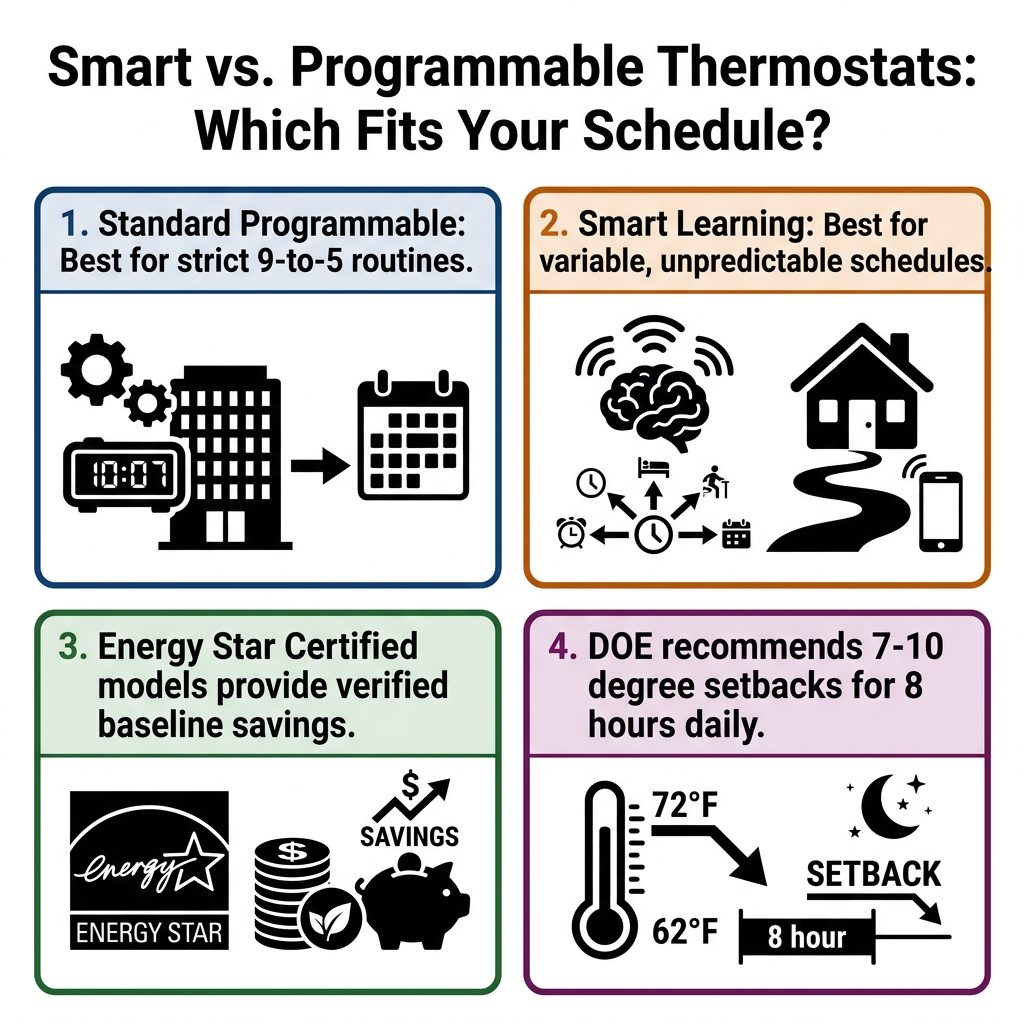
The Department of Energy recommends setting thermostats back 7 to 10 degrees for 8 hours a day to achieve optimal efficiency. Following this guideline can result in tangible energy savings over the course of a year. However, this recommendation relies on the assumption that the house will actually be empty for those 8 hours. When schedules change unexpectedly, that carefully crafted efficiency plan goes straight out the window.
The Psychological Reality of Manual Overrides
The friction of reprogramming: Adjusting a standard programmable thermostat for a temporary schedule change is tedious. You often have to navigate complex menus, cycle through days of the week, and adjust individual time blocks. Because this process is frustrating, most homeowners simply press the "Hold" or "Override" button to force the system to cool the house immediately.
Temporary holds become permanent: The psychological reality of manual overrides is that people forget to undo them. Once the house reaches a comfortable temperature, the thermostat fades into the background of daily life. That temporary override remains active overnight, through the next day, and sometimes for weeks. This completely destroys the intended efficiency of the device, effectively turning a modern programmable unit into an old-fashioned manual dial. Sometimes, this user error during manual overrides can even mimic system malfunctions, leading homeowners to search for answers when they find their thermostat not responding to AC settings properly.
Losing Efficiency During the Back-to-School Shift
Unpredictable afternoon arrivals: The late-summer back-to-school transition is notorious for ruining rigid cooling schedules. If your thermostat is programmed to start cooling the house at 5:00 PM for a standard post-work arrival, but teenagers start getting home from school at 3:15 PM, they will walk into a hot house. Their first reaction will be to march over to the wall and crank the temperature down manually.
Staggered family routines: Shifting household occupancy makes a previously optimized static schedule completely ineffective. When one parent works from home on Tuesdays, a child has soccer practice on Thursdays, and weekends are entirely unpredictable, a static programmable thermostat simply cannot keep up. A typical pattern we see is homeowners needing upgrades and detailed information on how their HVAC system operates to handle these shifts. One recent winter customer reached out for exactly this kind of education, gaining the knowledge needed to manage their system effectively and expressing deep satisfaction with the professional service provided. Education is the key to preventing wasted energy.
How Learning Technology Adapts to Unpredictable Days
To solve the manual override problem, the industry developed dynamic thermostats that utilize learning technology. Instead of forcing you to predict your schedule weeks in advance, these systems monitor your daily adjustments to build a responsive cooling profile. Devices like Ecobee or Nest learning thermostats track when you walk past the unit, when you manually adjust the temperature, and when the house sits empty.
Geofencing and Real-Time Adjustments
Smartphone location tracking: One of the most powerful features of a dynamic learning thermostat is geofencing. By linking the thermostat to the location services on your smartphone, the system draws an invisible perimeter around your neighborhood. When you cross that boundary on your way to work, the system automatically shifts into an energy-saving away mode.
Cooling on demand: Conversely, when you cross the boundary on your way home, the system triggers the cooling cycle. This eliminates the need to cool an empty house during extended work or school days, while guaranteeing the environment is comfortable the moment you unlock the front door. For households with shifting arrival times, this automated responsiveness is a game-changer.
Managing Late-Summer Heatwaves Automatically
Pre-cooling strategies: Advanced algorithms do more than just track your phone; they also track the weather. Baldwin Park's intense late-summer heatwaves heavily penalize manual schedule overrides if homeowners forget to adjust the AC before leaving the house. Learning models handle this automatically by monitoring local weather forecasts. If a massive temperature spike is predicted for the afternoon, the system will proactively pre-cool your home during the milder morning hours.
Verified energy reduction: By balancing indoor comfort with peak grid demand during extreme heat, these systems reduce the overall strain on your HVAC equipment. This is why Energy Star certified smart models provide verified baseline energy savings. They adapt to real-world usage and sudden outdoor temperature changes without requiring any manual intervention from the homeowner.
Feature Breakdown: Smart vs. Programmable Thermostats
When evaluating your options, a direct side-by-side comparison helps clarify the functional differences between static and dynamic technology. While both devices mount to your wall and control your HVAC system, their internal capabilities are vastly different.
Comparison Table: Which Model Wins?
The setup process for a programmable unit requires manual data entry for every day of the week. In contrast, algorithmic learning over the first few weeks allows a smart thermostat to program itself based on your actual habits. Remote accessibility is another major dividing line: programmable units offer localized control only, while smart devices feature comprehensive cloud-based app management.
• Schedule Creation — Standard Programmable Thermostat: Manual entry required for all time blocks and days. — Dynamic Smart Thermostat: Learns habits automatically over the first few weeks of use.
• Remote Access — Standard Programmable Thermostat: None. Must be adjusted physically at the wall unit. — Dynamic Smart Thermostat: Full control via smartphone app from anywhere with internet.
• Occupancy Response — Standard Programmable Thermostat: None. Runs the schedule even if the house is empty. — Dynamic Smart Thermostat: Uses geofencing and motion sensors to pause cooling when away.
• Energy Tracking — Standard Programmable Thermostat: No feedback or data provided to the homeowner. — Dynamic Smart Thermostat: Detailed monthly usage reports and efficiency recommendations.
• Ideal Household — Standard Programmable Thermostat: Best for perfectly predictable, rigid daily routines. — Dynamic Smart Thermostat: Best for variable schedules, hybrid work, and active families.
Standard units offer no feedback on how your system performs, while smart units provide detailed usage reports that help you identify wasted energy. Ultimately, the right choice depends heavily on which technology aligns best with your specific type of household predictability.

Matching Your Thermostat to Your Family's Reality
Evaluating your own household behavior is the most reliable way to make a practical hardware choice. Before you purchase a new device, sit down and map out a typical week in your home. Are your routines perfectly static, or are they highly variable? Answering this question honestly will guide you toward the right investment.
When a Standard Programmable Model is Enough
1. Strict 9-to-5 work-from-office routines: If everyone in the house leaves at 8:00 AM and returns at 5:30 PM, Monday through Friday, a standard programmable model is perfectly adequate.
2. Consistent weekend habits: If your weekends follow a predictable pattern of being home or being away, you can easily program those blocks into a static schedule.
3. Rare deviations: When household members rarely deviate from established patterns, manual overrides are infrequent, allowing the system to operate efficiently.
We believe in honest communication: a standard programmable model is fine for rigid schedules. Our goal is matching technology to your family's actual routine rather than just upselling the most expensive gadget on the market. If your life runs like clockwork, a basic programmable unit will serve you well.
When to Invest in Dynamic Features
1. Hybrid work schedules: If you work from home two days a week and commute the other three, a static schedule will fail. Dynamic features are essential here.
2. Unpredictable family activities: The late-summer back-to-school transition brings sports, clubs, and varied arrival times. Automated learning handles this chaos seamlessly.
3. Data-driven homeowners: If you want detailed energy consumption data to actively lower your utility footprint, smart models provide the necessary analytics.
One recent winter customer, a new homeowner tackling their first installation amidst a restoration, received expert insights that helped them match their equipment to their actual needs. The professional installation left the space spotless, demonstrating how important it is to pair the right hardware with the right household. Keep in mind that this decision applies year-round; the right choice is equally vital for managing both cooling and your heating services efficiently.
Hardware and Compatibility: What to Know Before Upgrading
Once you decide which type of thermostat fits your lifestyle, you must address the technical realities of upgrading. Modern thermostats, particularly smart models like Ecobee or Nest learning thermostats, have specific electrical requirements that older homes might not meet out of the box.
The C-Wire Requirement Explained
Constant 24V power: The most critical factor in a smart thermostat installation is the C-wire, or common wire. Older thermostats often ran on standard AA batteries or used a "power stealing" method to draw tiny amounts of electricity from the heating circuit. Modern smart thermostats feature bright, full-color LCD screens and continuous Wi-Fi radios. These components require a steady, dedicated flow of 24-volt power, which the C-wire provides.
Installation solutions: If you pull your current thermostat off the wall and do not see a C-wire in the bundle, you cannot simply plug a smart unit in and expect it to work reliably. Options for homes lacking an existing C-wire include pulling new thermostat wire through the walls or installing a specialized add-a-wire adapter kit at the furnace control board. Professional installation ensures this is done safely and correctly.
Wi-Fi Dependency and Reliability
What happens during an internet outage: A common concern is what happens to a smart thermostat if the home Wi-Fi goes down. The good news is that the standard heating and cooling functions continue during internet drops. The thermostat will still read the ambient room temperature, follow its downloaded schedule, and cycle the HVAC equipment normally.
Temporary limitations: What you lose during an outage is the remote access and app-based data tracking. You will not be able to adjust the temperature from your phone while at the office, and geofencing triggers will temporarily pause until the connection is restored. Ensuring your new thermostat is properly calibrated and integrated into a broader system care strategy, such as a comprehensive HVAC maintenance plan, guarantees long-term reliability regardless of network hiccups.
Common Questions About Thermostat Upgrades
Homeowners frequently have lingering doubts when navigating the thermostat upgrade process. Addressing these common questions helps clarify the behavioral and technical points we've covered, ensuring you have all the actionable insights needed to proceed.
Do learning thermostats work better for unpredictable schedules?
Yes, learning thermostats are specifically designed to handle unpredictable schedules by eliminating the need for manual programming. They use geofencing and motion sensors to detect occupancy and adjust the temperature automatically. When your routine shifts unexpectedly, the system recognizes the change and bypasses the static schedule, ensuring you never waste energy cooling an empty house.
Why is my programmable thermostat not saving energy?
Programmable thermostats often fail to save energy due to frequent manual overrides that disrupt the pre-set schedule. When homeowners feel too warm or too cold and manually press the "hold" button, the system is forced to run longer than intended. If these overrides are not reversed, the thermostat essentially operates as a manual dial, completely negating any potential efficiency gains.
Are smart thermostats worth it for families?
For families with shifting schedules, the automated energy savings and remote convenience typically justify the initial hardware investment. Features like Ecobee or Nest learning thermostats adapt to staggered school drop-offs, varying work shifts, and weekend activities without requiring constant attention. The peace of mind and tangible reduction in wasted energy make them highly valuable for busy households.
What is the difference between a Wi-Fi thermostat and a smart thermostat?
A Wi-Fi thermostat allows remote control via a smartphone app, but a true smart thermostat actively learns your habits and automates temperature adjustments. While a basic Wi-Fi model still requires you to manually input a schedule or adjust the temperature yourself (just from a phone instead of the wall), a smart model uses algorithms to optimize your home's climate control automatically.
Can a smart thermostat help manage cooling during a late-summer heatwave?
Yes, many advanced smart models use local weather tracking to pre-cool the home efficiently before peak outdoor temperatures hit. By gently lowering the indoor temperature during the cooler morning hours, the system reduces the heavy strain on your HVAC equipment during the hottest part of the afternoon. This proactive strategy maintains comfort while mitigating high energy demands.
Make a Confident Choice for Your Home's Climate Control
Ultimately, the best thermostat depends entirely on whether your family's routine is highly structured or constantly shifting. A standard programmable model is a perfectly sound choice if your household operates on a strict, unchanging daily schedule. However, if you find yourself constantly battling manual overrides during the late-summer back-to-school transition, upgrading to dynamic learning technology is the most practical solution.
A clear, practical breakdown of these features helps homeowners secure tangible energy efficiency without sacrificing daily comfort. If you are ready to evaluate your system compatibility and upgrade your hardware, our team is here to help. Reach out to discuss your household needs and explore our expert air conditioning services today.
Other blogs


Customer Testimonials



CUSTOMER SERVICE!
I highly recommend this company for anyone needing AC repair or maintenance. I'll definitely be calling them again for any future needs!

I had the pleasure of experiencing outstanding service and professionalism from Ruben, and I am beyond impressed. From the moment I first contacted them, by phone and follow up communication via email for my quotes. The attention to detail and commitment to excellence were evident.
Ruben, was incredibly responsive, addressing all my inquiries promptly and with clear, thorough explanations. Their dedication to understanding and meeting my needs was remarkable.
Ruben, went above and beyond to ensure that everything was handled seamlessly, demonstrating not just professionalism, but also a sincere dedication to customer satisfaction.
I can't recommend Piggies air Conditioning/Ruben highly enough. If you're looking for someone who combines expertise with exceptional service, look no further. They are a true example of what outstanding professionalism should be.
The technician arrived on time, which I really appreciated given how crucial air conditioning is in this heat. Ruben was professional and friendly, explaining what he was doing throughout the process. The issue I had was diagnosed fairly quickly, and they provided me with a few options on how to fix it. The pricing was transparent, and I didn't feel like there were any hidden costs, which is always a plus when it comes to service calls like these. Highly recommend this company!
1st & foremost, huge shout out to Ruben thank u so so much for reaching out & making things happen SO FAST! I was so surprised since i had reached out to a couple different places who lagged on even answering calls, messages, etc.
Ruben was also very informative & taught me ALOT that i didnt know about.
Also cant leave the amazing Luis & Miles out of
this review.
They came, they saw, they conquered!
And they worked pretty swiftly too, felt very comfy around em, loved their personalities, great attitude, work ethic, professionalism, had some really good convos & they still got the job done lightning fast
SUPER HUGE SHOUT OUT & THANKS for everything guys! Definitely recommending u guys to everyone i know.
recommendations and feedback. The actual installation was painless and unremarkable, his AC experts got it done, got it cleaned and most importantly got it right. Rueben even went a step further to assure we had
protection from the coming rain, that is service unheard of these days. His price was competitive and a REAL value for the service we recieved. Using anyone else for your AC needs, would be a huge mistake. We thank them again and will recommend to everyone.
Echoing a lot of the other reviews here, Piggies Air Conditioning responds so quickly to requests (even though I actually accidentally sent in multiple requests on my side without responding, oops!)
They were able to come do a FREE energy audit and initial inspection on the same day and Ruben was amazing at explaining his thoughts on our house's situation and what he thought was worth the money and wasn't worth the money.
I truly felt like he was trying to help me find the best solution to our issues instead of just trying to upsell us on everything and anything.
I'm definitely recommending this business to anyone I know if they want a trustworthy and realistic service, value, and quality.