










The Hidden Threat to Your Home's Climate Control During Late-Summer Heat
Your air conditioner is running flawlessly, keeping the house cool, until the lights suddenly flicker, dim, and go out completely. If you are wondering why we recommend surge protectors for modern HVAC equipment, the answer begins in this exact moment of vulnerability. Most homeowners assume their cooling system is safe as long as it is turned off or simply waiting for the power to return. However, the real danger is not the loss of electricity, but the chaotic fluctuations that occur immediately before and after an outage.
During a severe August late-summer grid strain, the electrical infrastructure gets pushed to its absolute limits. Air conditioners across the region run at full capacity, drawing massive amounts of current. This heavy load frequently results in unpredictable power drops, rolling blackouts, and unstable voltage levels entering your home. Your cooling system is forced to weather these electrical storms, often taking the brunt of the impact when the utility company restores the connection.
The central decision you face as a homeowner is whether to proactively install dedicated electrical safeguards or risk catastrophic component failure. Protecting this investment requires specialized knowledge that goes far beyond plugging a standard power strip into a wall outlet. For your home's HVAC systems, setting up a proactive, dedicated defense is the most effective strategy for uninterrupted comfort.
Why Modern Variable-Speed ACs Are Essentially Outdoor Computers
To understand why modern cooling technology is so sensitive to electrical fluctuations, we have to look at how these systems have evolved. The air conditioners installed a decade or two ago were built with simple, heavy-duty mechanical components. They relied on basic contactors—essentially large, durable switches—that simply clicked open or closed to send power to a single-speed compressor. If a power surge hit an older unit, those rugged mechanical parts could often absorb the shock without suffering immediate failure.
The problem: Today's high-efficiency systems operate entirely differently. Modern variable-speed units utilize Electronically Commutated Motors (ECMs) and highly complex printed circuit boards (PCBs). These microprocessors are designed to optimize energy use, precisely controlling the speed of the fan and compressor to match the exact cooling needs of your home. They are incredibly efficient, but they are also incredibly fragile when exposed to voltage irregularities.
The cause: Because these advanced units are essentially large outdoor computers, their delicate circuitry operates on very tight voltage tolerances. A sudden spike in electricity that a mechanical contactor would ignore can instantly melt the microscopic pathways on a modern control board. When delivering professional air conditioning services across the LA County / Baldwin Park area, one pattern we see frequently is modern equipment failing not from mechanical wear and tear, but from invisible electrical damage.
The solution: Recognizing that your high-efficiency air conditioner is a sophisticated electronic device changes how you protect it. Connecting the sensitivity of these modern components to the broader electrical stability of your home highlights the need for targeted defense. Just as you wouldn't plug a high-end desktop computer directly into a wall outlet without a surge protector, your outdoor variable-speed AC requires a similar level of dedicated electronic shielding.
The Reality of Grid Instability in Southern California
The threat to your air conditioner is not a hypothetical scenario; it is a localized reality tied directly to regional weather patterns. When intense summer heat waves settle over Baldwin Park and the greater LA County area, the local power grid experiences unprecedented peak energy demand. Millions of cooling systems activate simultaneously, drawing massive amounts of electricity and triggering California ISO (CAISO) Flex Alerts.
During these periods of extreme demand, the grid can become highly unstable. You might experience a brownout, which occurs when the utility intentionally or unintentionally drops the voltage below optimal levels to prevent a total system collapse. While a blackout is a complete loss of power, a brownout forces your air conditioner's motors to work much harder. As voltage drops, the system pulls in more amperage to compensate, causing the motors to overheat and stressing the sensitive electronics.
The danger isn't just the eventual loss of power; it is the highly unstable electrical environment leading up to the outage. As the grid strains under the August heat, your home experiences micro-fluctuations in power. The lights might dim for a fraction of a second, or an appliance might hum unusually. Every one of these minor voltage drops and spikes sends a ripple through your HVAC system's control board. Without a barrier in place, the LA County / Baldwin Park grid instability slowly degrades the microscopic components inside your outdoor unit, paving the way for a sudden breakdown on the hottest day of the year.
The Micro-Surge: What Happens When the Power Comes Back On
Many people assume that lightning strikes are the primary reason to invest in surge protection. The truth is much more mundane, and much more frequent. The majority of damaging power surges originate from routine utility grid switching and the sudden restoration of power after a blackout.
Grid Switching vs. Lightning Strikes
• Lightning is rare: Direct lightning strikes account for a tiny fraction of total surge damage to residential HVAC systems. While devastating, they are incredibly infrequent.
• Grid switching is daily: Utility companies constantly reroute power and switch grids to balance loads. This daily activity creates invisible, low-level surges that slowly degrade electronic components over time.
• Power restoration is violent: The most dangerous moment for your air conditioner is the exact second the utility company flips the switch to end a blackout.
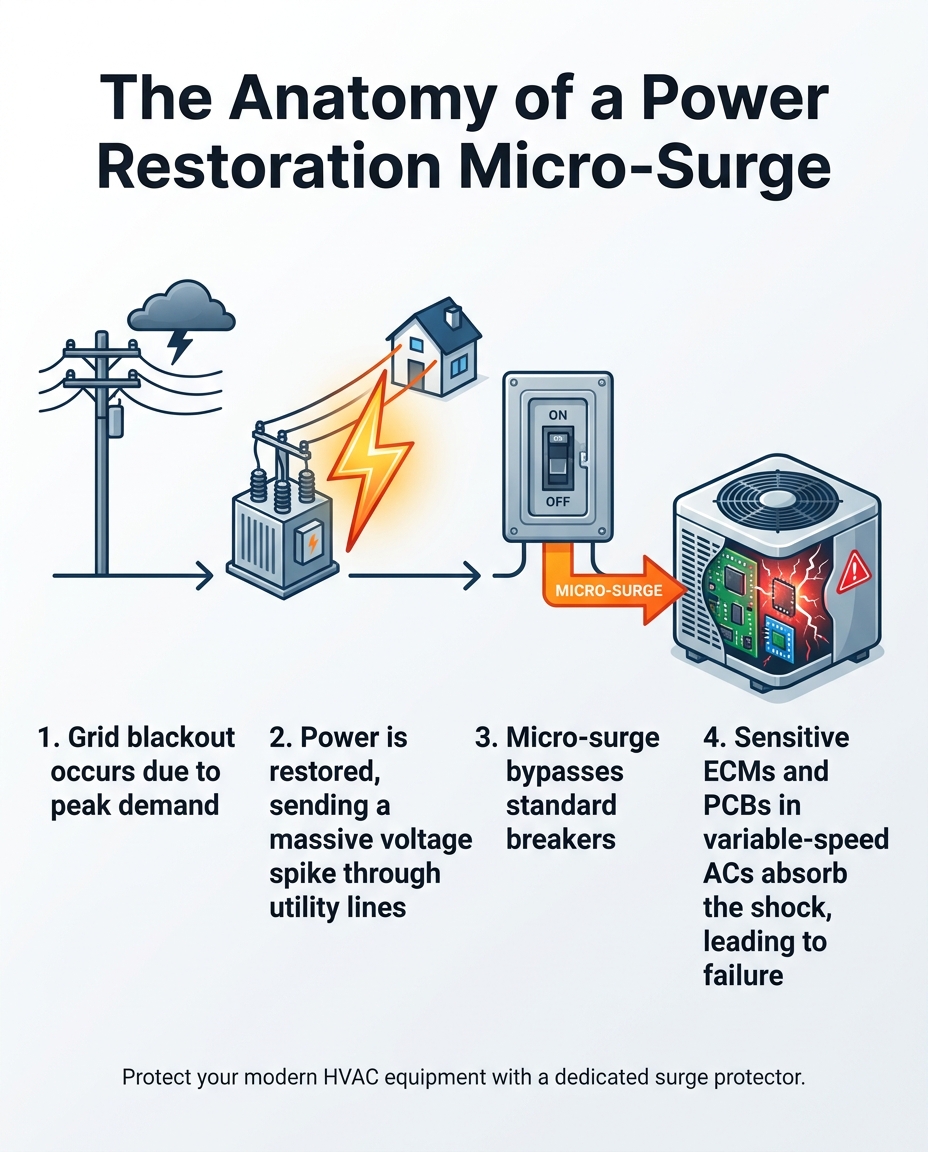
Here is exactly what happens during an August late-summer grid strain when the power comes back on:
1. The grid releases a massive spike: When utility workers restore power to a neighborhood, the electricity doesn't flow back smoothly. It surges through the lines in a massive, momentary spike of high voltage.
2. The electricity seeks an outlet: This high-voltage wave travels down the power lines, through your meter, and into your home's electrical panel, looking for a place to dissipate.
3. The AC control board absorbs the shock: Because your variable-speed air conditioner is hardwired directly into your electrical system, that instant micro-surge hits the outdoor disconnect box and slams into the delicate microprocessors of the AC unit.
4. Cascading damage occurs: The fragile printed circuit boards are overwhelmed by the voltage, causing pathways to short out and fail. If homeowners attempt to force the system back on, they risk further damage, similar to the danger of repeatedly resetting a tripped AC breaker when an underlying electrical fault exists.
This entire process takes less than a second. By the time your lights are fully back on and you reach for the thermostat, the damage to the outdoor computer has already been done.

Whole-Home vs. Dedicated HVAC Surge Protection
A common misconception is that installing a single surge protector at the main electrical panel provides a complete shield for every appliance on the property. While a whole-home device is a fantastic first line of defense, it isn't always enough to safeguard the outdoor unit.
A whole-home surge protector sits at the main breaker panel and monitors the electricity entering from the utility grid. If a massive spike comes down the street lines, this device shunts the excess voltage into the ground before it reaches your indoor outlets. However, power surges can also originate internally. When high-draw appliances like refrigerators or older pool pumps cycle on and off, they send smaller surges backward through your home's wiring. Furthermore, an outdoor AC unit sits far from the main panel, leaving it exposed to electrical anomalies that bypass the primary shield.
This is why the National Electrical Manufacturers Association (NEMA) guidelines strongly recommend layered surge protection. Your outdoor variable-speed unit requires its own dedicated defense installed directly at the exterior disconnect box.
• Whole-Home Protector — Installation Location: Main electrical breaker panel — Primary Function: Blocks large external surges from utility lines — Level of HVAC Defense: Good baseline, but allows internal micro-surges to pass
• Dedicated HVAC Protector — Installation Location: Outdoor AC disconnect box — Primary Function: Shields the specific circuit feeding the condenser — Level of HVAC Defense: Maximum defense for sensitive PCBs and ECMs
• Layered Strategy (Both) — Installation Location: Panel and Disconnect — Primary Function: Catches external surges and internal voltage spikes — Level of HVAC Defense: Comprehensive protection recommended by NEMA
Important Safety Notice: Installing a dedicated HVAC surge protector involves interacting with high-voltage 240V electricity at the disconnect box. This must only be performed by a licensed professional. Never attempt a DIY installation, as mishandling these components carries severe risks of injury and violates local LA County / Baldwin Park building codes.
The Real Cost of Control Board Failure in Late Summer
When an unprotected system takes a hit from a power restoration spike, the consequences are immediate. The most common outcome is a fried control board, which results in a complete system shutdown. Losing your air conditioning is frustrating at any time, but experiencing a total failure during the hottest part of an August late-summer grid strain is a miserable experience for your family.
The reality of repairing modern variable-speed technology adds another layer of difficulty to the situation. Unlike older mechanical units that used generic, universally available contactors, high-efficiency systems rely on proprietary, manufacturer-specific printed circuit boards. You cannot simply swap a generic part into an advanced communicating AC unit. When you call for AC repair in Los Angeles County after a surge event, the technician must diagnose the exact board that failed and order the specific replacement from the manufacturer.
This often leads to extended downtime. If the supply chain is backed up or the local warehouse is out of stock—a common occurrence during peak summer breakdown season—you could be waiting days for the proprietary part to arrive while indoor temperatures climb well past comfortable levels. Proactively installing a surge protector requires a fraction of the effort and prevents the massive inconvenience of waiting for extensive electronic repairs.
Proactive Safeguards for Your High-Efficiency Investment
Recommending a dedicated surge protector is entirely about protecting your long-term investment. At Piggies Air Conditioning, our philosophy is rooted in preventative care and honest recommendations. We focus on delivering exact, transparent information so homeowners can make educated decisions about their equipment, rather than waiting to profit off a catastrophic control board failure.
We see this commitment to long-term value in action every day. For example, one recent customer moved into a new house during the heat of the summer and needed a new AC unit installed on a tight budget. Rather than cutting corners, our team provided a higher-end, high-efficiency unit at no extra cost and even installed missing air vents for free to ensure the system operated perfectly. When you make that kind of investment in your home's comfort, leaving it exposed to the unpredictable LA County / Baldwin Park power grid simply doesn't make sense.
Preventative safeguards like dedicated surge protectors ensure your system reaches its maximum intended lifespan. They provide incredible peace of mind. Every time the lights flicker or the neighborhood experiences a rolling blackout, you can rest easy knowing the "brain" of your sophisticated cooling system is shielded from unpredictable utility fluctuations.
Frequently Asked Questions About HVAC Surge Protection
Does my modern variable-speed AC need a surge protector?
Yes, modern variable-speed AC units highly benefit from dedicated surge protection. These advanced systems use sensitive printed circuit boards and microprocessors to control motor speeds and maximize efficiency. Unlike older mechanical air conditioners, these electronic components are easily destroyed by minor voltage spikes. A dedicated protector shields these delicate parts from sudden electrical surges.
Can rolling blackouts damage my air conditioner?
Rolling blackouts themselves do not damage the air conditioner, but the power restoration process does. When the utility company turns the grid back on, a massive spike of electricity rushes through the lines into your home. If your AC is unprotected, this sudden influx of high voltage can instantly fry the control board and internal electronics.
Why did my AC circuit board fail after a power outage?
Your AC circuit board likely failed due to a micro-surge that occurred the moment power was restored. When electricity floods back into the grid, it often exceeds the normal voltage levels for a fraction of a second. Because the circuit board is constantly connected to the power supply, it absorbs this violent spike, causing the microscopic pathways on the board to short out.
Are HVAC surge protectors worth the investment?
Installing an HVAC surge protector is a highly effective preventative measure. The cost of replacing a proprietary variable-speed control board is significant, and the process often involves days of waiting for specialized parts to arrive. A surge protector acts as an insurance policy for your outdoor unit, blocking damaging voltage and extending the lifespan of the equipment.
What happens to my AC when power comes back on after an outage?
When power returns, the AC receives an immediate rush of electricity known as an inrush current. If the voltage spikes above safe operating levels, the excess energy hits the unit's disconnect box and travels into the system's "brain." Without a surge protector to shunt this excess energy away, the electrical shock will melt the internal circuitry and cause a total system shutdown.
Can I install an HVAC surge protector myself?
No, you should never attempt to install an HVAC surge protector yourself. This device must be wired directly into the outdoor disconnect box, which houses deadly 240-volt high-voltage connections. Installation requires specialized knowledge of local electrical codes and must only be performed by a licensed professional to ensure safety and proper functionality.
Secure Your Comfort Before the Next Power Flicker
Modern air conditioners are marvels of efficiency, but their advanced electronics make them uniquely vulnerable to the harsh realities of the local power grid. An August late-summer grid strain can turn a routine rolling blackout into a catastrophic failure for an unprotected unit. By understanding the true danger of power restoration micro-surges, you can take control of your system's longevity.
Professional surge protection offers the peace of mind that comes with knowing your sophisticated cooling technology is shielded from invisible electrical threats. Before the next major heat wave strikes and the power grid flickers, take the time to learn more about safeguarding your specific system. Proactive defense is the smartest way to ensure your home stays consistently comfortable.
Other blogs


Customer Testimonials



CUSTOMER SERVICE!
I highly recommend this company for anyone needing AC repair or maintenance. I'll definitely be calling them again for any future needs!

I had the pleasure of experiencing outstanding service and professionalism from Ruben, and I am beyond impressed. From the moment I first contacted them, by phone and follow up communication via email for my quotes. The attention to detail and commitment to excellence were evident.
Ruben, was incredibly responsive, addressing all my inquiries promptly and with clear, thorough explanations. Their dedication to understanding and meeting my needs was remarkable.
Ruben, went above and beyond to ensure that everything was handled seamlessly, demonstrating not just professionalism, but also a sincere dedication to customer satisfaction.
I can't recommend Piggies air Conditioning/Ruben highly enough. If you're looking for someone who combines expertise with exceptional service, look no further. They are a true example of what outstanding professionalism should be.
The technician arrived on time, which I really appreciated given how crucial air conditioning is in this heat. Ruben was professional and friendly, explaining what he was doing throughout the process. The issue I had was diagnosed fairly quickly, and they provided me with a few options on how to fix it. The pricing was transparent, and I didn't feel like there were any hidden costs, which is always a plus when it comes to service calls like these. Highly recommend this company!
1st & foremost, huge shout out to Ruben thank u so so much for reaching out & making things happen SO FAST! I was so surprised since i had reached out to a couple different places who lagged on even answering calls, messages, etc.
Ruben was also very informative & taught me ALOT that i didnt know about.
Also cant leave the amazing Luis & Miles out of
this review.
They came, they saw, they conquered!
And they worked pretty swiftly too, felt very comfy around em, loved their personalities, great attitude, work ethic, professionalism, had some really good convos & they still got the job done lightning fast
SUPER HUGE SHOUT OUT & THANKS for everything guys! Definitely recommending u guys to everyone i know.
recommendations and feedback. The actual installation was painless and unremarkable, his AC experts got it done, got it cleaned and most importantly got it right. Rueben even went a step further to assure we had
protection from the coming rain, that is service unheard of these days. His price was competitive and a REAL value for the service we recieved. Using anyone else for your AC needs, would be a huge mistake. We thank them again and will recommend to everyone.
Echoing a lot of the other reviews here, Piggies Air Conditioning responds so quickly to requests (even though I actually accidentally sent in multiple requests on my side without responding, oops!)
They were able to come do a FREE energy audit and initial inspection on the same day and Ruben was amazing at explaining his thoughts on our house's situation and what he thought was worth the money and wasn't worth the money.
I truly felt like he was trying to help me find the best solution to our issues instead of just trying to upsell us on everything and anything.
I'm definitely recommending this business to anyone I know if they want a trustworthy and realistic service, value, and quality.